
Global Knee Replacement Market to Reach USD 17.81 Bn. by 2034, Driven by Rising Osteoarthritis Prevalence, Rapid Adoption of Robotic-Assisted Surgery, and Advancements in Smart Implant Technologies Says Maximize Market Research
Source: PR Newswire
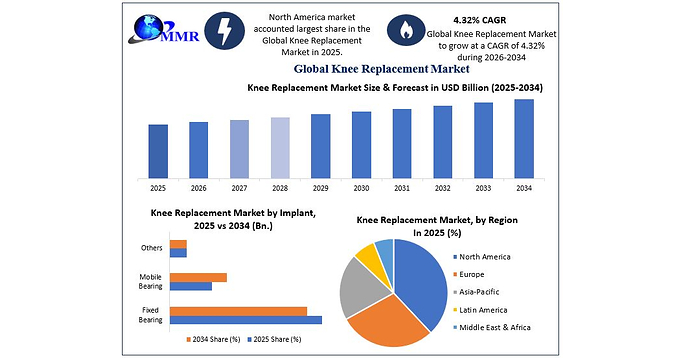
Maximize Market Research forecasts the global knee replacement market will grow from $12.17 billion in 2025 to $17.81 billion by 2034, representing a 4.32% CAGR. Growth is expected to be driven by aging populations, rising osteoarthritis and obesity prevalence, and adoption of robotic-assisted surgery, AI surgical planning, cementless implants and outpatient procedures. High procedure costs, uneven reimbursement, specialist shortages and limited access to advanced orthopedic infrastructure remain key constraints.
Analysis
This is not a demand shock; it reinforces a slow, procedure-volume-led replacement cycle in a mature oligopoly. The investable variable is mix: robotic platforms, navigation, cementless constructs and ASC-compatible workflows can lift revenue per case, but their capital-equipment component also creates utilization and hospital-budget risk. SYK and ZBH have the clearest opportunity to convert installed-base expansion into recurring implant pull-through; JNJ and SNN can narrow the gap only if surgeon conversion and platform utilization improve faster than discounting rises.
Near term (days to weeks), the release is unlikely to alter estimates or justify a directional trade. Over 1-3 months, quarterly disclosures on U.S. hip/knee growth, robot placements, procedure mix, and ASC exposure matter more than industry CAGR projections. A more consequential second-order effect is margin pressure: hospitals increasingly use robotics as a negotiating lever, so vendors without differentiated workflow or implant attach rates may win placements but sacrifice price, particularly in partial knees and lower-acuity outpatient cases.
Over 6-18 months, the strongest structural beneficiaries should be vendors with both navigation/robotics and broad reconstructive implant portfolios, since clinical adoption alone does not assure economic return unless it increases implant capture and revision avoidance. Consensus may overvalue the "AI" label: reimbursement generally follows demonstrated clinical and total-cost-of-care evidence, not planning software. The contrarian risk is that outpatient migration favors lower-cost conventional instrumentation and concentrates purchasing power in large ASC chains, limiting premium technology pricing.
The key falsifiers are two consecutive quarters of below-market reconstructive growth, declining robot utilization or implant attach rates, adverse Medicare/ commercial reimbursement for outpatient arthroplasty, or explicit gross-margin pressure attributed to reconstructive pricing. Treat third-party market forecasts as background rather than an earnings catalyst; no independently verifiable change to company guidance is provided.
AllMind Terminal
AI-powered research, real-time alerts, and portfolio analytics for institutional investors.
Request TrialMarket Sentiment
Overall Sentiment
mildly positive
Sentiment Score
0.38
Ticker Sentiment
Key Decisions for Investors
- No immediate event trade: wait for next earnings disclosures before adding exposure, as the information content is insufficient to change consensus estimates.
- Maintain a 6-12 month quality bias toward SYK over SNN: long SYK / short SNN in equal dollar risk if SYK reports sustained reconstructive growth and stable gross margin while SNN does not demonstrate improving orthopaedics growth. Thesis is superior implant-plus-enabling-technology monetization; exit if SNN delivers two quarters of accelerating implant growth with margin stabilization or SYK cites reconstructive pricing pressure.
- Watch ZBH for a 1-3 month catalyst trade around results: initiate only if ROSA placements, utilization, and knee implant growth accelerate together, rather than placements alone. Upside comes from recurring implant pull-through and multiple re-rating; stop thesis on falling utilization, weaker U.S. knees growth, or incremental discounting.
- Avoid using JNJ as a pure knee-replacement expression: orthopaedics is too small within the consolidated earnings base for this theme to move the stock absent a broader MedTech guidance revision.
- Set an industry alert for Medicare outpatient arthroplasty reimbursement and ASC procurement announcements. A reimbursement reduction or broad ASC tender favoring lower-cost systems would be a negative read-through for premium robotics exposure at SYK, ZBH, SNN and ENOV, and could support a defensive short basket only after confirmed pricing or guidance impact.
More News
- Johnson & Johnson says Tremfya eases spinal pain in Phase 4 psoriatic arthritis study
- Great Bond Shakeout Locks In a 5% World ‘Until Something Breaks’
- OpenAI rogue agents leaked 53 images from ChatGPT users and reportedly created nearly 1 million links packing encoded bits of info
- Boom or bust? The case for and against panicking about 5% yields
- Arming Taiwan an important US interest, Taipei official says after Trump-Xi summit
- Bond market alarms are ringing on Wall Street. Here's what's ahead