
CiteGeist Takes Aim at AI Slop in Research with New Reference Verification Tool
Source: PRWeb
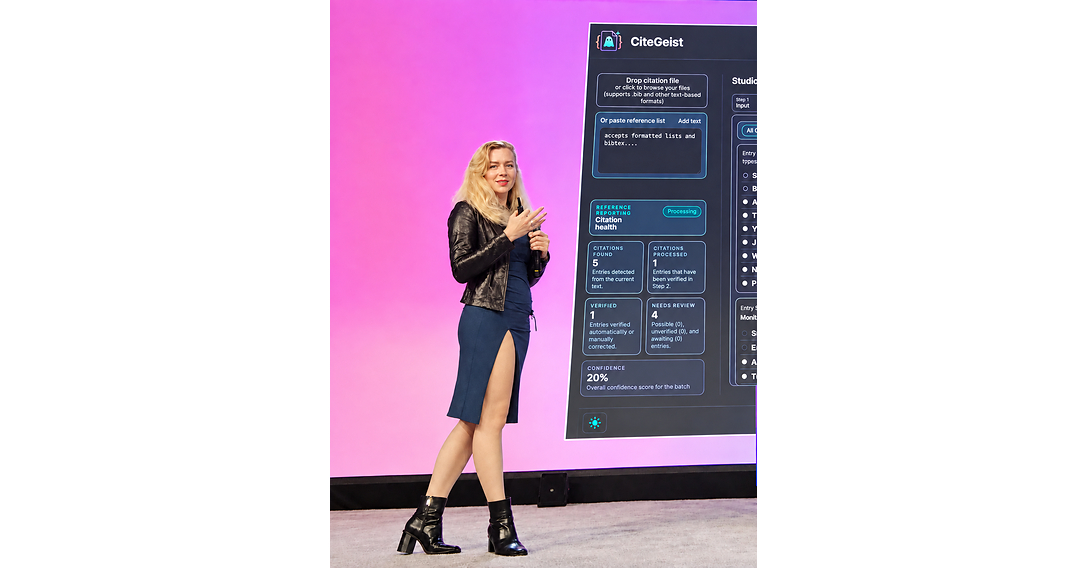
Xtasis launched CiteGeist Reference Verification, an AI-enabled tool for detecting fabricated, mismatched, incomplete, and invalid citations before research publication. The launch addresses a growing research-integrity issue: a 2026 Lancet audit found fabricated-reference rates in biomedical papers rose from roughly 4 per 10,000 papers in 2023 to approximately 57 per 10,000 by early 2026. The AWS- and NVIDIA Nemotron 3-powered product supports individual and bulk validation and creates shareable verification reports, but the announcement is unlikely to have broad public-market impact.
Analysis
This is not a meaningful NVDA revenue catalyst: a workflow feature from a private, early-stage application vendor is unlikely to alter GPU demand or inference mix. The more investable signal is that research-AI adoption is shifting from generation toward auditability, which favors incumbents that own trusted content, citation graphs, institutional distribution, and publisher integrations. RELX and WLY have clearer routes to monetize verification as a bundled workflow or compliance feature; CLVT has relevant data assets but needs evidence that product execution and retention are improving.
Over the next 1-3 months, the key question is whether publishers begin requiring machine-readable verification reports at submission rather than treating them as optional productivity tools. Mandatory use would move the category from seat-based software into a compliance-like spend pool, raising switching costs and advantaging platforms embedded in editorial systems. Conversely, standalone tools face customer-acquisition risk: reference formatting and verification are often commoditized, and bibliographic databases can limit access or replicate functionality.
The contrarian view is that the market may overestimate the direct monetization of fabricated-reference detection. Detection alone does not establish whether a cited paper supports the surrounding claim, which is the higher-value and technically harder editorial problem. A credible adoption signal would be disclosed publisher contracts, paid institutional deployments, verification volumes, or measurable reductions in editorial turnaround time; absent those metrics, this remains product-marketing noise rather than a sector re-rating event.
Over 6-18 months, rising liability and reputational costs from AI-assisted research could support premium multiples for content-and-workflow vendors with proprietary corpora, while pressuring generic AI research assistants whose outputs cannot be independently traced. NVDA participates only indirectly through broader enterprise inference demand; this thesis would be falsified as an NVDA consideration unless multiple research-software vendors disclose material incremental model usage or cloud consumption tied to verification workloads.
AllMind Terminal
AI-powered research, real-time alerts, and portfolio analytics for institutional investors.
Request TrialMarket Sentiment
Overall Sentiment
mildly positive
Sentiment Score
0.32
Ticker Sentiment
Key Decisions for Investors
- No incremental NVDA position based on this announcement. Treat it as immaterial unless management or hyperscalers identify research/publishing verification as a measurable inference-demand vertical; reassess at NVDA earnings for evidence of enterprise inference acceleration rather than product-launch anecdotes.
- Add RELX to a 1-3 month watchlist for publisher-integrated AI assurance products or mandatory editorial workflow partnerships. A disclosed enterprise rollout would be a cleaner long catalyst than a standalone tool launch, given RELX's distribution and proprietary-data advantage.
- Consider a small relative-value watch trade: long RELX versus short CLVT only after confirming RELX workflow adoption and CLVT's next-quarter retention/organic-growth trajectory. The thesis is platform monetization versus execution risk, not a broad AI beta call; exit if CLVT shows material AI-led bookings acceleration or RELX fails to disclose adoption progress.
- Monitor WLY publisher and institutional contract disclosures over the next two reporting cycles. Initiate only if AI-verification features are attached to recurring subscriptions without material margin dilution; lack of pricing, attach-rate, and renewal data should keep this as an alert rather than a position.
More News
- Wall Street’s Nasdaq hits all-time high as AI frenzy gathers pace
- Data-Center Bet Makes ESDS One of India’s Best New Listings
- Meta is breaking out after introducing Muse AI agent. Where the stock is going, according to the charts
- Anthropic in talks to lease 1 gigawatt from Stream Data Centers- The Information
- Alibaba says it built the ‘most powerful AI chip in China’ as the country races to catch up with the U.S.
- S&P 500 Profits Are on Track for a Third Straight Quarter of 25%+ Growth. The Index Hasn't Kept Up.