
Why One Bond Investor Says France Outlook Echoes Greece in 2010
Source: Bloomberg
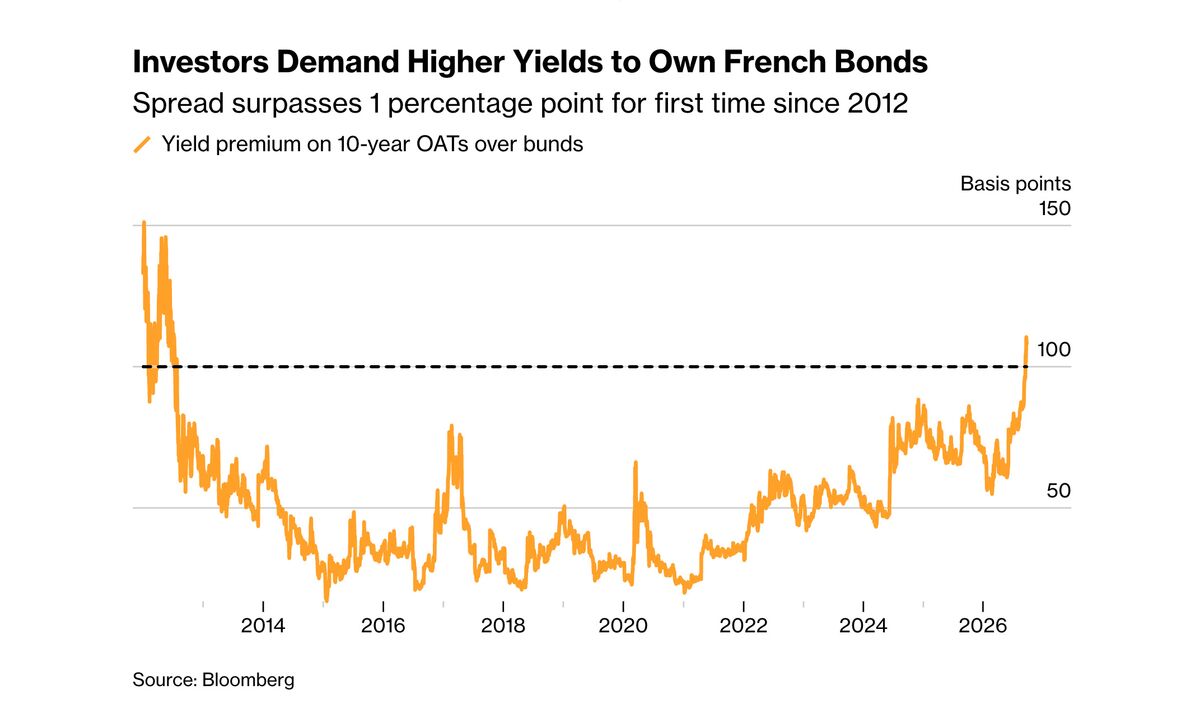
Jupiter Asset Management bond investor Ariel Bezalel said France’s investment outlook evokes Greece’s 2010 sovereign-debt crisis, highlighting concern over fiscal credibility and debt dynamics. The comparison points to potential downside risk for French government bonds, though the article notes that many investors dispute the analogy.
Analysis
The investable transmission is not a near-term default analogy but a repricing of France's fiscal-risk premium: a persistent widening in the 10-year OAT-Bund spread raises sovereign funding costs, pressures domestic-bank capital through mark-to-market losses, and tightens lending standards. BNP Paribas (BNP FP), Société Générale (GLE FP) and Crédit Agricole (ACA FP) are the cleanest listed conduits because sovereign exposure, French corporate credit and retail funding are correlated in a stress episode. Insurers, notably AXA (CS FP), face a slower but material solvency and investment-portfolio headwind if duration losses coincide with wider credit spreads.
Over days, rhetoric alone can produce a crowded OAT short, making an initial move vulnerable to a sharp squeeze on credible fiscal measures or ECB support. The more consequential 1-3 month catalyst path is budget execution, rating-agency action, and evidence that auctions require a materially higher concession versus Germany; these would turn a political narrative into an earnings and capital-cost issue. Over 6-18 months, sustained spread widening would erode French banks' relative valuation versus diversified European peers and weigh on French domestic cyclicals through higher mortgage and corporate borrowing rates.
The contrarian view is that euro-area institutional backstops make a nonlinear Greek-style outcome a poor base case; without banking-system deposit flight or impaired market access, spreads can remain elevated without becoming existential. The better risk-adjusted expression is therefore relative value rather than outright catastrophe positioning. Falsification: a durable narrowing of the OAT-Bund spread following a credible, funded fiscal package, stable rating outlooks, and no deterioration in French-bank funding spreads.
AllMind Terminal
AI-powered research, real-time alerts, and portfolio analytics for institutional investors.
Request TrialMarket Sentiment
Overall Sentiment
mildly negative
Sentiment Score
-0.35
Key Decisions for Investors
- Monitor the 10-year OAT-Bund spread as the primary trigger; if it widens through its prior 12-month high and remains there for 5 trading days, initiate a 1-3 month relative-value short in iShares MSCI France ETF (EWQ) versus long iShares MSCI Germany ETF (EWG). Target a further 5-8% relative decline; exit if the spread retraces below the breakout level.
- Underweight BNP FP, GLE FP and ACA FP versus pan-European diversified-bank exposure through EUFN over the next 1-3 months. Use a basket rather than a single-name short to reduce idiosyncratic earnings risk; cover on clear evidence of stable wholesale-funding spreads and OAT-Bund compression.
- For a defined-risk stress hedge, buy 3-6 month put spreads on EWQ rather than outright puts or sovereign-default proxies. This captures an equity multiple and domestic-growth transmission if fiscal concerns escalate, while limiting premium burn if policymakers stabilize the narrative.
- Do not initiate a directional France sovereign trade solely on commentary. Upgrade conviction only after auction-tail deterioration, a rating/outlook change, or measurable widening in French bank senior funding spreads; absent those signals, the likely opportunity is tactical volatility rather than a sustained crisis trade.
More News
- Great Bond Shakeout Locks In a 5% World ‘Until Something Breaks’
- Boom or bust? The case for and against panicking about 5% yields
- The Tiny Magnet Maker That Attracted $1.6 Billion From Lutnick
- 10-year Treasury yield hit a 19-year high—and some investors see opportunity to buy bonds
- US, Iran Said to Be Exploring Phased Deal to Open Hormuz
- Why High Yields on US Treasury Bonds, Government Debt Look Like the New Normal