
Global M&A Value Rises as Megadeals Return, but the Recovery Remains Narrow
Source: PR Newswire
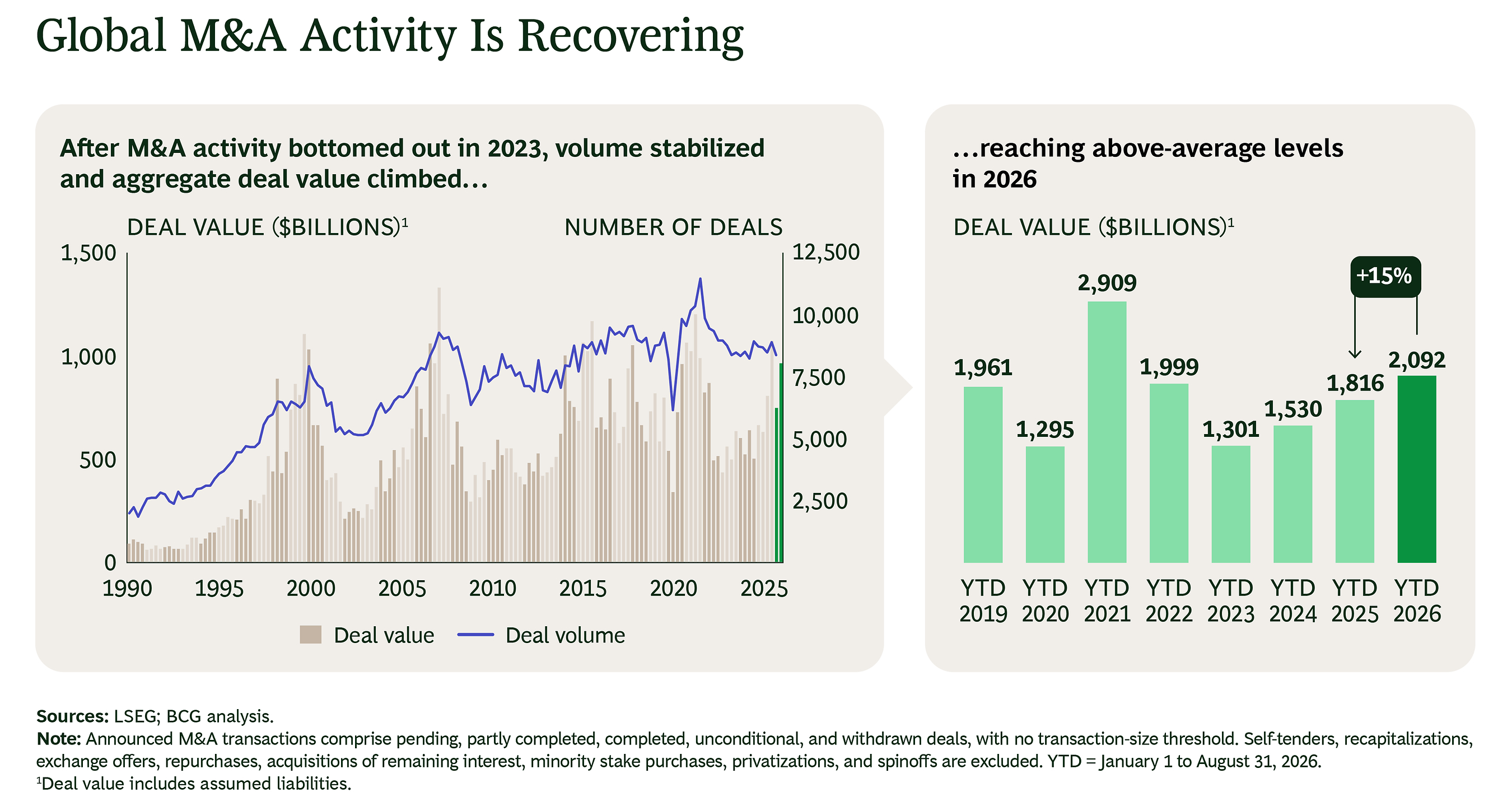
Global M&A value rose 15% year over year in the first eight months of 2026, 11% above the 10-year average, led by 37 megadeals worth $10B or more versus 24 a year earlier. The recovery remains narrow: sub-$1B deal activity is below historical norms and BCG's M&A Sentiment Index improved only to 83 from 79, still below its long-term average of 100. AI is stimulating investment while complicating valuations and deal execution, while asset readiness, valuation gaps, and evolving national-security and foreign-investment reviews remain key constraints.
Analysis
The investable signal is not broad risk-on M&A; it is a fee-pool and financing concentration trade. Large-cap advisory franchises with credible cross-border, regulatory, and complex-structure capabilities—MS, GS, PJT, EVR and LAZ—should capture a disproportionate share of incremental wallet, while subscale boutiques and lower-middle-market sponsors remain exposed to delayed exits. LSEG is a modest beneficiary through transaction, data and workflow demand, but its recurring-data multiple is unlikely to rerate materially unless deal breadth improves rather than merely headline value.
The more consequential second-order effect is that incomplete valuation discovery in AI-exposed software should sustain private-market mark-down pressure and constrain sponsor realization cycles. That favors publicly traded alternative managers with permanent-capital and infrastructure strategies (BX, KKR, APO, ARES) over firms reliant on rapid traditional buyout exits; within software, strategic buyers may selectively acquire assets whose AI risk is operationally manageable, but broad takeout speculation is premature. Higher use of earnouts, minority stakes and JVs reduces near-term advisory economics per transaction while creating later conversion optionality, so announced-value data will overstate immediate revenue capture.
Over the next 1-3 months, announced megadeals can support advisory estimates and sentiment, but regulatory review duration is the key offset: delayed closes defer success fees and raise break-risk. The 6-18 month upside case requires divestitures and sponsor exits to broaden asset supply; without that, elevated headline values can coexist with weak mid-market fee revenue. Consensus may overread improving aggregate deal statistics as a cyclically broad recovery, leaving the most attractive relative trade in quality large-cap advisory versus small-cap/private-capital beta rather than a sector-wide long.
Falsifiers are a sustained decline in announced large-cap transactions, a widening of financing spreads that impairs leveraged deal capacity, or quarterly commentary from GS/MS/PJT indicating that pipelines are converting into contingent structures rather than signed mandates. A material acceleration in sponsor exits and sub-$1bn deal volume would invalidate the narrow-market thesis and favor a broader long in alternative managers and regional advisory exposure.
AllMind Terminal
AI-powered research, real-time alerts, and portfolio analytics for institutional investors.
Request TrialMarket Sentiment
Overall Sentiment
mildly positive
Sentiment Score
0.28
Ticker Sentiment
Key Decisions for Investors
- Initiate a 3-6 month pair: long PJT and EVR / short a diversified private-equity beta basket led by TPG. Target 10-15% relative upside if complex strategic activity persists while exit-dependent fee realization remains uneven; stop if both advisory firms cite weaker large-cap mandate conversion or TPG demonstrates a clear acceleration in realizations.
- Overweight MS and GS into the next two earnings cycles versus broad financials (XLF). Advisory and capital-markets operating leverage should outperform if large transactions close, while diversified trading and wealth businesses cap downside; reassess if announced-deal pipelines fail to translate into completed fees by the following quarter.
- Maintain a selective long bias in BX, KKR and APO, but avoid treating this as a broad alternative-asset-manager rally. Favor firms with infrastructure, credit and permanent-capital deployment over pure buyout-exit sensitivity; trim if credit spreads widen sharply or management guides to slower deployment and fee-related earnings growth.
- Do not chase AI-software takeout rumors. Create an alert basket of profitable software companies with concentrated enterprise customers and clear AI product monetization, and only underwrite event-driven longs after disclosed strategic review, activist involvement, or a valuation reset that makes a cash bid financially accretive to likely acquirers.
- Use LSEG as a low-beta watch position rather than a primary M&A expression. Upgrade only if transaction/workflow revenue and management commentary show broadening activity beyond large transactions; otherwise, its exposure is too indirect to justify paying for a deal-cycle rerating.
More News
- China slows humanoid robot IPO rush as hype outruns reality
- Iran vows 'painful' retaliation as Trump piles on pressure ahead of UN General Assembly meeting
- Chinese biopharma stocks jump as U.S. weighs keeping door open to drug deals
- Oil falls as crude flows remain 'surprisingly strong'
- Trump & Xi to Meet Amidst Friction on Wars, Tech, Trade
- Bessent proposes U.S.-China AI safety system in talks with China