
New Study Finds E-Cigarette Directory Laws Did Not Lead to Sustained Reductions in Sales of Flavored E-Cigarettes, Which Are Known to Appeal to Youth
Source: PR Newswire
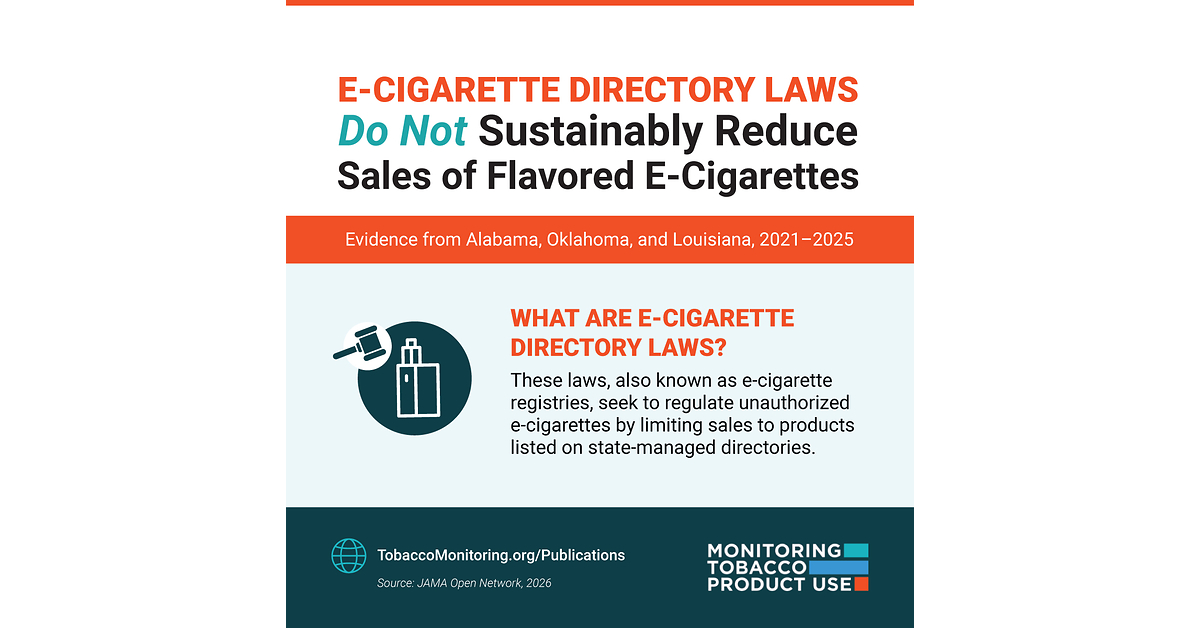
A CDC Foundation study found e-cigarette directory laws in Alabama, Oklahoma and Louisiana did not produce sustained reductions in flavored e-cigarette sales. Louisiana sales initially declined after its directory was published but rebounded within eight months to exceed pre-directory levels, while product availability remained lower. By April 2025, more than 50% of per-capita e-cigarette nicotine sales in all three states came from products not listed on state directories, highlighting enforcement and policy-design gaps.
Analysis
The investable implication is not a broad nicotine-demand read-through but a regulatory-enforcement read-through: state directories appear to shift volume toward loophole-compliant, non-listed channels/products rather than eliminate consumption. That weakens the thesis that piecemeal state restrictions can create durable share gains for FDA-authorized incumbents such as Altria (MO), British American Tobacco (BTI), or Japan Tobacco (JAPAY). Their valuation upside still requires federal enforcement that removes unauthorized disposable competitors, not merely additional state directory adoption.
Near term, the study is unlikely to move listed tobacco equities because scanner coverage excludes the channels most relevant to the enforcement-arbitrage thesis. The more important 1-3 month catalyst is whether state attorneys general or the FDA convert this evidence of noncompliance into retailer penalties, import seizures, or broader PMTA enforcement; absent that, enforcement costs remain fragmented and illicit/unauthorized brands preserve price and flavor advantage. A stricter federal action would be disproportionately positive for MO's NJOY franchise and BTI's Vuse, but only if enforcement reaches vape shops, online sellers, and distributors rather than conventional retail alone.
Contrarian view: lower product variety can still matter economically even if aggregate nicotine volume does not decline, because it may concentrate sales among high-velocity disposables and raise retailer dependence on gray-market distributors. That creates a future binary risk: an effective enforcement sweep could cause an abrupt category revenue reset rather than a gradual shift to authorized brands. No immediate trade is warranted from this release alone; it is evidence that regulatory risk should be priced as a discontinuous catalyst, not modeled as a steady volume headwind.
AllMind Terminal
AI-powered research, real-time alerts, and portfolio analytics for institutional investors.
Request TrialMarket Sentiment
Overall Sentiment
mildly negative
Sentiment Score
-0.20
Key Decisions for Investors
- Maintain a watch, not a position, in MO and BTI ahead of FDA enforcement, state AG actions, or distributor/import seizures; initiate relative longs only after evidence that enforcement covers specialty-vape and online channels, the missing sales channels in the underlying data.
- For a 6-18 month regulatory-upside basket, prefer MO over BTI if verifiable enforcement accelerates: MO has greater valuation sensitivity to successful NJOY share capture, while BTI has a broader combustible earnings cushion. Falsify on another two quarters of weak NJOY retail share or guidance indicating no enforcement-led category improvement.
- Avoid treating new state-directory legislation as a standalone short catalyst for tobacco or convenience retail. The historical mechanism suggests channel substitution, and any volume disruption can reverse within months; reassess only if reported enforcement includes meaningful fines, retailer-license suspensions, or import interdiction.
- Monitor FDA PMTA decisions and enforcement releases as event triggers. A coordinated action against leading unauthorized disposable supply chains would support a tactical 3-6 month long MO/BTI versus a short broad consumer-staples proxy (XLP); lack of actions despite additional state laws invalidates the relative thesis.
More News
- China's AI leaders keep quiet despite U.S. 'publicity' on tech risks
- US Senate crypto bill collapses in blow to industry
- BlackRock’s Fink, Blackstone’s Gray Back Carney’s Canada Investment Push
- Chinese investors rush into US stocks as Beijing opens wider path overseas
- Factbox-How AI leaders and world governments react to ’AI doom’ fears
- Is Amazon Stock a Buy After Its Best Quarter in Years?