
BrightLocal Report: Small Businesses Losing Online Visibility as Social and AI Prioritised Over Google
Source: PR Newswire
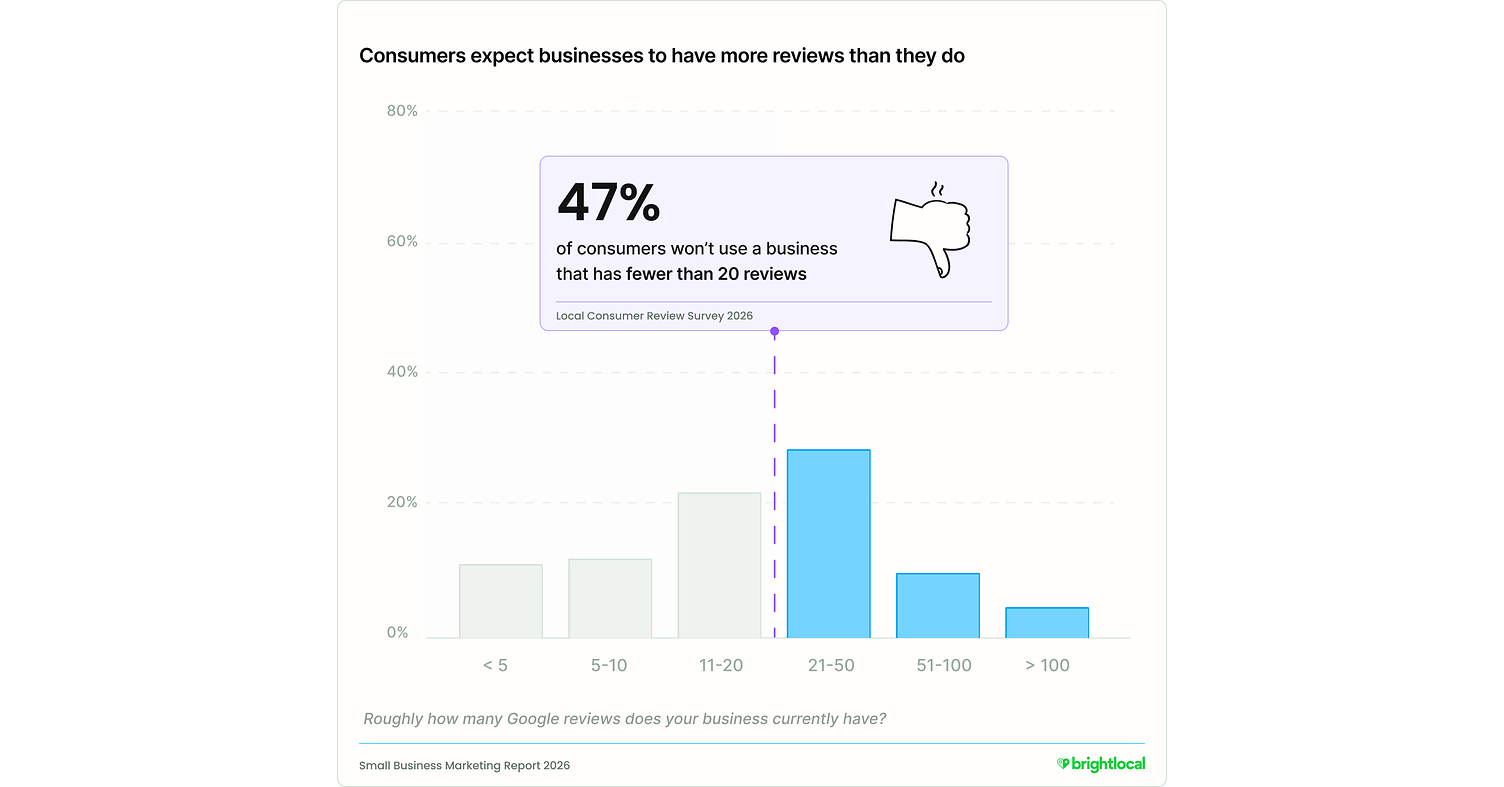
BrightLocal’s survey of more than 1,000 US small-business owners found a mismatch between consumer search behavior and business priorities: 71% of consumers use Google for local searches, but only 22% of owners rank it among their top two customer-acquisition channels. While 65% of owners said they are optimizing for AI search, just 35% maintain an active Google Business Profile, 41% an active website, and 26% active directory listings. The survey also found that 47% of businesses have fewer than 20 Google reviews, the same share of consumers who say they would not consider a business with fewer than 20 reviews.
Analysis
The key read-through is not that Google is losing local-search relevance, but that SMB execution is lagging where consumers already make discovery and selection decisions. That mismatch could sustain demand for listing, reputation-management, and local-SEO tools, but this company-sponsored survey does not establish incremental software spend or revenue; BrightLocal is not a mapped public ticker.
For Alphabet (GOOG), the findings are mildly supportive of the durability of Google Search/Maps as a local-intent gateway, while highlighting a monetization caveat: weak SMB profile maintenance may limit conversion quality and advertiser returns, but the survey gives no evidence of ad-budget changes. Social channels are important discovery alternatives, yet Meta (META) is not shown to be displacing Google at the point of decision. Yelp (YELP) and Tripadvisor (TRIP) could benefit if AI answers rely on structured third-party listings and reviews, but the article does not establish that either has gained referral traffic or pricing power; do not equate directory relevance with earnings leverage.
Near term, this is too soft and self-reported to justify a directional position. Over 1–3 months, look for corroboration in Google local-ad trends, YELP/Tripadvisor traffic and monetization commentary, and SMB marketing-software bookings. Over 6–18 months, AI interfaces could redirect discovery, but inconsistent underlying business listings make reliable structured data more valuable—potentially reinforcing established directories as data sources even if clicks move away from them. The contrarian point: AI optimization claims may be premature activity, not a new budget pool; the persistent consumer reliance on Google is the firmer signal. Falsify the Google-resilience thesis if local-intent usage or monetization weakens in company disclosures, and the directory-beneficiary thesis if AI referrals fail to translate into traffic or paid adoption.
AllMind Terminal
AI-powered research, real-time alerts, and portfolio analytics for institutional investors.
Request TrialMarket Sentiment
Overall Sentiment
mildly negative
Sentiment Score
-0.15
Ticker Sentiment
Key Decisions for Investors
- No immediate trade on this release: treat it as a low-confidence survey signal, not evidence of changing revenue or market share.
- Keep GOOG as a watch rather than a short; verify local-search monetization and advertiser-return commentary before concluding that SMB neglect is financially material.
- Track YELP and TRIP for measurable AI-originated referrals, traffic engagement, and paid-product conversion; absent those metrics, avoid a long thesis based solely on their presence in AI data sources.
- Set an alert for upcoming earnings and product disclosures on local ad demand, directory traffic, and SMB marketing-software bookings; a sustained decline in local-search monetization would challenge the defensive read-through for GOOG.
More News
- US tech stocks tumble as investors fret over AI spending
- Asian shares wobble as tech rout boosts bonds, dents rate hike bets
- The perfect storm behind the Nasdaq's rout — plus, some of the bright spots in the market
- A lesson from poker tells us not to fold on Meta after its earnings sell-off. Here’s why
- Meta stock sinks 6% as AI spend pushes free cash flow negative
- Elon Musk’s dream merger is a nightmare for SpaceX shareholders
From AllMind Research
- Anthropic IPO Preview: Valuation, Timing, and What to Watch
- Shein After the IPO: Venue, Valuation, and What Must Be Proved
- What AI Research Tools Should a Small Hedge Fund Buy First?
- AlphaSense Pricing: What Public Contract Data Shows in 2026
- Eli Lilly Q4 2025 Earnings: Revenue Surges 43% as Mounjaro and Zepbound Dominate the GLP-1 Market