
Age Group 19-30 Had Highest Percentage of Telehealth Patients Treated for Mental Health Conditions Nationally and in Every Region in Second Quarter 2026
Source: PR Newswire
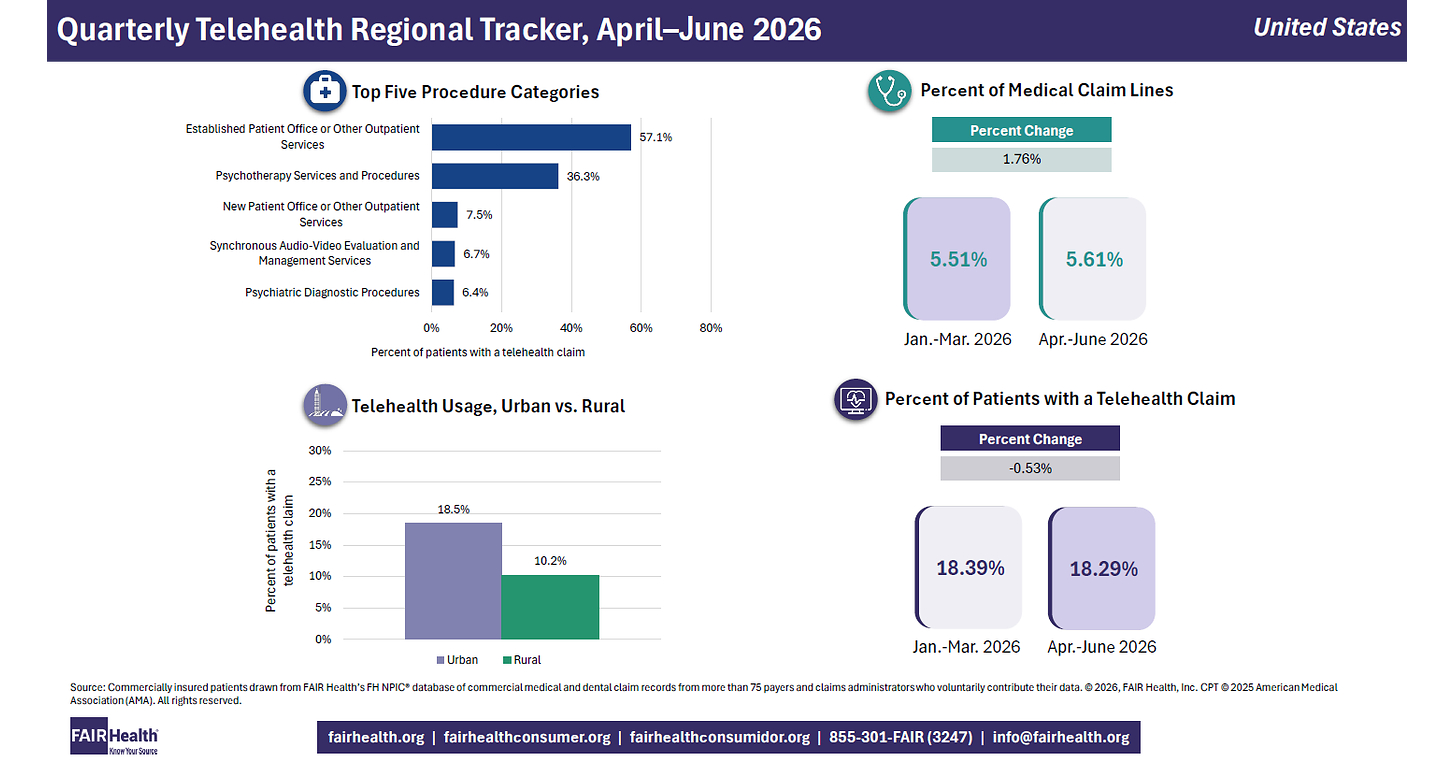
FAIR Health reported that 70.9% of commercially insured telehealth patients aged 19-30 were treated for mental health conditions in Q2 2026, versus 53.7% across all telehealth patients nationally. The share of patients with a telehealth claim edged down to 18.3% from 18.4% in Q1 nationally, while the West rose 3.1% and telehealth medical claim-line utilization increased to 5.6% from 5.5%. Mental health remained the leading telehealth diagnostic category across all regions and age groups, while overweight and obesity rose to second nationally among top diagnostic categories.
Analysis
This is a low-signal, claims-based read rather than a material demand inflection, but it reinforces that virtual behavioral care has become a recurring utilization channel rather than a pandemic-era discretionary service. For Teladoc (TDOC), Amwell (AMWL) and privately held behavioral platforms, the relevant variable is not aggregate telehealth penetration but behavioral visit mix, reimbursement realization and member retention; a modest decline in unique patients alongside higher service intensity can support revenue only if provider utilization improves without heavier marketing spend.
The more investable second-order implication is payer economics. Behavioral telehealth can lower access friction and shift care from high-cost acute settings, but sustained utilization also raises medical-cost trend if it uncovers previously untreated demand. UnitedHealth (UNH), Elevance (ELV), CVS Health (CVS) and Centene (CNC) should see the effect through 2027 benefit-cost guidance, especially in employer-sponsored books; investors should watch whether behavioral utilization is accompanied by falling emergency-department or inpatient behavioral claims, rather than assuming virtual care is automatically cost-saving.
The emerging obesity-care presence is strategically more important than its current ranking: telehealth is a scalable acquisition and adherence channel for GLP-1 treatment, potentially expanding prescription persistence for Novo Nordisk (NVO) and Eli Lilly (LLY) while increasing pharmacy-benefit-manager rebate and prior-authorization leverage. The counter-consensus view is that digital-health equities do not automatically capture this value—most economics may accrue to drug manufacturers, insurers and PBMs unless platforms can demonstrate paid conversion, longitudinal care retention and favorable CAC/LTV.
Near term, this should not move large-cap healthcare estimates. Over 1-3 months, quarterly results from TDOC/AMWL and employer medical-cost commentary from UNH/ELV/CVS are the catalysts; over 6-18 months, reimbursement parity, state licensure rules and employer coverage of obesity drugs determine whether utilization becomes profitable growth. The thesis is falsified if behavioral virtual visits fail to substitute for higher-acuity care, or if payer utilization-management actions reduce reimbursement and visit frequency.
AllMind Terminal
AI-powered research, real-time alerts, and portfolio analytics for institutional investors.
Request TrialMarket Sentiment
Overall Sentiment
neutral
Sentiment Score
0.05
Key Decisions for Investors
- No directional trade solely on this release; treat it as a watch item given limited magnitude and commercial-insurance-only sample coverage.
- Maintain a quality-biased pair: long LLY or NVO / short TDOC on a 6-12 month horizon. GLP-1 manufacturers capture prescription economics, while TDOC must prove that obesity and behavioral engagement converts into durable, high-margin revenue; reassess if TDOC shows sustained improvement in adjusted EBITDA, paid-member growth and marketing efficiency.
- For payer books, monitor UNH, ELV and CVS during the next earnings cycle for behavioral medical-cost trend versus acute-care offsets. A disclosed rise in outpatient behavioral utilization without an offset in ED/inpatient claims is a negative margin signal and supports reducing exposure rather than adding.
- Set an alert around TDOC and AMWL earnings: consider tactical longs only after evidence of sequential behavioral revenue growth plus stable or improving gross margin and CAC. Without those data, telehealth utilization data are insufficient to underwrite a rerating.
More News
- Asian stocks rise as oil retreat eases inflation fears, BOJ in focus
- Microsoft exec called AI scraping the “largest theft of labor in human history”
- After being sidelined, Boeing's Starliner to get starring role in NASA's spaceflight plans
- Jensen Huang says Nvidia will sell twice as many chips next year
- This AI-picked stock jumps 18% on Amazon’s $8 billion power deal
- Generac shares surge on big Amazon deal. Wall Street thinks the generator stock has more to go
From AllMind Research
- Anthropic IPO Preview: Valuation, Timing, and What to Watch
- Shein After the IPO: Venue, Valuation, and What Must Be Proved
- What AI Research Tools Should a Small Hedge Fund Buy First?
- Palantir (PLTR) Q4 2025 Earnings: 70% Revenue Growth, Then an 11% Single-Day Crash
- AlphaSense Pricing: What Public Contract Data Shows in 2026