
Huddle Up Calls for a Shift from Staffing Solutions to System Solutions in Special Education
Source: PR Newswire
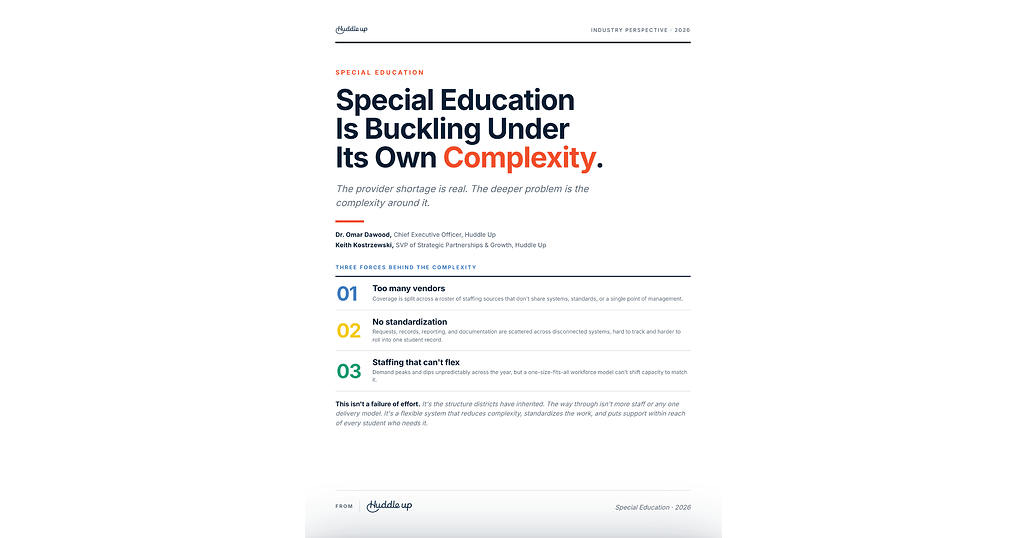
Huddle Up released an Industry Perspective arguing that special-education constraints stem more from operational complexity than provider shortages, citing that 98% of districts have coordinators/admins spending over 20 hours/month managing IEP logistics (nearly half over 41 hours). It also notes 73% of superintendents lack full confidence in IEP tracking data accuracy due to information being spread across multiple systems. The report calls for standardized workflows and integrated data/operations rather than relying primarily on additional staffing, with Huddle Up highlighting a 96% provider retention rate and 1M+ delivered sessions across 100+ districts.
Analysis
This reads less like a demand inflection and more like a packaging shift: the economic prize is not extra provider hours, it is whoever can collapse workflow, compliance, and scheduling into one control plane. That favors integrated service models and adjacent education workflow software, while punishing fragmented local agencies that rely on manual coordination and thin vendor relationships. The first-order revenue impact is likely modest, but the second-order effect is better retention and higher switching costs for scaled platforms.
The key timing issue is procurement friction. Districts can agree with the diagnosis quickly, but budget authority, implementation, and data migration usually stretch the conversion path over 1-3 budget cycles, so near-term tape reaction should fade unless there is a visible contract pipeline. For IUSDF specifically, the burden of proof is monetization: we need evidence that the message converts into backlog, higher ARPU, or margin expansion, not just thought leadership.
Contrarian view: consensus may still be pricing this as a staffing shortage story, when the more durable issue is operational standardization. If that is right, the upside accrues to fewer, larger vendors with W-2-style retention and integrated documentation, not to headcount-heavy intermediaries. But the reverse is also true: if districts lack funding for systems upgrades, they may keep patching the current model, and the thesis stalls for 6-18 months.
AllMind Terminal
AI-powered research, real-time alerts, and portfolio analytics for institutional investors.
Request TrialMarket Sentiment
Overall Sentiment
neutral
Sentiment Score
0.05
Ticker Sentiment
Key Decisions for Investors
- No immediate position in IUSDF; treat this as a marketing signal, not a catalyst. Reassess only after the next filing or quarter if revenue, gross margin, or backlog shows acceleration; otherwise assume no tradable earnings impact.
- Watch PWSC as the cleaner public proxy for the 'integrated workflow' thesis and buy only on confirmation of district cross-sell or special-ed workflow attach rates over the next 1-3 months. Risk/reward is attractive only if the market starts paying for operational software consolidation rather than pure staffing.
- If you want a relative-value expression, consider a small long PWSC / short AMN pair over 3-6 months: long the company that benefits from standardization, short the labor-intermediary model that gets disintermediated by integrated service delivery. Keep size modest because the linkage is indirect.
- Set an alert on any district procurement or reimbursement policy change in the next budget cycle; if funding does not support system upgrades, fade the thesis and avoid chasing education-services names tied to operational transformation.
More News
- Nvidia GPUs are everywhere. Here are the ways companies are accessing them
- Bank of America is bullish on these top stocks ahead of earnings
- As companies pour billions into Earth-based AI infrastructure, Google is taking the data center race off-planet
- AI's Supercharging a Scam Economy Bigger Than the Cocaine Trade
- How U.S. know-how is fracking Australia into a gas boom, from Texas oilmen to Trump’s energy secretary
- The world needs Ukraine’s grain. Its farmers are running out of reasons to plant
From AllMind Research
- Anthropic IPO Preview: Valuation, Timing, and What to Watch
- Shein After the IPO: Venue, Valuation, and What Must Be Proved
- What AI Research Tools Should a Small Hedge Fund Buy First?
- Weekly Update: Live Event Center, In-App Documents, and Faster Transcripts
- How to Automate Equity Research Workflows: A Control-First Guide