
Fundraise Up Launches AI Visibility Assessment to Help Nonprofits Prepare for Agentic Giving
Source: PR Newswire
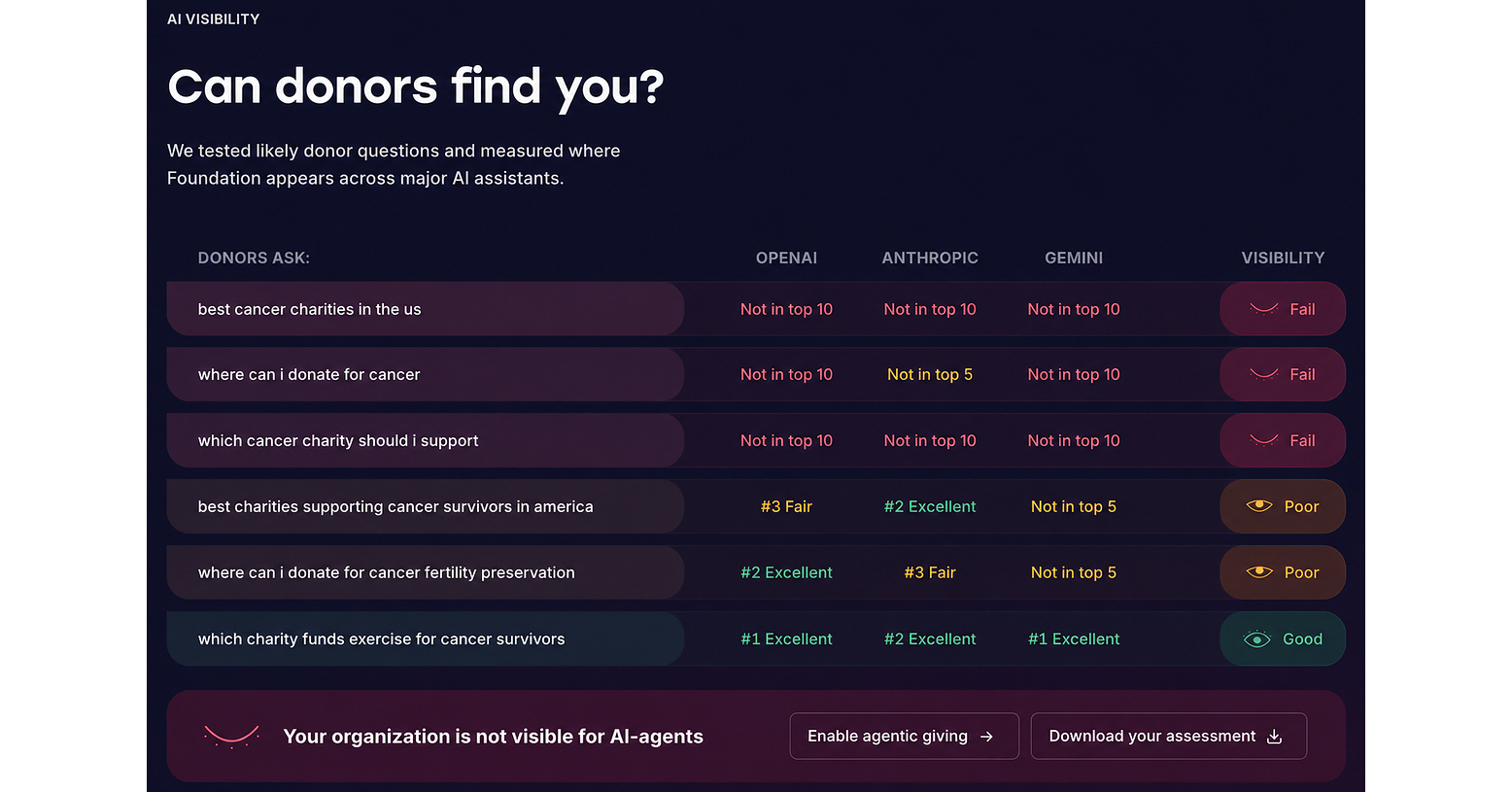
Fundraise Up launched a free AI Visibility Assessment, aimed at helping nonprofits see how AI assistants interpret and represent their organizations. The article cites a ~35% year-over-year decline in organic search traffic to nonprofit sites, alongside ~1,000% growth in AI-referred traffic, as donors increasingly ask AI assistants which nonprofits match their causes. It frames Agentic Giving as preserving the official donation/CRM experience when AI agents initiate giving via Fundraise Up’s donation gateway.
Analysis
This is less a near-term revenue event than an early signal that donor acquisition is migrating from owned web traffic to machine-mediated discovery. The first winners are vendors that can become the trusted “system of record” behind AI-generated recommendations and the authorized checkout layer after intent is formed; that favors nonprofit CRM / fundraising software more than generic web tools. The second-order loser is any nonprofit stack that still depends on SEO, landing-page optimization, and manual form navigation to drive conversion, because those layers lose leverage when the AI agent short-circuits the funnel.
For public markets, the monetization path is indirect and likely slow. The cleanest beneficiaries would be payment and recurring-giving infrastructure with high attach rates to donation flows, but the addressable pool is small relative to their overall volume, so this is more of a narrative tailwind than a fundamental inflection. The more interesting read-through is competitive: if one platform becomes the default “authorized donation gateway,” it can deepen switching costs by controlling attribution, receipts, CRM sync, and recurring gift management.
Contrarian view: the market may be overestimating how fast nonprofits will pay for this. Many charities will treat AI visibility as a hygiene issue, not a budgeted software category, and AI assistants themselves still have poor citation discipline, so conversion lift may not show up in measurable donor LTV for several quarters. The thesis is falsified if AI-referred traffic fails to sustain growth after initial experimentation or if conversion from AI-originated sessions does not outperform existing direct/paid channels by at least low-double digits over 1-2 quarters.
AllMind Terminal
AI-powered research, real-time alerts, and portfolio analytics for institutional investors.
Request TrialMarket Sentiment
Overall Sentiment
mildly positive
Sentiment Score
0.25
Key Decisions for Investors
- No immediate directional trade in WWRL; the signal is too weak and too indirect to underwrite a standalone position. Reassess only if management can show AI-originated donation conversion, not just traffic, in the next 1-2 reporting cycles.
- Watch-list long BLKB on any pullback as the most plausible public beneficiary of nonprofit workflow centralization; the upside case is modest but durable if AI discovery becomes a budget line item. Falsify if nonprofit spend remains flat and AI features stay non-monetized.
- Pair idea: long BLKB / short GDDY as a relative-value hedge on the shift from generic website ownership to structured donor/CRM workflow ownership. This works only if AI-mediated discovery reduces the importance of website traffic more than it reduces the value of online presence overall.
- Use a monitoring alert on PYPL and GPN for commentary around agentic checkout or recurring-donation volume; if neither names this as a growth lever by next earnings season, the read-through is probably narrative-only.
More News
- AI Capex, Gamble or Jackpot?: Market Snapshot
- ‘I told you so’: China’s chip sector is making breakthroughs—and U.S. export controls are the reasons why
- CoreWeave credit default swaps hit distress levels as investors sour on AI debt
- Hybe shares jump 10% as K-pop sensation BTS' tour lifts earnings hopes
- Treasuries Soar as Tech Slump Threatens Growth
- Giant Taiwanese chipmaker TSMC confirms it’s in talks with Elon Musk to join ‘Terafab’ complex in Texas: ‘The AI market continues to be very strong’