
Specialty Food Association Unveils the San Francisco Restaurants Serving New Tasting Menus on the Winter FancyFaire* Campus Tasting Trail
Source: PR Newswire
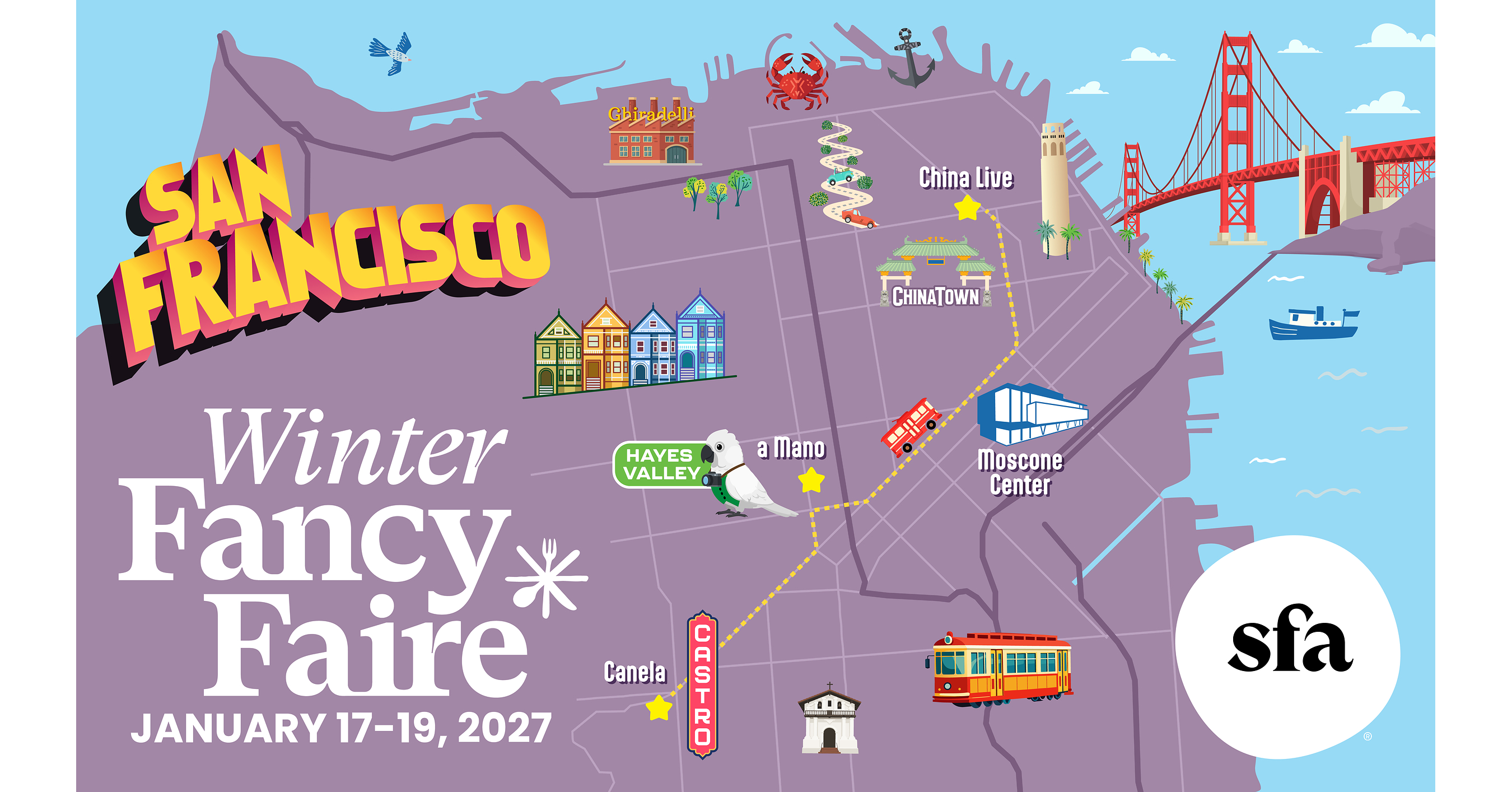
The Specialty Food Association announced three San Francisco restaurant partners for the January 17-19, 2027 Winter FancyFaire Campus Tasting Trail, an exhibitor-focused sampling initiative. The show is expected to feature more than 1,000 exhibitors as SFA returns to San Francisco for the first time since 2020. The announcement cites city tourism spending tracking above pre-pandemic levels by year-end 2026 and convention-center business up more than 60% since 2024.
Analysis
This is not a listed-equity earnings catalyst; it is a low-signal industry-marketing event. The more relevant mechanism is that trade-show sampling lowers buyer adoption friction for emerging premium brands, potentially supporting incremental shelf resets at specialty and conventional grocers over the following 1-3 buying cycles. That benefit is diffuse and unlikely to be material for scaled public staples companies, whose innovation pipelines and distribution breadth dominate any single event outcome.
The second-order read-through is modestly constructive for San Francisco convention, lodging, and restaurant demand into January, but the event itself is far too small to alter estimates for Marriott (MAR), Hilton (HLT), Airbnb (ABNB), or casino/convention proxies. A stronger signal would be a sustained recovery in Moscone bookings and citywide room-rate growth, which could validate a broader normalization in corporate travel rather than merely promotional claims from an event organizer.
Contrarian view: specialty-food enthusiasm can be a lagging indicator of discretionary spending, not evidence of durable volume growth. Premium food brands remain exposed to trade-down if real wage momentum weakens or grocery promotional intensity rises; distribution wins can be offset by slotting costs, retailer margin demands, and elevated failure rates after initial launch. No standalone trade is warranted.
AllMind Terminal
AI-powered research, real-time alerts, and portfolio analytics for institutional investors.
Request TrialMarket Sentiment
Overall Sentiment
mildly positive
Sentiment Score
0.28
Key Decisions for Investors
- No immediate position based on this release; expected financial impact for listed consumer, travel, and hospitality issuers is immaterial.
- Monitor January 2027 San Francisco hotel ADR and occupancy data versus January 2026 as a watch item for MAR and HLT; consider a tactical long only if citywide ADR growth exceeds broader U.S. urban-market growth by at least 300 bps, indicating genuine convention-demand recovery.
- For consumer-staples research, screen post-show retailer assortment changes and syndicated velocity data in Q1-Q2 2027 rather than treating exhibitor participation as a demand signal. A measurable increase in premium/private-label shelf allocation would be more actionable for branded-food margin and share forecasts.
- Use any broad premium-food rally as an opportunity to test trade-down risk: weakening grocery unit volumes, rising promotional spend, or downward retailer guidance would falsify an optimistic specialty-demand narrative within 1-3 months.
More News
- 'Science fiction': Transport companies — the backbone of economy — are sounding alarm on fuel prices
- What to know about US Federal Reserve’s first interest rate hike in 3 years
- Fed Rate Hike Looms as Retail Sales Surge
- Consumers hit by one-two punch of oil and rates from Iran war. The estimated bill is $1,700 per household
- US retail sales rebound sharply in August
- Now that the Fed raised rates, where to score the best yields on your cash