
Nvidia’s Jensen Huang Touts Himself as an AI VC Role Model
Source: Bloomberg
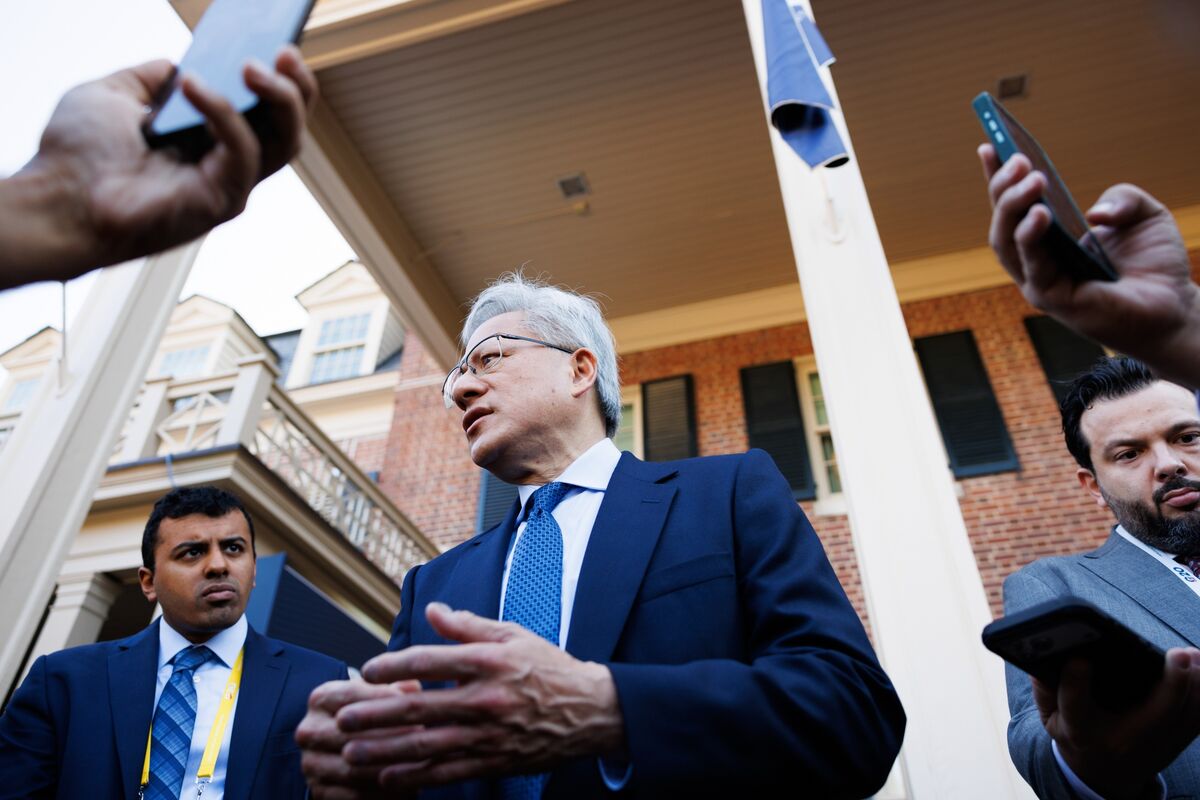
Nvidia CEO Jensen Huang is expanding his role as an AI evangelist through growing investments, reinforcing his influence across the AI ecosystem. Separately, OpenAI, Anthropic and Google DeepMind are collaborating on AI-model safety efforts, partly aimed at addressing risks and potentially limiting the need for additional safety regulation. The article provides no investment amounts, valuations or financial performance figures.
Analysis
The more investable implication is not the executive’s private-market activity itself, but the reinforcement of NVIDIA’s ecosystem gravity: founder-led capital and advocacy can channel startups toward CUDA-native infrastructure, raising switching costs before those companies become meaningful buyers. That creates a 6-18 month demand-supportive feedback loop for NVDA’s software and networking stack, but it is unlikely to alter near-term reported revenue or valuation without disclosed portfolio-company procurement commitments.
For GOOG, coordinated safety work is strategically double-edged. Larger incumbents can absorb evaluation, compliance, and model-governance costs that would burden open-source and smaller frontier-model competitors, potentially strengthening Google Cloud and Gemini’s enterprise positioning over 12-24 months. The near-term risk is that voluntary coordination invites regulators to codify costly standards while leaving the largest platforms exposed to liability, copyright, and distribution constraints; the group’s claims should not be treated as evidence of reduced regulatory risk.
Consensus is prone to read any AI ecosystem endorsement as incremental NVIDIA upside. At current AI-infrastructure expectations, the marginal signal matters only if it translates into accelerated venture funding, GPU reservations, or enterprise deployment volumes. The cleaner second-order beneficiary may be hyperscaler cloud capacity—GOOG, MSFT, and AMZN—if governance standards make enterprises more willing to move sensitive workloads from on-premise pilots into managed platforms; absent evidence of that conversion, this is narrative rather than a catalyst.
AllMind Terminal
AI-powered research, real-time alerts, and portfolio analytics for institutional investors.
Request TrialMarket Sentiment
Overall Sentiment
mildly positive
Sentiment Score
0.20
Ticker Sentiment
Key Decisions for Investors
- No standalone trade on this disclosure; treat as a watch item rather than a catalyst. Require evidence of incremental GPU capacity commitments, startup funding rounds tied to NVIDIA infrastructure, or cloud backlog acceleration before adding AI-exposure risk.
- Maintain a 6-12 month relative-value bias toward GOOG versus smaller AI software/platform peers with limited compliance budgets; regulatory-standardization risk can widen incumbent-versus-challenger cost advantages. Falsify if EU/US rules impose model-distribution restrictions or liability costs disproportionately on frontier-model owners, or if Google Cloud growth decelerates despite AI product launches.
- For AI infrastructure exposure, prefer a hedged basket—long NVDA or SMH against a short high-multiple, low-revenue AI application basket—rather than adding unhedged NVDA on ecosystem headlines. Reassess if hyperscaler capex guidance or NVIDIA data-center backlog begins to normalize over the next two earnings cycles.
- Monitor 1-3 month regulatory catalysts: formal US/EU safety-rule proposals, antitrust actions, and enterprise AI-governance announcements. A binding compliance regime that privileges audited managed models would support GOOG/MSFT cloud multiples; a shift toward open-model exemptions would undermine that relative thesis.
More News
- Data centers can be good citizens. It’s why we’re partnering with Google and Nvidia to create the AI Energy Management Alliance
- FBN Securities initiates Five9 stock coverage with outperform rating
- Terradot and Google Combine Superpollutants and Carbon Removal in the World's Largest Enhanced Rock Weathering Project in Southern Brazil
- What the Anthropic IPO Means for Amazon and Alphabet Investors
- Delivering predictable regulation in an unpredictable world
- Push for AI regulation mounts as talk of AI’s ‘existential’ risks go mainstream. But Trump resists calls for a slowdown