
Jeonbuk National University Researchers Develop Breathable Paper Patch for Wearable Health Care
Source: PR Newswire
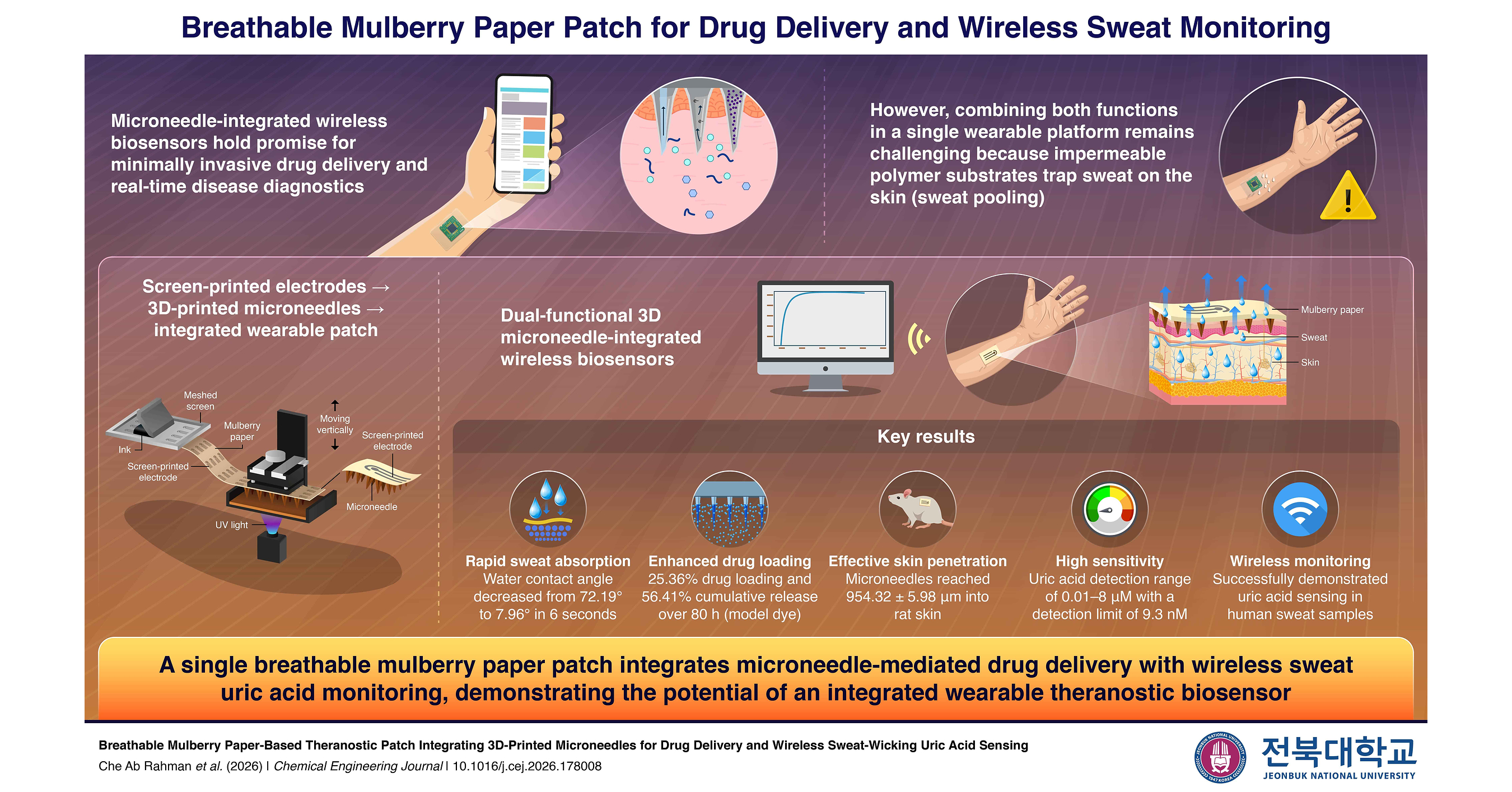
Jeonbuk National University researchers developed a breathable hanji-paper patch platform combining 3D-printed microneedles and wireless sweat-based uric acid sensing. Optimized microneedles achieved 25.36% drug loading versus 12.6% for unmodified needles, while the sensor detected uric acid from 0.01 to 8 micromolar with a 9.3-nanomolar detection limit. Drug delivery and sensing were evaluated separately, and clinical-drug, skin-safety and on-body testing remain future work.
Analysis
This is an early-stage platform result, not yet a commercial product catalyst. The investable gap is between analytical performance in samples and a clinically useful, integrated device: the sensing and drug-delivery functions were evaluated separately, while on-body reliability, skin safety, drug compatibility, and the relationship between sweat uric acid and decisions about gout treatment remain unproven. Those are the gates to regulatory clearance, reimbursement, and repeat-use demand—not the paper substrate itself.
Near term, the publication is unlikely to change earnings for any identifiable public company; the university is the only named institution and no commercialization partner is identified. Over 6–18 months, successful clinical validation could support the broader microneedle and wearable-diagnostics ecosystem, but a paper-based format alone is not a defensible moat. Established sensor makers and contract manufacturers could potentially compete or partner if performance translates, while disposable-device economics and quality-controlled manufacturing may limit the value captured by the research team.
Contrarian read: headline sensor sensitivity may overstate the opportunity. In-home gout monitoring requires clinically actionable readings across real-world hydration, activity, and skin conditions, and the proposed treatment-plus-monitoring loop is not yet demonstrated. Treat this as technology optionality, not evidence of an imminent displacement of blood testing or existing monitoring approaches.
AllMind Terminal
AI-powered research, real-time alerts, and portfolio analytics for institutional investors.
Request TrialMarket Sentiment
Overall Sentiment
mildly positive
Sentiment Score
0.25
Key Decisions for Investors
- No direct trade: there is no named listed issuer or disclosed commercialization deal, and the research result has no clear near-term earnings transmission.
- Keep wearable diagnostics and microneedle-delivery companies on a watchlist rather than buying the theme on this announcement. Reassess only when there is an identified industry partner, a clinical/on-body study, and a credible regulatory pathway.
- For any future commercial claim, verify paired sweat-versus-blood results and reproducibility under real-world use, alongside skin-safety and integrated drug-delivery data. Analytical recovery in collected samples alone would not establish clinical utility.
- The thesis weakens if on-body testing shows poor correlation or inconsistent readings, or if skin safety, drug loading/release in actual medicines, or scalable manufacturing fails. Until those gates are cleared, avoid assigning material value to the platform.
More News
- What Wall Street billionaires are saying about Democrats' midterm sweep
- A blue wave sends futures into the green
- Asian chip stocks slide as disappointing Qualcomm, Arm earnings weigh
- China Blocks SoftBank Acquisition of ABB Robot Unit, FT Says
- After the midterms, a bigger clash over data centers could be coming
- Inside the chip talent war: Trade secrets and rising Chinese rivals