
Logic Fruit Technologies Unveils L-Nex™, a Reconfigurable BMC Platform for Next-Generation AI and Datacenter Servers
Source: PR Newswire
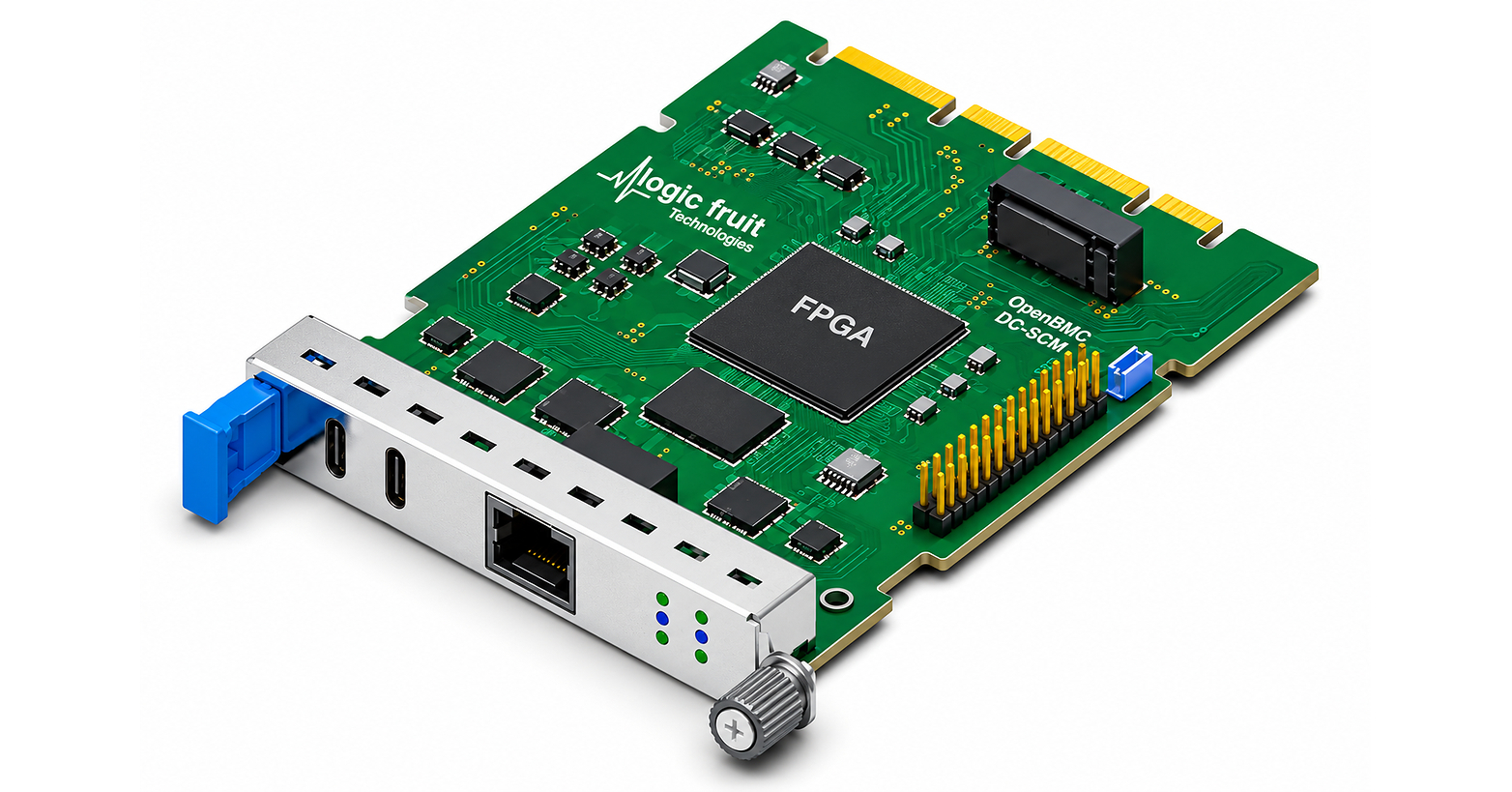
Logic Fruit Technologies unveiled L-Nex, a family of FPGA-based BMC products for OCP DC-SCM 2.x servers, designed to let customers configure server management and security at design-in and update capabilities after deployment. The platform combines OpenBMC, telemetry, remote KVM and hardware root of trust; production readiness is targeted for Q3 2027, and the company is engaging potential design partners. The announcement describes a product in development and provides no commercial or financial results.
Analysis
The investable signal is a possible shift in server-management value from fixed-function BMC silicon toward programmable platforms—not near-term earnings. If customers adopt this architecture, incumbent BMC suppliers such as ASPEED could face slower content growth or pricing pressure over time; FPGA suppliers and vendors able to support OpenBMC integration may gain design influence. That outcome is conditional: qualification, power/cost trade-offs, firmware support burden, and compatibility with OEM security processes can outweigh configurability. Reprogrammability also expands the attack surface: authenticated updates and recovery mechanisms must work reliably across years of deployment, or the security proposition becomes a liability.
Near term, the announcement is a weak catalyst: the product remains in development and production readiness is targeted well beyond the next few quarters. In 1–3 months, the useful evidence would be named design partners, evaluation-to-design-win conversion, and customer validation—not additional capability claims. Over 6–18 months, monitor qualification milestones, production timing, and whether FPGA-based management is adopted in volume AI servers. A delay, higher system cost/power, or failure to secure OEM qualification would undermine the substitution thesis. The contrarian point: flexible management may be valuable, but hyperscalers can also prefer standardized, internally controlled designs; configurability alone does not establish a durable moat. No company identity or ticker is supplied, so this is a sector watch item rather than a direct security recommendation.
AllMind Terminal
AI-powered research, real-time alerts, and portfolio analytics for institutional investors.
Request TrialMarket Sentiment
Overall Sentiment
mildly positive
Sentiment Score
0.20
Key Decisions for Investors
- No immediate trade: the development-stage announcement does not establish revenue, design wins, or a material near-term change to listed-company earnings.
- Watch ASPEED for evidence of BMC content or pricing pressure, but do not short on this announcement alone; look for customer qualification losses or guidance commentary linking programmable alternatives to reduced demand.
- Track FPGA suppliers and server OEMs for named design wins and production commitments. Treat evaluation programs as non-binding until supported by qualification milestones or disclosed volume deployments.
- Set a thesis-falsification check for any adoption narrative: production timing slips, unacceptable system cost/power, or security/update failures would favor incumbent fixed-function solutions over reconfigurable platforms.
More News
- US stock market hits all-time high as investors bet big on AI
- Singapore's Temasek warns of the ‘biggest risk’ facing markets right now
- U.S. stock futures steady after tech rally lifts S&P 500, Nasdaq to records
- Nvidia Is on the Verge of a $6 Trillion Market Value
- What Marvell's rosy long-term guidance means for our AI chip stocks
- Meta may ditch the idea of a cloud business for Muse. We think that’s a good trade