
MediKarma's Jack™ AI Responsibly Powers the Infrastructure Behind Direct-to-Patient Care: Organized, Longitudinal Medical Records at Scale, Without Taking the Provider Out of the Loop
Source: PR Newswire
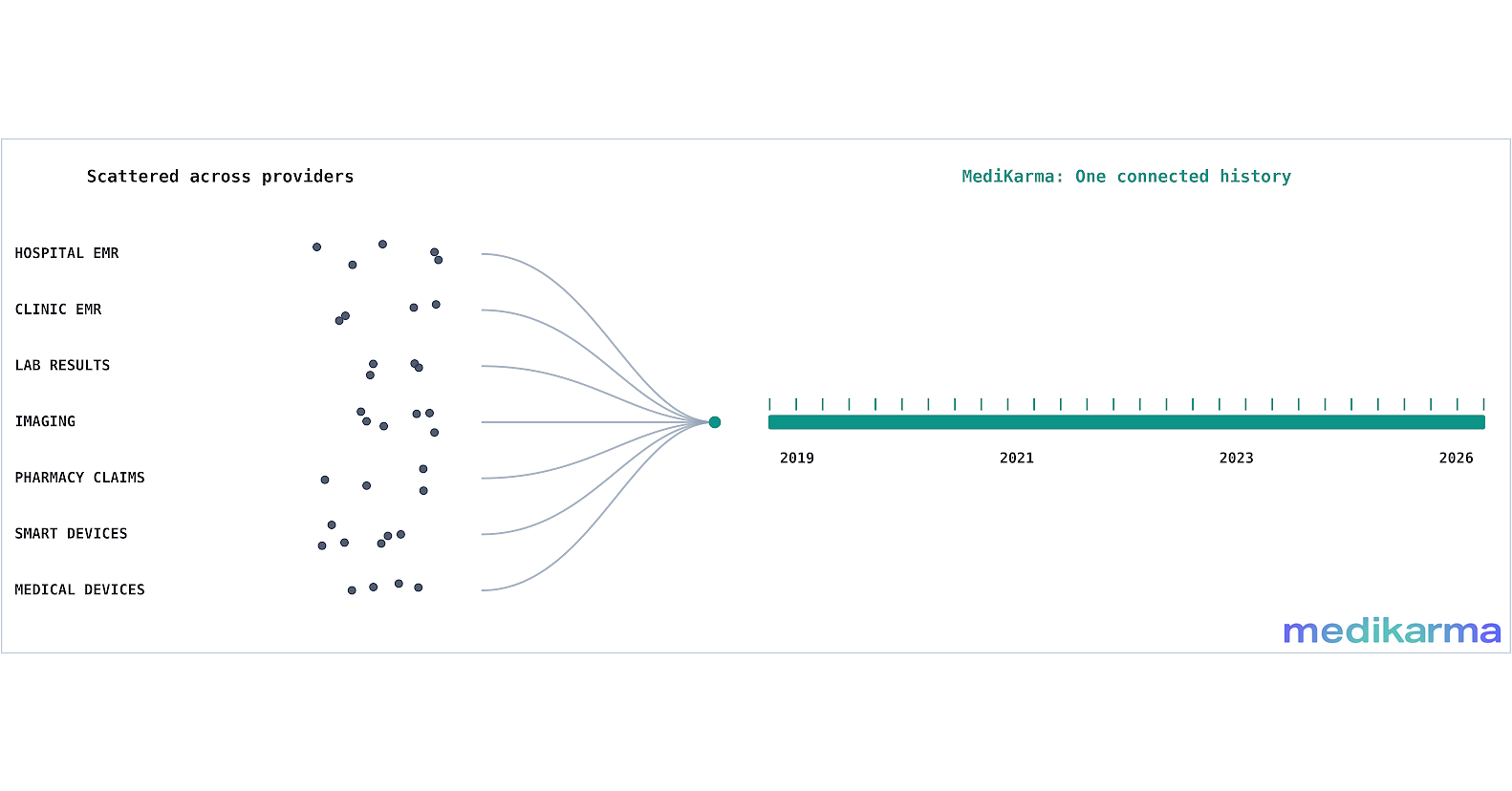
MediKarma announced that its Jack AI and Jill technologies are live in production deployments, providing longitudinal medical-record infrastructure and provider-supervised engagement for direct-to-patient healthcare offerings. In an 8 million-patient cohort, its health score had a 90.6% correlation with actual claims costs; in a 120-day endocrinology pilot, 50% of participants reduced A1C or maintained a healthy baseline. CMS formally accepted MediKarma's application to the Health Technology Ecosystem Diabetes & Obesity track, supporting its interoperability positioning, though the announcement provides no revenue, contract-value, or profitability data.
Analysis
There is no directly investable read-through from this private-company release, and the cited clinical and cost correlations are not sufficient to infer commercial traction, retention, reimbursement, or unit economics. The relevant market mechanism is that longitudinal-record aggregation could lower clinical-review labor and prescribing-liability costs for direct-to-patient platforms; however, provider supervision also limits gross-margin expansion versus fully automated AI-care models. The key diligence question is whether record-retrieval completeness translates into lower medical-loss ratios, fewer adverse events, or higher conversion—not merely better data organization.
Public digital-health platforms with substantial patient-acquisition spend, including HIMS, TDOC and AMWL, could benefit if interoperable records reduce contraindication-related friction and improve care personalization. Conversely, payer-owned platforms such as UNH/Optum, CVS and HUM retain an advantage in proprietary claims, pharmacy, and provider-network data; an independent aggregator only becomes strategically meaningful if it can bridge payer silos at materially lower cost and with demonstrably better consent coverage. Incumbent EHR and workflow vendors, notably ORCL and VEEV, are more likely beneficiaries of enterprise interoperability budgets than a standalone vendor absent named, scaled contracts.
Over the next 1-3 months, the only meaningful catalyst would be disclosed health-plan, pharma, or device contracts with implementation scope, pricing, and measurable outcomes. Over 6-18 months, CMS-linked interoperability standards may expand the addressable market, but formal participation in an ecosystem program is not equivalent to reimbursement, procurement preference, or regulatory clearance. Consensus enthusiasm around healthcare AI underweights the bottleneck: fragmented data rights and provider workflow integration, rather than model quality, usually determine deployment speed and margin capture.
AllMind Terminal
AI-powered research, real-time alerts, and portfolio analytics for institutional investors.
Request TrialMarket Sentiment
Overall Sentiment
moderately positive
Sentiment Score
0.42
Key Decisions for Investors
- No standalone trade on MediKarma: it is private and the release lacks independently verifiable ARR, customer concentration, gross margin, or outcome data. Add an alert for named contracts with public payers, pharma sponsors, or listed digital-health customers.
- Maintain a selective long bias in ORCL over high-multiple digital-health names if interoperability procurement accelerates: Oracle can monetize integration through installed EHR workflow, while customer-acquisition-driven platforms must prove that richer records improve contribution margin. Reassess if Oracle Health implementation metrics or healthcare-cloud bookings weaken.
- Watch HIMS and TDOC for evidence that clinical-data integration lowers clinician cost per consult or improves retention during the next two earnings cycles. Do not underwrite upside from AI personalization without disclosed changes in care-team expense, adverse-event rates, or subscriber lifetime value.
- For a relative-value expression only after sector strength, consider long ORCL / short a basket of TDOC and AMWL over 6-12 months, sized modestly: the thesis is that interoperability spending accrues to embedded enterprise workflows before it accrues to consumer telehealth. Exit if telehealth firms show sustained gross-margin expansion tied to automation or Oracle reports deteriorating healthcare bookings.
More News
- Wall Street’s Nasdaq hits all-time high as AI frenzy gathers pace
- Data-Center Bet Makes ESDS One of India’s Best New Listings
- Asia stocks ride tech wave higher, oil stays subdued
- Paramount will need to release way more movies to make this merger work
- Sullivan: Wall Street admits it doesn't know where oil is headed. There's one stock they do agree on
- How Kevin Warsh’s rate hike exposed a 2-speed U.S. economy, with AI and housing at the poles