
New Debt.com Survey Uncovers America's Silent Crisis: 78% Carry Financial Regret, Driven by Surging Credit Card Balances and Constant Anxiety
Source: PR Newswire
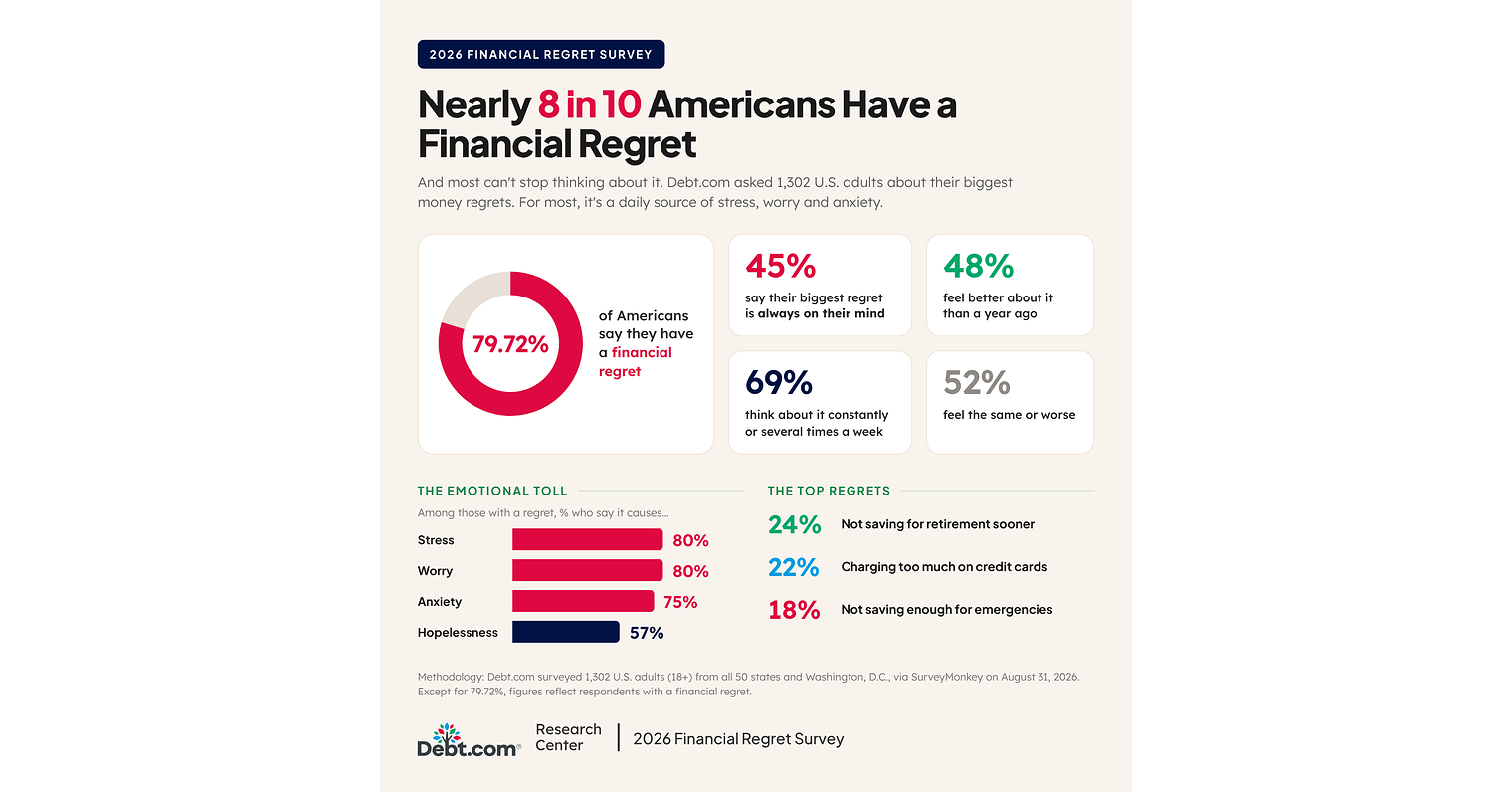
Debt.com's survey found 78% of Americans report at least one major financial regret; charging too much on credit cards was the top regret at 24%, up from 21%. Among consumers regretting credit card use, 16% carried six or more cards, up from 10% in initial benchmarks, and 37% said debt was always on their mind. The survey also found 20% of respondents regretting inadequate retirement savings had saved nothing, while 9% of surveyed Millennials regretted buying a home.
Analysis
This is a weak, lagging consumer-credit signal—not a basis for trading issuer stocks on its own. The survey is self-reported, and the release provides no sampling or delinquency data; the rise in people with six or more cards does not establish that balances or losses are rising across the market. The market-relevant transmission is whether revolving balances become unpayable: then higher charge-offs and provisions could outweigh interest income at card lenders, while constrained discretionary spending pressures lower-end retailers. Conversely, issuers may continue earning on balances if payment rates hold and losses remain contained. Debt-relief providers could see more inquiries, but demand is not equivalent to profitable conversions.
Near term, expect little fundamental price impact absent confirmation in issuer disclosures or credit data. Over 1–3 months, monitor card delinquencies, charge-offs, payment rates, and lender guidance; a deterioration would matter more for lenders with greater exposure to lower-credit borrowers than for diversified banks. Over 6–18 months, sustained repayment stress could weigh on discretionary demand and increase credit costs. The survey does not establish a change in retirement saving, student-loan repayment, or housing demand large enough to trade those themes. Contrarian read: the release frames card count and worry as crisis indicators, but neither is a reliable substitute for balances and loss performance; treating it as a broad consumer-credit break would be premature.
AllMind Terminal
AI-powered research, real-time alerts, and portfolio analytics for institutional investors.
Request TrialMarket Sentiment
Overall Sentiment
moderately negative
Sentiment Score
-0.35
Key Decisions for Investors
- No trade from this survey alone. Avoid using the headline as a reason to short card issuers or consumer discretionary names.
- Set a confirmation watch on card delinquency and charge-off trends, payment rates, and provisions at Capital One, Synchrony, and large diversified banks; compare changes with management guidance before taking issuer-specific exposure.
- If several data points and lender disclosures confirm worsening losses, consider a relative short in lenders more exposed to lower-credit borrowers versus a diversified-bank peer, sized to the observed spread and credit deterioration rather than this survey.
- Falsify the downside thesis if delinquency and charge-off metrics stabilize, payment rates hold, and issuer guidance does not indicate rising credit costs; also verify the survey methodology and whether the reported card-count increase reflects a comparable sample.
More News
- Budget 2026 speech
- Wendy's shares jump 15% as Nelson Peltz's Trian offers $1.4 billion to buy burger chain
- Federal Reserve issues FOMC statement
- Asian shares fall as Alphabet earnings miss drags Wall St futures lower
- Dollar steady after Fed hold leaves rate path murky
- Burnham’s government unveils its first UK budget: What to expect