
Phillips 66 and ConocoPhillips Warned Justice Alito His Oil Investments Face Material Risk From Climate Lawsuits For Years; Their Trade Association, Suncor and Exxon Briefed Him on How to Eliminate that Risk, Says Consumer Watchdog
Source: PR Newswire
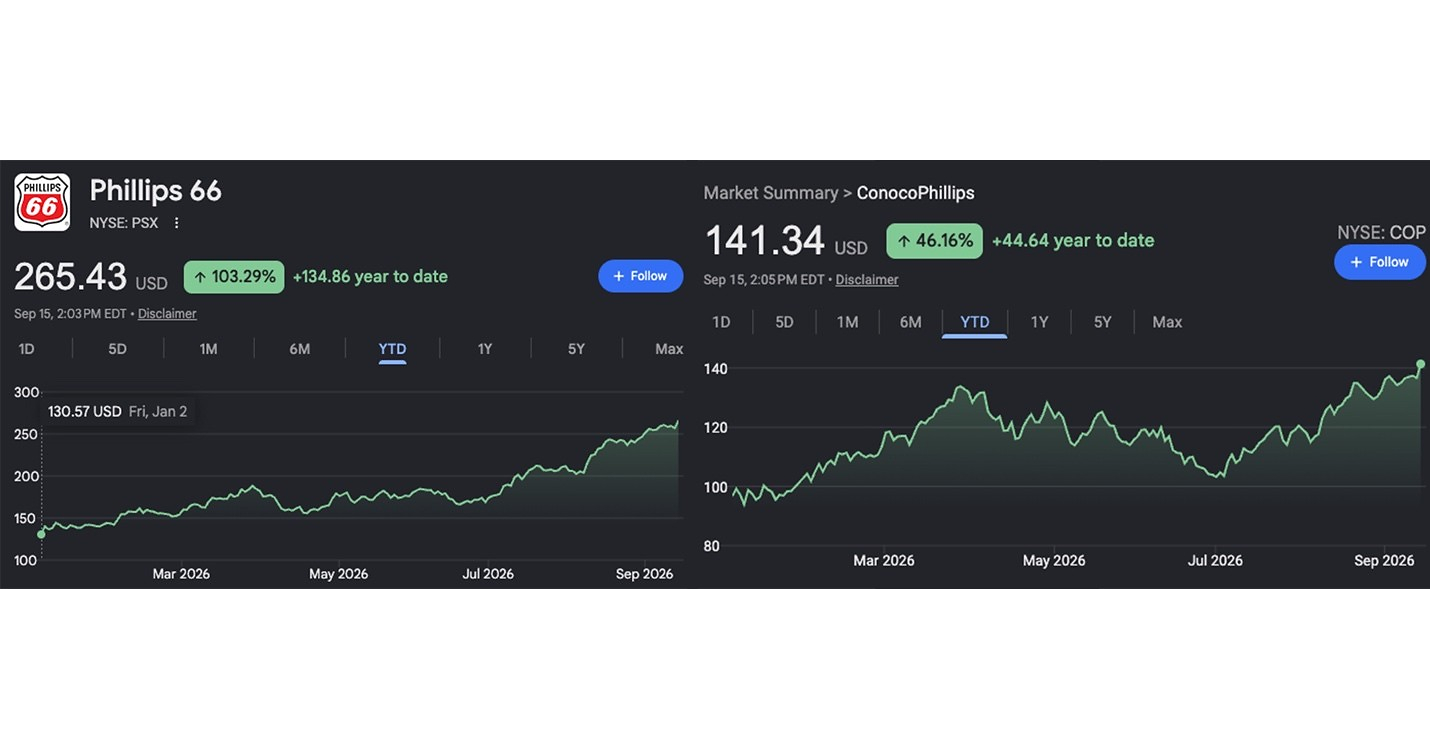
Consumer Watchdog called for Justice Samuel Alito to recuse from the Supreme Court's Oct. 5, 2026 hearing in Suncor v. Boulder, alleging his holdings of up to $15,000 in ConocoPhillips and $15,001-$50,000 in Phillips 66 create a financial conflict. The advocacy group argues a ruling sought by Suncor, Exxon and industry groups could affect roughly three dozen state-law climate-liability cases, including nine stayed California cases in which ConocoPhillips is named in all nine and Phillips 66 in seven. The Supreme Court has previously said Alito has no financial interest in a party and that recusal is not required; the article reports advocacy-group allegations rather than a new judicial action or ruling.
Analysis
This is primarily a governance/headline-risk event rather than a near-term earnings event. The economic sensitivity is greatest for COP and PSX because a state-law pathway that survives would extend their litigation tail, raise defense and settlement reserves, and potentially increase the cost of capital applied to long-duration hydrocarbon cash flows. XOM and SU are more useful read-throughs on sector-wide liability precedent than direct vehicles for this specific governance controversy.
The immediate market effect should be limited absent a change in court participation or a substantive procedural signal; an advocacy-group release is not independently dispositive and recusal decisions are largely opaque. Over the next 1-3 months, the relevant catalyst is whether the Court narrows federal-preemption defenses or leaves state claims viable, which would reopen a discounted but non-zero liability overhang across integrated oils, refiners, and insurers exposed to climate-loss claims. PSX may be relatively more vulnerable to multiple compression than COP because refining cash flows already carry structurally lower terminal-value confidence and less commodity-price upside to offset legal uncertainty.
Consensus likely overweights the binary liability narrative. Even an unfavorable procedural outcome would leave plaintiffs with years of causation, attribution, jurisdictional, and damages hurdles; it does not create an immediate reserve requirement. Conversely, a favorable industry outcome would remove a tail risk but is unlikely to be a major rerating catalyst for large-cap energy unless it changes disclosure language, litigation accruals, or insurer willingness to underwrite climate-related liabilities.
The cleanest second-order watch is commercial insurance and municipal-finance spillover, not just E&P equities: broader state-law viability could increase D&O/E&O pricing and pressure local-government litigation-finance economics. Monitor COP and PSX quarterly legal-contingency disclosures, any change in insurance recoverability, and whether peer risk factors become more explicit; those are more actionable than media attention around judicial ethics.
AllMind Terminal
AI-powered research, real-time alerts, and portfolio analytics for institutional investors.
Request TrialMarket Sentiment
Overall Sentiment
mildly negative
Sentiment Score
-0.25
Ticker Sentiment
Key Decisions for Investors
- Do not initiate a directional COP or PSX short solely on this release; treat it as an event-risk alert. Reassess after the Oct. 5 argument for questioning that indicates the Court may preserve broad state-law claims, and require confirmation through legal-reserve or guidance changes before sizing a fundamental short.
- For existing COP/PSX longs, reduce concentrated idiosyncratic exposure into the hearing only if implied volatility remains below realized headline risk; use 1-3 month put spreads rather than outright puts, as a procedural loss would still leave a long litigation timeline and limits downside convexity.
- If the argument suggests state claims remain broadly viable, express the relative thesis as short PSX / long XLE over 1-3 months: PSX has lower litigation-risk absorption capacity in its valuation narrative than diversified upstream-heavy XLE constituents. Exit if PSX maintains guidance and legal disclosures without incremental contingency language at the next reporting date.
- Maintain SU and XOM as lower-beta sector read-throughs rather than primary expressions. A broad favorable ruling would be more likely to support sector multiples than near-term EPS; the trade is underwritten only if energy prices are not simultaneously falling enough to dominate the legal catalyst.
More News
- Exxon Mobil says floodwater overwhelmed pump at Joliet, Illinois refinery
- Can Strong Oil Prices Drive ExxonMobil's Business Growth?
- Khosla-backed Mazama Energy just raised $135M to drill deeper into super-hot-rock geothermal
- Bank of Japan raises interest rates to 31-year high, flags concerns over inflation
- Italy to deploy warships to protect shipping through Bab al-Mandeb
- UN mission finds evidence of U.S. war crimes in Iran; Washington rejects report