
U.S. Tech Hiring Moderates as Employers Prioritize Human Skills
Source: PR Newswire
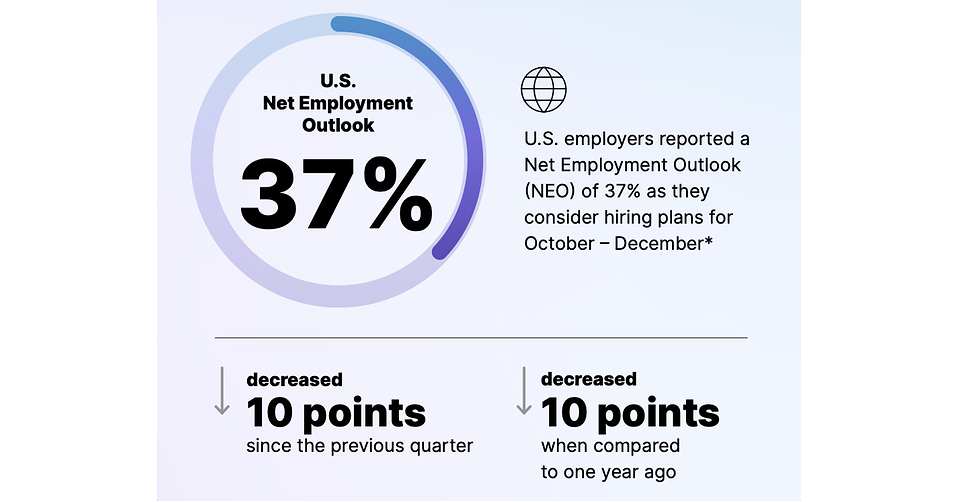
Experis' U.S. tech Net Employment Outlook fell 10 points both quarter-over-quarter and year-over-year to 37% for Q4 2026, signaling a meaningful moderation in tech hiring. Still, 53% of tech employers expect to add staff, versus 16% planning reductions, with business growth the main hiring driver. Demand remains concentrated in human skills such as professionalism (44%) and critical thinking (39%), while AI literacy is the leading technical skill at 34%.
Analysis
The signal is modestly negative for MAN because staffing revenue is driven more by hiring velocity and assignment starts than by the absolute share of employers adding headcount. A deceleration in tech hiring intentions should first pressure Q4 fill volumes and utilization, while client caution can also shift mix toward lower-margin temporary placements. The survey was fielded in July, however, so it is a lagging input rather than evidence of a fresh September deterioration; MAN’s next revenue outlook and permanent-placement trends carry greater weight than this release.
The more consequential second-order effect is a bifurcated labor market: demand for AI-adjacent implementation talent may remain firm while broad-based IT hiring weakens. This favors firms with scarce-skill recruiting, reskilling, and managed-services exposure over generalized staffing, but only if wage spreads hold. KFY is relatively insulated through executive-search and consulting mix; ASGN and RHI are more exposed to discretionary technology project starts, while ACN, EPAM, and GLOB face a mixed setup—better AI implementation demand but weaker client willingness to fund large transformation teams.
Consensus may overread AI-literacy demand as a near-term staffing tailwind. Employers can meet much of that need through internal training, vendor platforms, and productivity gains rather than net new hires, which caps the revenue conversion for recruiters. Over the next 1-3 months, a broad deterioration in payrolls or tech-sector guidance would validate a cyclical volume slowdown; conversely, stabilization in Q1 hiring intentions, improving permanent-placement fees, or rising bill-rate spreads would falsify the bearish interpretation. The 6-18 month opportunity is in providers monetizing training and managed talent rather than transactional placement alone.
AllMind Terminal
AI-powered research, real-time alerts, and portfolio analytics for institutional investors.
Request TrialMarket Sentiment
Overall Sentiment
mildly negative
Sentiment Score
-0.22
Ticker Sentiment
Key Decisions for Investors
- No standalone MAN trade on this survey; maintain a downside alert into MAN’s next earnings if management guides organic revenue lower or reports worsening North American Experis volumes. A combination of declining placement volume and bill-rate compression—not hiring-intentions data alone—would justify a tactical short.
- For a 1-3 month cyclical hedge, prefer a small long KFY / short RHI pair rather than outright short MAN: KFY’s consulting and higher-end search mix should be less sensitive to slowing contingent IT requisitions. Exit if RHI reports sequential improvement in technology staffing demand or if KFY’s fee backlog weakens materially.
- Watch ASGN for a potential short only after its next guidance update confirms reduced commercial IT project starts; the thesis requires evidence that AI-related demand is not offsetting traditional consulting attrition. Target a 10-15% downside versus a 5-7% stop on a guidance raise or accelerating bookings.
- Do not chase AI-services longs solely on this labor signal. Consider ACN, EPAM, or GLOB only after bookings demonstrate that AI pilots are converting into implementation programs; the key confirmation is improving revenue growth guidance and utilization, not stated skills demand.
More News
- ShinyHunters claims FBI hack: 'This is NOT financially motivated'
- Wall Street’s Nasdaq hits all-time high as AI frenzy gathers pace
- Data-Center Bet Makes ESDS One of India’s Best New Listings
- Asia stocks ride tech wave higher, oil stays subdued
- South Korean solar stocks jump as curbs on Chinese sector expected to remain in place
- How Kevin Warsh’s rate hike exposed a 2-speed U.S. economy, with AI and housing at the poles