
From Pasta to Pints: Trainline and Nicola Coughlan Put Europe's Best Grain-Based Bites on the Map
Source: PR Newswire
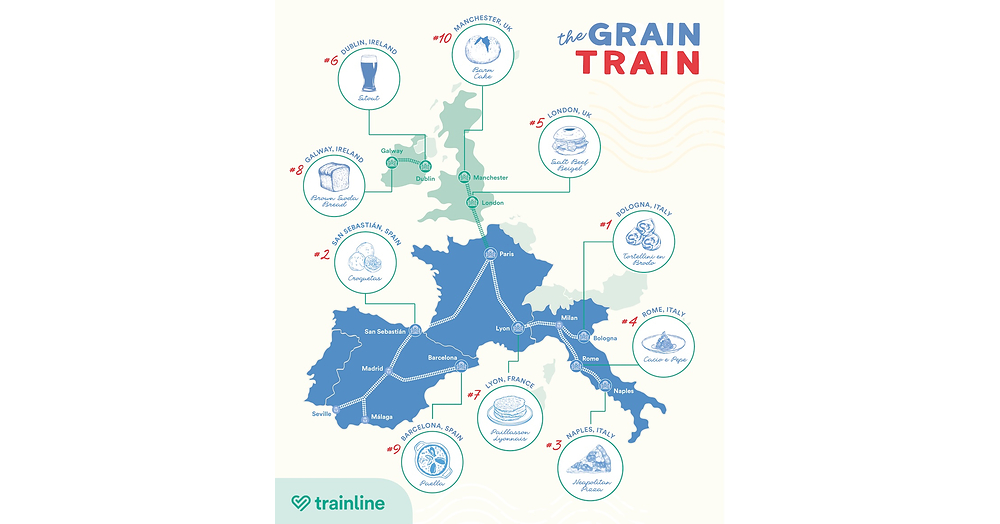
Trainline launched its Culinary Rail Index, ranking 10 European rail-accessible food destinations from an assessment of 37 cities across 11 countries. Bologna led with a 98% score, followed by San Sebastián at 96.5% and Naples at 95%, while the company introduced destination Taste Guides intended to convert food-tourism interest into rail bookings. The promotional campaign, featuring Nicola Coughlan, supports Trainline's positioning around convenient and sustainable multi-city European rail travel but is unlikely to materially affect near-term financial performance.
Analysis
This is low-signal brand marketing rather than evidence of incremental bookings, pricing, or carrier-content expansion. The near-term value is limited to low-cost customer-acquisition content and potential app engagement around multi-city leisure itineraries; it should not change revenue estimates absent data on guide traffic, conversion to ticket purchase, or paid-marketing displacement. The relevant read-through is that Trainline is continuing to position itself upstream in trip discovery, where direct rail operators and Google travel surfaces retain structural advantages.
Over 1-3 months, the useful KPI is whether leisure mix supports higher take rates and attach rates on cross-border, multi-leg journeys versus domestic point-to-point tickets. If discovery content meaningfully improves organic acquisition, TRN could reduce marketing intensity and expand contribution margin, but the campaign's celebrity and editorial framing make material conversion uncertain. A better beneficiary of European food-led city breaks may be Booking Holdings (BKNG), whose lodging inventory monetizes longer stays, while Ryanair (RYAAY) and easyJet (EZJ.L) remain substitutes for origin-to-destination travel despite rail's favorable intra-Europe narrative.
Contrarian view: the market should not extrapolate consumer enthusiasm for rail-themed itineraries into a durable modal-shift thesis. Cross-border rail fragmentation, disruption risk, and fare opacity remain the binding constraints; content can stimulate intent but does not solve fulfillment economics. Thesis turns constructive only if upcoming reporting shows organic growth accelerating while sales-and-marketing as a percentage of revenue declines, or management identifies measurable conversion from destination-content funnels.
AllMind Terminal
AI-powered research, real-time alerts, and portfolio analytics for institutional investors.
Request TrialMarket Sentiment
Overall Sentiment
mildly positive
Sentiment Score
0.15
Ticker Sentiment
Key Decisions for Investors
- No standalone TRN trade on this release; treat as an engagement-data watch item rather than an earnings catalyst.
- For existing TRN exposure, monitor next results for organic traffic, repeat-booking rate, cross-border ticket mix, and sales-and-marketing leverage. A sustained increase in organic bookings alongside lower marketing intensity would support a 6-18 month margin-expansion thesis.
- Maintain BKNG as the cleaner public-market expression of European experiential city-break demand over the next 1-3 months; reduce the relative-long thesis if European lodging ADR or forward bookings soften materially.
- Avoid using this campaign as a basis to short airline proxies. Rail substitution is most relevant on specific short-haul corridors and is unlikely to offset airline capacity, pricing, or fuel-driven earnings catalysts.
More News
- US launches task force to disrupt Iran’s land-based supply routes
- Coffee giant Dutch Bros made all of its executives, including the CEO, do a two-week bootcamp where they learned how to pour drinks and run stores
- Iran war live: Explosions hit Qeshm; US moves to block land supply routes
- Iraq’s FM says external parties using Iraqi soil to attack neighbours
- Alabama Power spent more than $6 million on ads last year — and customers can be billed for half of them until 2029
- Starter homes cost $1 million in a record 242 U.S. cities—proof the affordability crisis has hit the homes meant for first-time buyers