
Legend Robot präsentiert auf der BATIMAT 2026 eine CE-konforme, autonome Lösung für das europäische intelligente Bauwesen
Source: PR Newswire
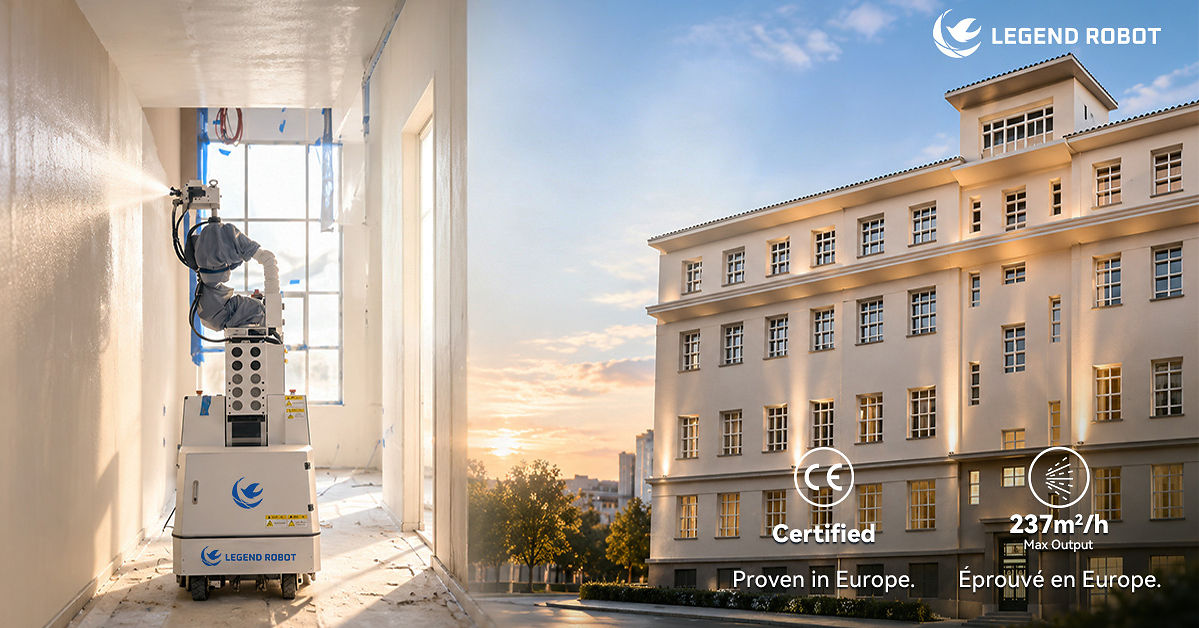
Legend Robot unveiled a CE-compliant autonomous paint and putty spraying robot for the European construction market at BATIMAT 2026. In an Athens hotel-renovation project, its robot fleet achieved a peak spraying rate of 237 m²/hour and reduced material waste by up to 15%; the company targets a further 30% efficiency gain through closed-loop AI optimization. The product is positioned to address European construction labor shortages, improve renovation productivity and support ESG-focused building modernization.
Analysis
This is not yet an investable standalone automation signal: the vendor is private, the productivity and waste figures are company-reported, and a single renovation deployment does not establish utilization, uptime, service economics, or contractor payback. CE compliance reduces procurement friction but is a market-access requirement rather than a durable competitive moat; European distributors and service coverage will determine adoption more than demonstrated spray speed.
If autonomous finishing equipment reaches scale, the first economic effect is likely labor-cost deflation and schedule certainty for large renovation contractors, not a material-volume surge for PPG, SHW, or AKZO. Faster turnover could modestly improve demand timing for coatings and rental equipment, while lowering rework and waste may cap paint-volume growth per square meter. The more exposed incumbent is conventional equipment suppliers without integrated vision software, fleet telemetry, and local maintenance networks; ABB and FANUY could benefit only if the category shifts toward broadly sourced industrial automation components rather than vertically integrated Chinese systems.
Over the next 1-3 months, BATIMAT customer announcements, distributor agreements, and independently disclosed project economics are the relevant catalysts, but none currently justify a directional public-equity position. Over 6-18 months, watch whether EU renovation incentives and persistent skilled-trade wage inflation make robotics leasing economically attractive; a credible installed-base ramp would favor equipment-rental firms with construction-channel density over paint manufacturers. The thesis is falsified if deployment remains limited to highly standardized interiors, requires substantial human supervision, or lacks local parts/service support—conditions that would erase contractor ROI despite nominal throughput.
AllMind Terminal
AI-powered research, real-time alerts, and portfolio analytics for institutional investors.
Request TrialMarket Sentiment
Overall Sentiment
moderately positive
Sentiment Score
0.48
Key Decisions for Investors
- No immediate directional trade: treat the announcement as a diligence alert rather than a catalyst, given absent public-company exposure and no independently verified unit economics.
- Monitor Ashtead Group (AHT.L) and United Rentals (URI) for European autonomous-finishing rental partnerships or fleet pilots over the next 6-12 months; consider a long only after disclosed rental utilization and contractor payback support incremental returns above ordinary equipment rental economics.
- Keep PPG, SHW, and AKZO on a relative-value watchlist rather than shorting: automation can improve renovation throughput, but lower coating waste offsets volume upside. A bearish materials view would require evidence that waste reduction exceeds project-throughput growth for at least two reporting periods.
- For industrial automation exposure, require evidence of OEM component sourcing or integrator contracts before adding ABB or FANUY. A broad autonomous-construction narrative alone is insufficient, and pricing pressure from vertically integrated low-cost robotics vendors is a material downside risk.
More News
- All Iranian airlines to be 'shut down' from Wednesday, Bessent tells CNBC
- Taiwan benchmark Taiex rises to record intraday high as tech stocks advance
- AMD joins the $1 trillion club as chip rally surges - our AI Strategy saw it early
- Jamie Dimon says hyperscaler AI spending could hit $1 trillion next year
- Factbox-Key issues for this week’s Trump-Xi summit in Washington
- Here's who we know is going to the Trump-Xi dinner so far