
Huawei onthult het verbeterde Stellar AI-netwerk om de Agentische wereld te voorzien van veilige, intelligente connectiviteit
Source: PR Newswire
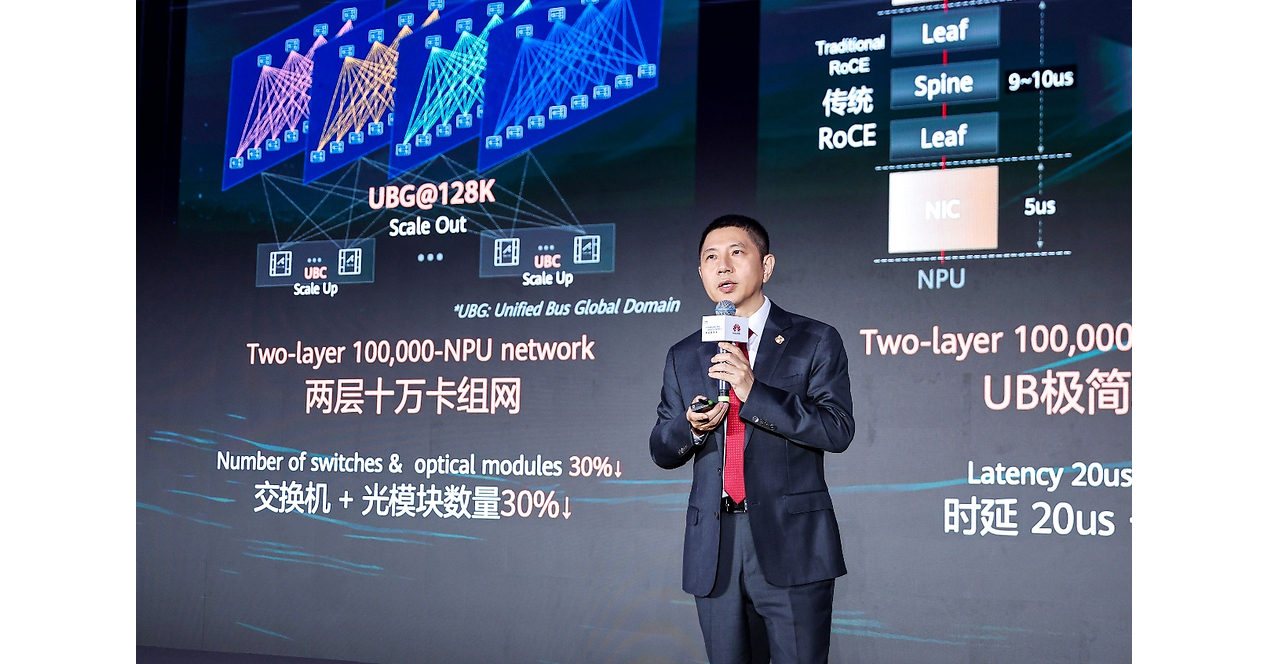
Huawei unveiled its upgraded Stellar AI Network at HUAWEI CONNECT 2026, spanning AI Fabric, AI WAN and AI Campus networking for AI-compute connectivity and security. The SF9300 architecture is claimed to cut network deployment costs by 30%, reduce end-to-end latency from 20μs to 11μs and eliminate packet loss during link flaps, while its NPO switches reduce interconnect power consumption from 1,000W to 600W. Huawei also cited 95%+ remote-computing efficiency over 1,000km, 95% detection rates for several AI-related threats, and AI-driven campus operations that reduce MTTR to under five minutes.
Analysis
Huawei’s integrated fabric/WAN/security positioning is most consequential in China and export-restricted markets, where customers increasingly value a single accountable vendor over best-of-breed architecture. That raises competitive pressure on Cisco (CSCO), HPE/Juniper (HPE), Arista (ANET) and Nokia (NOK) in sovereign-cloud, telco and state-enterprise tenders, but does not materially change their near-term hyperscaler revenue trajectories. The second-order issue is margin: bundled networking and security can force rivals to discount switching, optics and support contracts even where Huawei cannot directly win on geopolitical grounds.
The more important signal is that AI-cluster buyers are treating network utilization, fault recovery and data-residency controls as constraints on accelerator ROI rather than as conventional IT spend. If this architecture gains verified deployments, it supports demand for Ethernet AI fabrics and optical interconnect broadly—benefiting Broadcom (AVGO), Credo (CRDO), Coherent (COHR) and Ciena (CIEN)—while challenging the view that proprietary GPU interconnect alone captures all AI-network economics. Company performance claims should not be capitalized without customer references, shipment data, and evidence that deployments displace rather than merely supplement legacy networks.
Near term, this is unlikely to move listed equities absent tender wins or evidence of Chinese enterprise AI capex acceleration. Over 1-3 months, monitor China carrier and provincial-cloud procurement, ANET/CSCO commentary on pricing in international enterprise markets, and AVGO/CRDO order trends for AI Ethernet. Over 6-18 months, the risk is a bifurcated networking stack: Western vendors retain hyperscalers, while Huawei establishes a lower-cost sovereign-AI standard that narrows overseas enterprise addressable markets and compresses networking multiples.
AllMind Terminal
AI-powered research, real-time alerts, and portfolio analytics for institutional investors.
Request TrialMarket Sentiment
Overall Sentiment
moderately positive
Sentiment Score
0.48
Key Decisions for Investors
- No standalone directional trade on the launch; Huawei is unlisted and the disclosed claims lack independently verifiable revenue, backlog, or customer-conversion data. Create an alert for named large-scale deployments, carrier tenders, or export-market wins before assigning financial impact.
- Maintain a 3-6 month relative-value bias: long AVGO or CRDO / short CSCO, sized modestly. AI Ethernet component content has cleaner exposure to cluster buildouts than Cisco’s enterprise-routing mix; exit if AVGO/CRDO report AI-networking order deceleration or CSCO demonstrates sustained security/networking backlog acceleration.
- For investors seeking China AI-infrastructure exposure, monitor—not yet initiate—long CIEN or COHR versus short NOK. The trade requires evidence that cross-region AI connectivity drives incremental optical demand rather than Huawei internalizing the stack; invalidate on weak optical order books or an escalation in export controls that limits addressable deployments.
- Treat ANET as a watchlist risk rather than a short: a sovereign-market share loss is unlikely to offset hyperscaler demand in the next two quarters. Reassess only if management cites international enterprise pricing pressure or reduced Ethernet AI-fabric attach rates in guidance.
More News
- Trump & Xi to Meet Amidst Friction on Wars, Tech, Trade
- Here are the 3 big things we're watching in the stock market this week
- Tech leads shares higher in Asia, oil eases
- Yuan hits fresh multi-year peak as PBOC eases curb ahead of Trump-Xi summit
- China slows humanoid robot IPO rush as hype outruns reality
- The economy has undergone a structural transformation that ended the low-cost era. ‘The regime change in inflation and interest rates is the outcome’