
Huawei prezentuje nową architekturę obliczeniową UnifiedBus dla systemów SuperPoD i klastrów
Source: PR Newswire
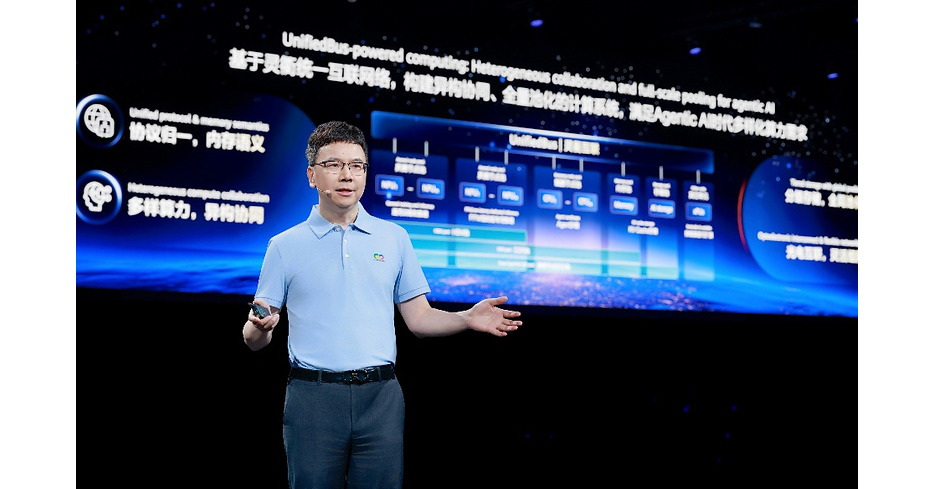
Huawei unveiled its UnifiedBus interconnect architecture for SuperPoD systems and AI clusters, targeting scalable deployments from a single rack to clusters of up to 1 million NPUs. The company claims the technology raises link bandwidth from 100 GB/s to terabit-per-second levels and reduces round-trip latency from 7 to 2 microseconds; its LinkDevice offers 176 ports at 1.6 Tbit/s each, or 280 Tbit/s aggregate throughput. Huawei also introduced UnifiedBus-based systems for SMEs and expanded Ascend's open-source AI-agent ecosystem, positioning the platform as an alternative computing infrastructure for trillion-parameter AI models.
Analysis
The investable implication is not a direct Huawei read-through—Huawei is private—but a potential erosion of Nvidia’s China-adjacent AI infrastructure moat if customers can achieve acceptable distributed-training efficiency without access to leading U.S. accelerators. The more important competitive pressure falls on the networking and memory-content profit pool: a system architecture that substitutes pooled DDR/SSD capacity for premium HBM at the margin could reduce HBM content per accelerator, pressuring the long-duration AI memory thesis for MU and Korean HBM vendors before it materially affects total AI capex.
Near term, this is unlikely to move U.S. semiconductor estimates: the claims are vendor-provided, lack customer benchmarks, pricing, power-efficiency data, software maturity evidence, and disclosed production volumes. Over the next 1-3 months, the relevant catalyst is evidence of third-party MLPerf-like training/inference results, named Chinese hyperscaler deployments, and whether Ascend software can sustain developer portability. Without these, the announcement is principally a procurement narrative for Chinese enterprises facing restricted access to Nvidia hardware.
The second-order beneficiary could be China’s domestic optical-interconnect and server supply chain rather than Huawei alone, while Nvidia’s constrained China product line remains the clearest relative loser if domestic systems narrow time-to-train and total-cost-of-ownership gaps. Contrarian view: the market may overstate any immediate threat to NVDA; hardware fabric claims do not solve CUDA ecosystem lock-in, model-tooling compatibility, yield, or field-service reliability. Conversely, escalating export controls would accelerate customer qualification of domestic alternatives even if their initial economics are inferior, making the strategic risk to NVDA asymmetric over 6-18 months.
AllMind Terminal
AI-powered research, real-time alerts, and portfolio analytics for institutional investors.
Request TrialMarket Sentiment
Overall Sentiment
mildly positive
Sentiment Score
0.38
Key Decisions for Investors
- No directional trade on this release alone; set an alert for independently verified large-scale deployment, customer names, and training throughput/power data. Treat a disclosed top-tier Chinese cloud win or repeatable benchmark parity as a catalyst to reassess NVDA China revenue and gross-margin risk.
- Maintain NVDA as the preferred AI compute exposure versus AMD over the next 1-3 months; Huawei’s announcement reinforces that software ecosystem and installed-base durability—not only chip specifications—are the key moat. Revisit if China-specific NVDA revenue guidance is cut or domestic alternatives demonstrate comparable model portability.
- For a 6-18 month hedge against China substitution risk, consider a modest long 000660 KS / short NVDA relative-value basket only after confirming domestic deployment volume. The thesis requires HBM demand to remain structurally tight while NVDA’s China mix deteriorates; exit if HBM pricing weakens or NVDA offsets China losses through non-China hyperscaler demand.
- Avoid extrapolating this into a bearish MU position yet: pooled-memory designs can lower HBM intensity per system but may also enable larger aggregate clusters and raise total memory demand. Monitor HBM bits per deployed accelerator and Chinese server-memory mix in 2027 supply-chain commentary before positioning.
More News
- All Iranian airlines to be 'shut down' from Wednesday, Bessent tells CNBC
- Taiwan benchmark Taiex rises to record intraday high as tech stocks advance
- AMD joins the $1 trillion club as chip rally surges - our AI Strategy saw it early
- Jamie Dimon says hyperscaler AI spending could hit $1 trillion next year
- Factbox-Key issues for this week’s Trump-Xi summit in Washington
- Here's who we know is going to the Trump-Xi dinner so far
From AllMind Research
- Anthropic IPO Preview: Valuation, Timing, and What to Watch
- Shein After the IPO: Venue, Valuation, and What Must Be Proved
- What AI Research Tools Should a Small Hedge Fund Buy First?
- Choosing an AI Copilot for Equity Research
- Weekly Update: Advanced Search Filters, Redesigned Ticker Dashboard, and Improved Search Experience