
Democrats’ Midterm Map Expands in Warning Sign for Republicans
Source: Bloomberg
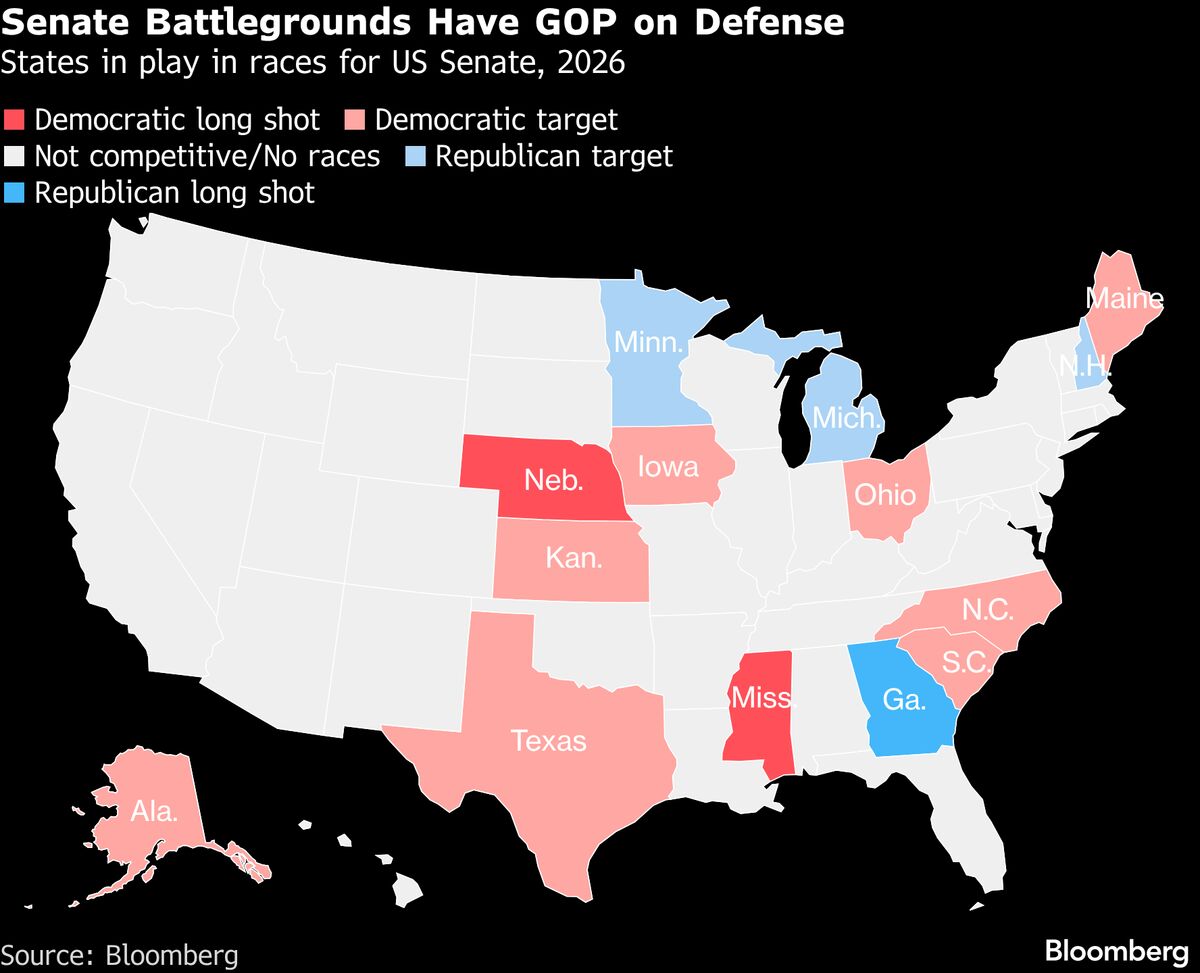
With less than two weeks until Election Day, Republicans’ expected advantage on the Senate map has weakened, according to the article. President Donald Trump is campaigning defensively in GOP strongholds such as South Carolina and Mississippi, while groups are spending in deep-red Texas; there are also signs Republicans have largely given up on Georgia and North Carolina.
Analysis
The useful signal is not a forecast of a Democratic Senate; it is a wider distribution of possible control outcomes. If Republicans lose expected seats, the market may price a lower probability of extending their legislative agenda and more post-election gridlock. That can matter more for policy-sensitive sectors than for broad earnings: renewables and some clean-energy developers could regain a policy-risk premium, while fossil-fuel producers and drugmakers face greater downside from prospective climate or drug-pricing initiatives. Those are conditional exposures, not immediate earnings revisions; the House outcome, chamber margins, and actual legislative feasibility remain decisive.
Near term (days), campaign activity and polls can move prediction-market odds and sector sentiment, but the article supplies no polling probabilities or market pricing to establish a tradeable mispricing. Over 1–3 months, watch whether fundraising and candidate withdrawals translate into durable changes in race forecasts. Over 6–18 months, any effect depends on control of both chambers and enacted policy; divided government could instead constrain major changes and blunt both the clean-energy upside and the healthcare downside.
Contrarian point: campaigning in nominally safe states may signal defensive resource allocation, but it is not proof those states are lost—or that Democrats will gain control. The market may overread campaign optics while underweighting the policy gridlock that could follow even a seat shift. No directional election trade is justified from this report alone.
AllMind Terminal
AI-powered research, real-time alerts, and portfolio analytics for institutional investors.
Request TrialMarket Sentiment
Overall Sentiment
mildly negative
Sentiment Score
-0.20
Key Decisions for Investors
- Keep exposure to policy-sensitive sectors sized for binary election risk; do not treat campaign stops or fundraising as a substitute for race-odds data.
- Watch clean-energy funds and fossil-fuel producers as a relative-value expression only if polling shifts materially and the market has not already repriced the relevant policy odds; verify House control and likely legislative margins before adding risk.
- For healthcare, monitor proposed drug-pricing policy and subsequent guidance or earnings commentary rather than shorting the sector on election headlines alone.
- Falsification: race forecasts stabilize or move back toward a Republican Senate, or post-election control is too divided for material policy change. Reassess on polling and forecast revisions, chamber outcomes, and any concrete legislative proposals.
More News
- American embassies tighten security as Iran threat warnings intensify ahead of U.S. midterm elections
- France’s latest debt warning describes a country where governance is breaking down — and even doing too little, too late is barely possible
- Israelis hold final rally against Netanyahu ahead of what may be the most consequential election in the country’s history
- Iran blames US for deal failure, urges new try amid fear of new attacks
- What next for France as riots rattle markets? Three questions facing investors ahead of more protests
- French police use tear gas and water cannons after some protests turn violent as shopkeepers board up storefronts across Paris
From AllMind Research
- Anthropic IPO Preview: Valuation, Timing, and What to Watch
- Shein After the IPO: Venue, Valuation, and What Must Be Proved
- What AI Research Tools Should a Small Hedge Fund Buy First?
- Weekly Update: In-App Tutorials, Futures Data, and Watchlist Enhancements
- AI Tools for Independent Research Firms: A Publishing System