
DUO POWER BOOST: Clivet Debuts Next-Gen Magnetic Levitation Technology and AI Cooling Portfolio at AI Infra Summit 2026
Source: PR Newswire
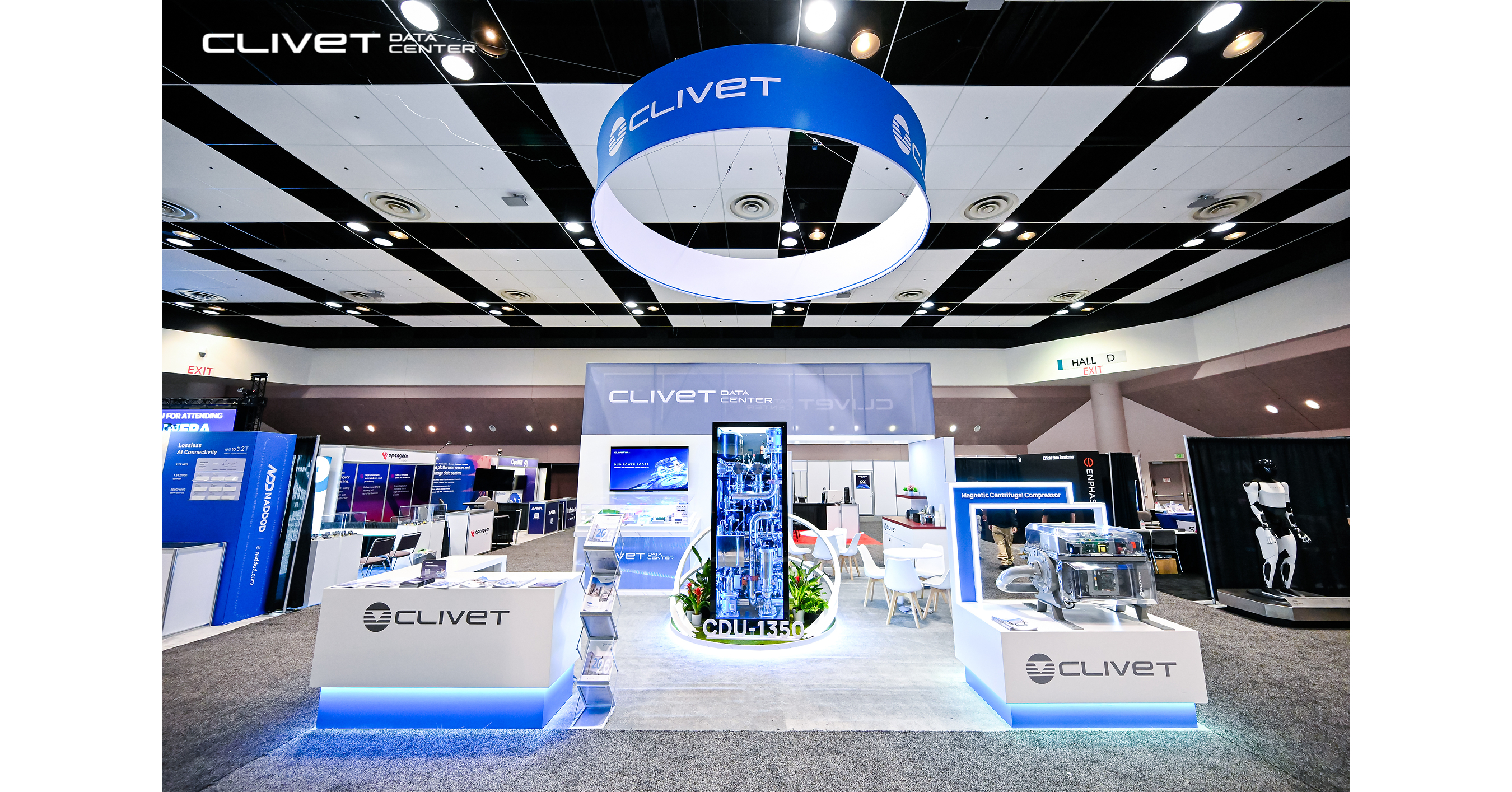
Clivet debuted its next-generation DUO POWER BOOST magnetic-levitation compressor and an AI data-center cooling portfolio at AI Infra Summit 2026. The lineup includes cooling sources, magnetic and high-capacity CDUs, fan walls and terminal units; its high-capacity CDU supports up to 3 MW at a 3K approach temperature difference or 5 MW at 5K ATD, with predictive temperature control within ±0.5°C. Clivet and CLOU also demonstrated an integrated power-and-cooling solution for high-density AI computing projects, addressing increasing thermal-management and reliability demands.
Analysis
This is not yet a standalone earnings catalyst for Clivet’s parent ecosystem; it is a signal that HVAC incumbents are converging on liquid-cooling architectures traditionally associated with Vertiv (VRT), Modine (MOD), nVent (NVT), and Schneider Electric (SBGSY). The key competitive question is whether dual-rotor compressor efficiency translates into lower total cost of ownership at partial loads, where AI clusters exhibit highly variable utilization. Until independent PUE/WUE data, installed-project wins, and service-attach economics are disclosed, the announcement should not justify a valuation rerating.
The more material second-order implication is margin pressure at the facility-cooling layer. As cooling equipment becomes more integrated with power delivery and controls, differentiated value shifts toward system design, commissioning, software controls, and recurring service—not commodity chillers. VRT and ETN remain better positioned near the highest-value electrical/thermal integration points; pure HVAC exposure at TT, JCI, and CARR faces greater risk of price competition if Asian suppliers use data-center cooling to gain share internationally.
Over the next 1-3 months, watch hyperscaler capex guidance, announced GPU-cluster deployments, and evidence that high-density racks are forcing liquid-cooling adoption faster than planned. Over 6-18 months, the binding constraint may be grid interconnection and power availability rather than cooling hardware; that favors ETN, PWR, GEV, and VRT over an undifferentiated thermal-management basket. The contrarian view is that investors may be overpaying for every "AI cooling" narrative: deployment delays from utility queues would defer revenue recognition even if long-run demand remains intact.
AllMind Terminal
AI-powered research, real-time alerts, and portfolio analytics for institutional investors.
Request TrialMarket Sentiment
Overall Sentiment
mildly positive
Sentiment Score
0.35
Key Decisions for Investors
- Maintain a core long VRT versus short JCI pair for 3-6 months: VRT has greater exposure to integrated high-density data-center infrastructure and service, while JCI has broader conventional-building HVAC exposure. Target 10-15% relative upside; exit if VRT bookings or backlog conversion decelerates materially for two consecutive quarters.
- Prefer long ETN or PWR over a broad cooling-equipment trade for 6-18 months. Power distribution, interconnection, and electrical balance-of-plant are likely to remain the gating items for AI campus deployment; reassess if hyperscalers materially reduce 2027 capex plans or utility interconnection timelines improve sharply.
- Do not initiate a direct Clivet/Midea-linked trade solely on this release. Create an alert for independently disclosed North American data-center contract wins, third-party efficiency benchmarks, and evidence of recurring service penetration; absent these, the commercial impact is unverified.
- For a higher-beta tactical expression, buy MOD only on a post-earnings pullback if management confirms liquid-cooling backlog conversion rather than merely pipeline growth. Risk/reward is attractive only if revenue timing is visible; a reduction in data-center revenue guidance is the thesis stop.
More News
- Iran vows 'painful' retaliation as Trump piles on pressure ahead of UN General Assembly meeting
- Oil falls as crude flows remain 'surprisingly strong'
- Trump & Xi to Meet Amidst Friction on Wars, Tech, Trade
- US Diesel Tops $6.50 a Gallon as Wars Worsen Global Fuels Crunch
- Here are the 3 big things we're watching in the stock market this week
- Tech leads shares higher in Asia, oil eases
From AllMind Research
- Anthropic IPO Preview: Valuation, Timing, and What to Watch
- Shein After the IPO: Venue, Valuation, and What Must Be Proved
- What AI Research Tools Should a Small Hedge Fund Buy First?
- Weekly Update: Sector Analysis, Improvements on Research Data, and Performance Enhancements
- Choosing an AI Copilot for Equity Research