
FutureVault Launches AI Agents, Bringing Governed End-to-End Workflow Execution to the Document Layer
Source: PR Newswire
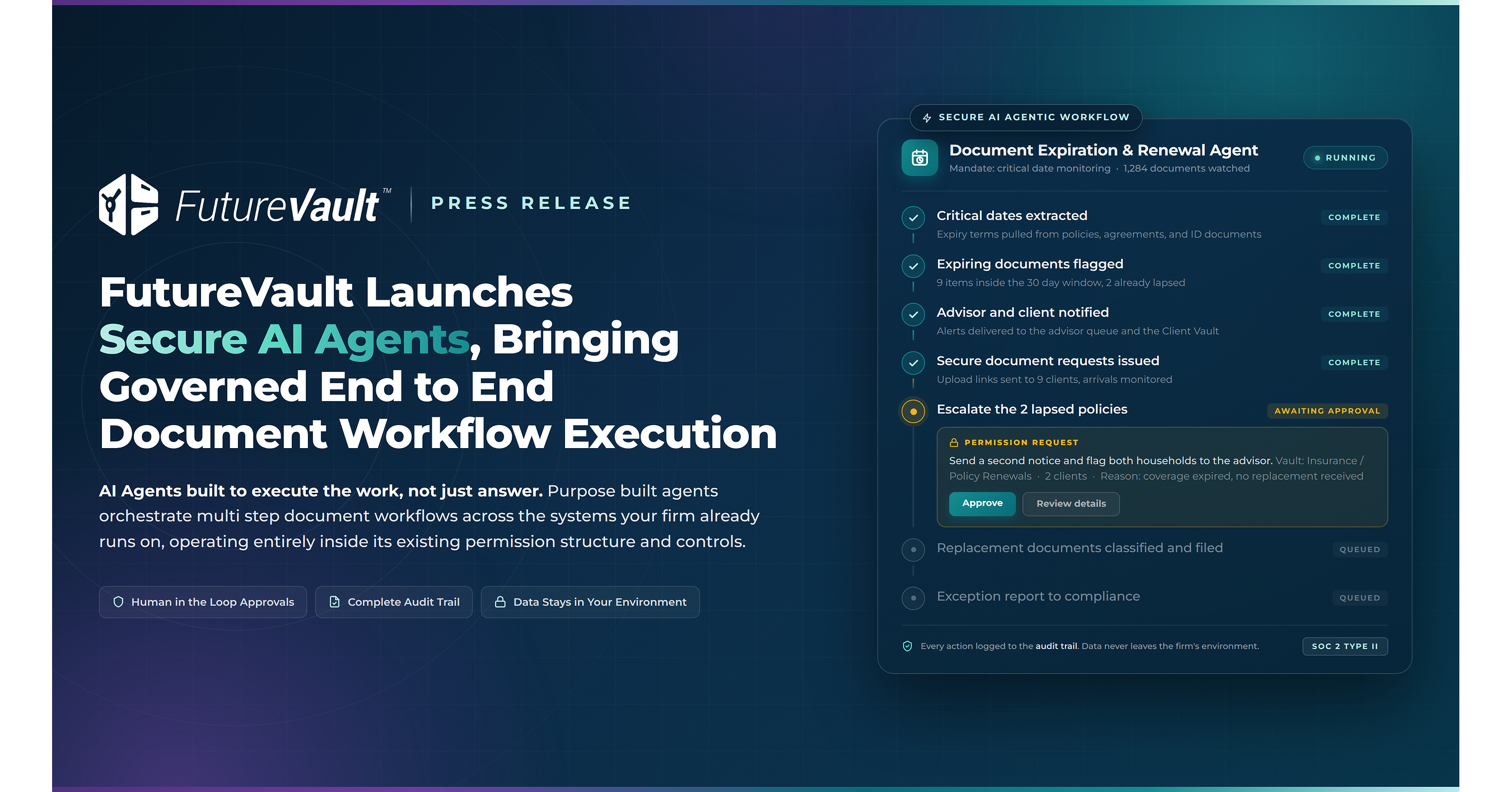
FutureVault launched AI Agents for BFSI enterprises to automate multi-step, compliance-driven document workflows while retaining firm permission controls, audit trails and human escalation for exceptions. The agents target documented operational bottlenecks including client records entered across seven or more systems and onboarding processes lasting roughly three weeks. The release is FutureVault's third major AI-infrastructure launch in six months and expands its platform from document intelligence toward governed end-to-end workflow orchestration.
Analysis
This is not directly investable, but it reinforces a selective read-through for incumbent workflow vendors with regulated-data moats rather than broad AI software. The economic value sits in reducing exception handling and audit-preparation labor; vendors able to demonstrate lower error rates and shorter implementation cycles can convert AI pilots into recurring platform revenue. Public beneficiaries include SS&C Technologies (SSNC), Envestnet (ENV), Broadridge (BR), and Roper-owned financial workflow assets, though each needs evidence that agent functionality drives net retention rather than merely defends existing contracts.
The key competitive pressure is on horizontal automation and generic copilots. Microsoft (MSFT), Salesforce (CRM), ServiceNow (NOW), UiPath (PATH), and OpenText (OTEX) have larger distribution but face higher permissioning, data-lineage, and liability hurdles in regulated workflows; a vertical specialist can win where a bad autonomous action carries supervisory risk. Conversely, well-capitalized incumbents can bundle comparable features into existing CRM, records-management, and compliance relationships, making standalone vendors vulnerable to procurement compression.
Over the next 1-3 months, monitor enterprise deployment disclosures, implementation duration, and whether customers expand from document intake into money-movement-adjacent workflows. The critical falsifier is not model performance but measurable adoption: no uplift in net revenue retention, paid workflow volume, or professional-services-to-subscription conversion would indicate this remains a feature announcement. Over 6-18 months, regulators' acceptance of auditable human-in-the-loop workflows could broaden the addressable market, while any high-profile permissioning or document-extraction failure would sharply raise sales-cycle friction across the category.
Contrarian view: governance-heavy agent architectures may be economically more valuable than fully autonomous agents, but they also preserve approval bottlenecks. The market may over-credit stated labor savings before firms redesign operating procedures; initial deployments could shift work from data entry to exception review, limiting near-term margin expansion for customers and near-term usage monetization for vendors.
AllMind Terminal
AI-powered research, real-time alerts, and portfolio analytics for institutional investors.
Request TrialMarket Sentiment
Overall Sentiment
moderately positive
Sentiment Score
0.48
Key Decisions for Investors
- No immediate directional trade from this private-company release; treat as a watch signal pending independently disclosed paid deployments or public-peer commentary on regulated AI workflow attach rates.
- Watch SSNC and BR for 1-2 quarters as higher-quality regulated-workflow proxies; add only if earnings show improving recurring revenue growth or retention attributable to AI/compliance modules. Thesis fails if implementation costs rise faster than subscription growth.
- Consider a 6-12 month relative-value basket long SSNC/BR versus short PATH only after valuation and revenue-momentum confirmation: vertical compliance distribution should monetize more reliably than horizontal automation if regulated buyers prioritize auditability. Avoid initiating if PATH reaccelerates enterprise ARR or reports material regulated-industry wins.
- Set an alert around SEC/FINRA enforcement or guidance concerning AI recordkeeping, supervision, and money-movement controls. Clear acceptance of logged approval workflows is a category catalyst; enforcement tied to automated document or approval failures would favor established compliance incumbents and impair smaller vendors.
More News
- What investors need to know about Alphabet's stock-busting earnings report
- Our next steps for Alphabet stock after earnings disappoint at nearly every turn
- Budget 2026 speech
- Fortinet’s stock is taking a dive after earnings. Here’s why.
- The UK cuts energy bills, taxes banks and boosts defense in high-stakes budget
- Microsoft's Big Bets on AI Start to Pay Off