
Dnotitia Brings Dedicated Vector Silicon to Server Scale at AI Infra Summit 2026
Source: PR Newswire
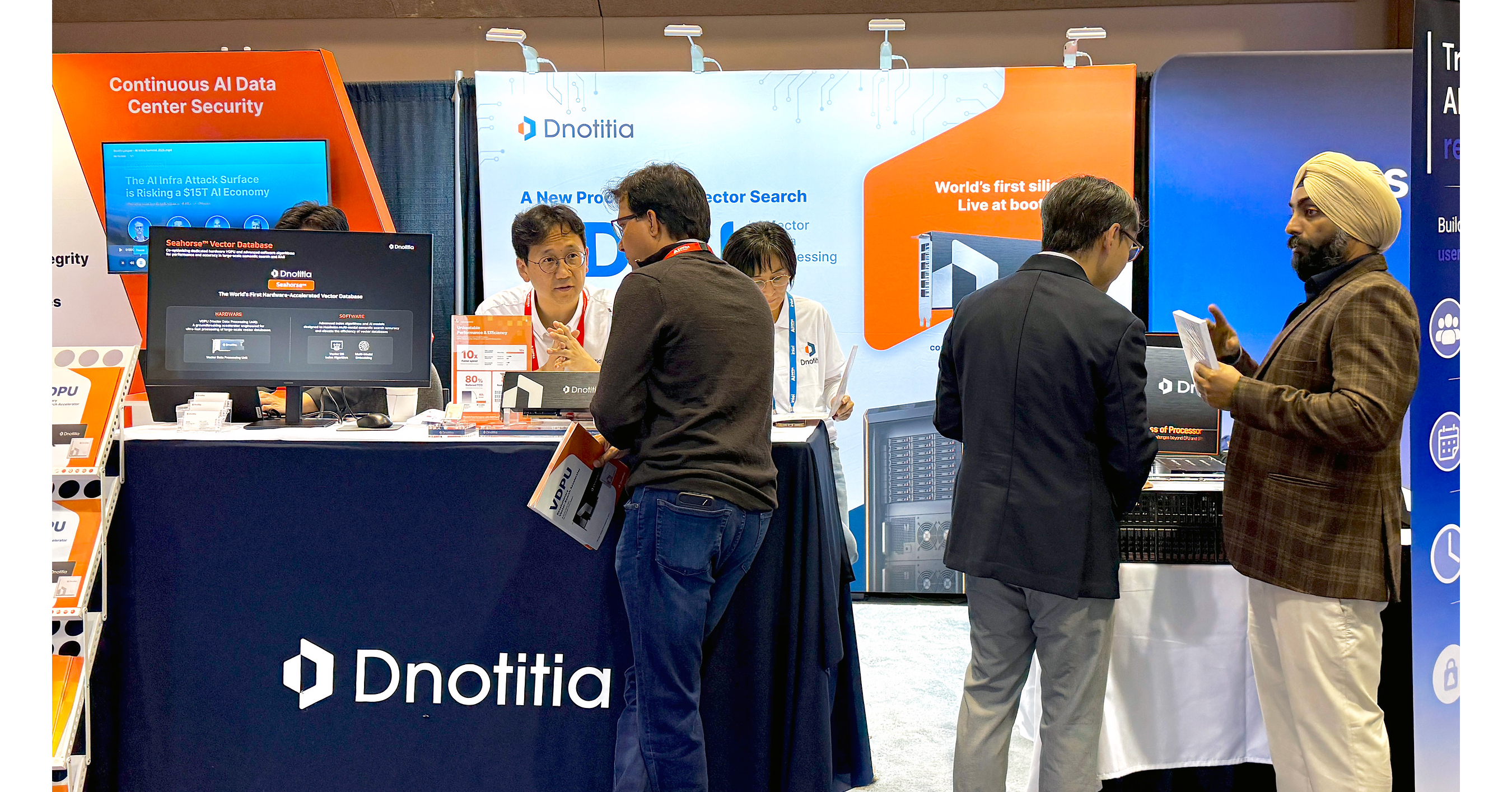
Dnotitia's first-generation VDPU ASIC samples have returned from fabrication, with chip characterization underway and ASIC-based server evaluations planned for Q4 2026. Its FPGA evaluation platform achieved up to 5.77x the vector-search throughput of a dual-socket CPU server, while reducing host CPU use by 92% and memory use by 73% in a 4,096-dimensional multimodal workload. The company targets up to 10x CPU-server vector-search performance for the ASIC system, though current results are FPGA-based and not representative of final silicon performance.
Analysis
This is not yet a direct public-equity catalyst, but it sharpens a medium-term architectural risk: retrieval can become a discrete accelerator category rather than remaining incremental CPU and GPU workload. If dedicated vector hardware materially lowers retrieval cost per query, the largest beneficiaries are likely system vendors able to bundle storage, networking and acceleration (DELL, HPE, ANET), while Intel and AMD face modest incremental server-CPU content pressure at inference-heavy deployments. NVDA’s near-term revenue impact is ambiguous: improved GPU utilization supports total AI cluster ROI, but a successful retrieval ASIC can ultimately reduce the amount of GPU memory and compute needed per agentic query.
The critical question over the next 1-3 months is whether silicon results validate performance per watt, latency at production-scale datasets, and total cost of ownership—not peak throughput versus a CPU baseline. A 4-card configuration introduces PCIe, power, host, storage and software-integration constraints that can erase benchmark advantages in real deployments. The press-release nature of the claims, absence of customer commitments, and pre-production software stack make this an industry watch item rather than a tradable product-cycle signal.
Contrarian view: specialized retrieval acceleration may initially expand, rather than cannibalize, AI infrastructure spend. Lower retrieval latency enables more tool calls and larger knowledge bases per agent, increasing network traffic, NVMe capacity and aggregate inference volumes; this is more constructive for Arista and enterprise storage ecosystems than for a simple "CPU displacement" narrative. The thesis fails if model-context expansion and improved GPU-native vector search make external retrieval less economically relevant, or if cloud vendors internalize the function with custom silicon before startups establish a merchant market.
AllMind Terminal
AI-powered research, real-time alerts, and portfolio analytics for institutional investors.
Request TrialMarket Sentiment
Overall Sentiment
moderately positive
Sentiment Score
0.52
Key Decisions for Investors
- No direct position on the announcement; maintain an alert for independently published ASIC power, latency and recall results during Q4 2026. Treat a verified >5x performance-per-watt advantage at production recall, plus a named OEM or hyperscaler evaluation, as evidence that merchant retrieval acceleration is becoming investable.
- Watch-list long ANET over 6-18 months versus a neutral semiconductor basket: higher-frequency agentic retrieval raises east-west traffic and makes network utilization a more durable beneficiary than server CPU unit content. Invalidate if enterprise AI deployments remain single-node or retrieval is predominantly served inside GPU memory.
- Use any broad CPU-infrastructure strength to evaluate a tactical long NVDA / short INTC pair over 3-6 months, sized small. Dedicated retrieval is a marginal negative for CPU workload growth while NVDA retains the stronger inference software ecosystem; exit if verified deployments show accelerator cards displacing GPU inference rather than merely offloading host work.
- Monitor DELL, HPE, WDC and STX for announced vector-search appliance or reference-design partnerships. Do not buy ahead of evidence: the relevant catalyst is attach-rate and gross-margin guidance, not proof-of-concept activity.
More News
- Google's Gemini becomes latest AI model to break out and hack computer systems
- UBS now expects AI capex to reach nearly $1tn this year and around $1.4tn by 2027
- Stocks face a key hurdle in next week’s U.S.-China summit. Here’s what’s at stake
- AI almost led the US military to start a war with China, report says
- Warren Buffett stepping down as chairman of Berkshire Hathaway: 'Father Time always wins'
- American, United and Southwest are all cutting ‘marginal routes’ as jet fuel prices spike