
Piezo Direct Announces the World's Most Advanced Mesh-Based Piezo Atomizer for Nebulizing and Vaping Applications
Source: PR Newswire
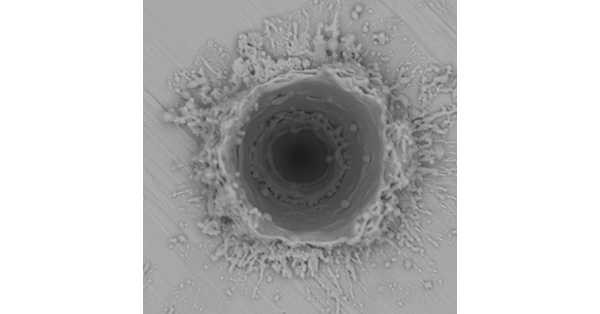
Piezo Direct launched a titanium mesh piezo atomizer for nebulizer, inhaler and vaping applications with 2.0-2.5 micron laser-drilled holes held to ±0.3 microns. Its proprietary post-process removes laser-drilling recast debris and spatter, while the resulting aerosol achieves a 3.0-4.2 micron mass median aerodynamic diameter suited to lower-respiratory delivery. The product is available now, with future development targeting sub-1.5-micron holes and full inline inspection.
Analysis
This is not yet a listed-equity catalyst; it is a supplier capability claim without disclosed customer wins, qualification status, yield, unit economics, or regulatory validation. The near-term implication is primarily competitive: tighter aerosol-size control and particulate reduction could raise validation burdens for incumbent mesh suppliers and device OEMs if clinical or regulatory teams begin treating mesh cleanliness as a documented design-control requirement rather than a component-level specification.
For 1-3 months, monitor whether established respiratory-device vendors such as PHG, RMD, VAPO, and privately held nebulizer OEMs reference mesh durability, particle shedding, or aerosol consistency in filings, recalls, adverse-event databases, or new-product materials. A verified shift toward titanium mesh and tighter tolerances would favor specialized precision-drilling, piezoelectric, and titanium-processing supply chains, but the likely economic value accrues only after design-in cycles that typically run 12-36 months.
The contrarian view is that the technical advantage may be commercially irrelevant in regulated drug delivery. Finished-device aerosol performance, formulation compatibility, dose uniformity, cleaning protocols, and clinical evidence dominate procurement decisions; a superior mesh plate alone will not displace qualified components unless it reduces total device validation cost or enables a differentiated drug-delivery label. The company’s vaping opportunity is also less attractive than it appears: regulatory scrutiny and declining category economics may constrain adoption despite safety improvements.
Falsification of the strategic thesis would be absence of named OEM design wins or third-party aerosol/particulate data within 6-12 months, or evidence that conventional meshes meet regulatory requirements at materially lower cost. Conversely, an FDA device filing, a major respiratory OEM supply agreement, or independently measured lower particulate release would convert this from technical publicity into a potentially material supply-chain signal.
AllMind Terminal
AI-powered research, real-time alerts, and portfolio analytics for institutional investors.
Request TrialMarket Sentiment
Overall Sentiment
moderately positive
Sentiment Score
0.42
Key Decisions for Investors
- No immediate directional trade: the announcement lacks a public ticker, revenue contract, pricing data, and independently validated performance; treat as a watch-item rather than a catalyst.
- Set a 6-12 month alert for PHG, RMD, and VAPO disclosures involving vibrating-mesh nebulizers, inhalation-device recalls, or component-supply changes. Consider relative longs only after a named design win demonstrates that higher-spec mesh supports premium pricing or reduces warranty/validation expense.
- For respiratory-device exposure, prefer a conditional long PHG or RMD versus a broad medtech hedge only if next earnings show portable-nebulizer growth or gross-margin expansion tied to consumables/device mix; invalidate on respiratory-segment guidance cuts or evidence of price-driven commoditization.
- Avoid extrapolating the technology into vaping equities without customer confirmation. Any safety-led adoption thesis is vulnerable to regulatory restrictions and weak category demand, which can outweigh component-level product differentiation.
More News
- What investors need to know about Alphabet's stock-busting earnings report
- Our next steps for Alphabet stock after earnings disappoint at nearly every turn
- Wendy's shares jump 15% as Nelson Peltz's Trian offers $1.4 billion to buy burger chain
- Fortinet’s stock is taking a dive after earnings. Here’s why.
- RBC Capital cuts Sprouts Farmers Market stock rating on margin concerns
- Microsoft's Big Bets on AI Start to Pay Off
From AllMind Research
- AllMind Platform Feature Updates - Fall 2026
- AI Credit Covenant Monitoring: From Clause to Review
- AI-Led Expert Interviews vs. Transcript Libraries
- Augmented Intelligence: AllMind, Elevate Human Judgement With an Accessible, Powerful, Data-Driven Financial AI Toolkit
- Choosing an AI Copilot for Equity Research