
Happy Money's 2026 Credit Check-In Reveals Growing Divide in Americans' Financial Progress and the Influence of AI in Financial Decision-Making
Source: PR Newswire
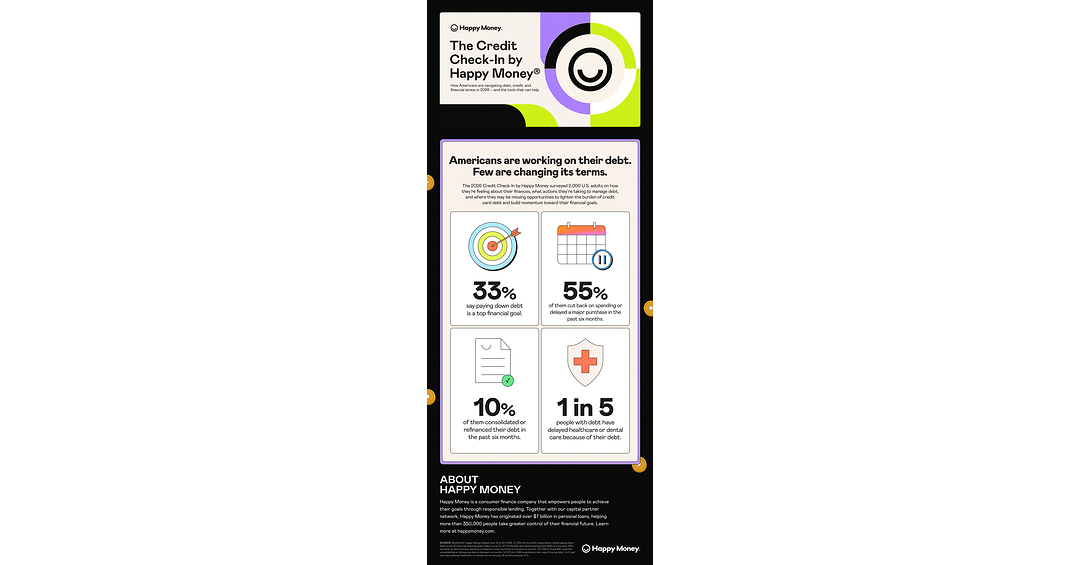
Happy Money's survey of 2,000 U.S. adults found that 41% carry credit-card debt and 75% of indebted respondents are concerned about interest rates, underscoring continued consumer pressure in a high-rate environment. Financial security is increasingly uneven: 45% of households earning $100,000 or more feel more secure than a year ago, versus 29% of lower-income households, while 20% of debt holders have delayed healthcare or dental care. AI is becoming a supplemental financial-advice source, trusted by 13% of Americans, but only 14% of AI users rely on it alone.
Analysis
This is a weak but directionally negative read-through for discretionary categories exposed to middle-income households: the relevant transmission is not aggregate confidence but the marginal consumer diverting cash flow toward revolving-debt service. Over the next 1-3 months, watch credit-card delinquency and payment-rate trends at COF, SYF, DFS and AXP alongside retailer commentary from TGT, BBY and WMT; a widening gap between resilient affluent spending and pressured subprime/mid-prime demand favors premium and value share takers over broad consumer-discretionary exposure.
The more investable second-order effect is credit selection. Consumers who consolidate are likely the more financially engaged borrowers, leaving card issuers with an adverse-selection problem if balance growth increasingly comes from borrowers unable or unwilling to refinance. That raises loss-reserve risk for SYF and COF more than AXP, whose spend base and credit quality skew materially higher; meanwhile, personal-loan originators and securitization buyers benefit only if refinancing volumes rise without deterioration in post-refinance performance.
AI adoption is not yet a monetizable advice-channel signal: low stated trust and continued human validation imply that consumer-facing AI may reduce customer-acquisition and servicing costs before it creates meaningful lending conversion. The survey is commissioned by an interested lender and measures sentiment rather than verified balances, repayment behavior, or credit performance, so it should not independently alter earnings estimates. The thesis is falsified by falling card APRs, sustained normalization in charge-offs, or retailer results showing broad middle-income transaction acceleration rather than trade-down behavior.
Contrarianly, persistent debt anxiety can be modestly constructive for consumption if refinancing lowers monthly payments rather than simply causes spending retrenchment. The key missing data are consolidation approval rates, borrower FICO mix, and payment reduction; absent those, there is no basis to underwrite a broad fintech-originations trade.
AllMind Terminal
AI-powered research, real-time alerts, and portfolio analytics for institutional investors.
Request TrialMarket Sentiment
Overall Sentiment
mildly negative
Sentiment Score
-0.18
Key Decisions for Investors
- Maintain a 3-6 month quality-credit pair: long AXP / short SYF, sized beta-neutral. AXP should retain affluent-spend resilience while SYF has greater exposure to promotional retail credit and reserve sensitivity; reassess if SYF's 30+ day delinquencies stabilize for two consecutive monthly periods or AXP guides to material spend deceleration.
- Avoid adding broad XLY exposure into the next retail earnings cycle; express consumer bifurcation selectively through long WMT versus short TGT for 1-3 months, subject to valuation discipline. Exit if TGT demonstrates sustained comparable-sales and discretionary-category recovery without incremental markdown pressure.
- Set an alert on COF and DFS for monthly delinquency, net charge-off, and payment-rate releases. A simultaneous rise in delinquencies and decline in payment rates would support a tactical short basket; do not initiate solely from survey evidence.
- Watch SOFI and UPST rather than buying them on this release. Upgrade only if quarterly originations rise while weighted-average borrower FICO, net charge-off guidance, and funding costs remain stable; otherwise higher consolidation demand may merely import weaker credit into new channels.
More News
- Oil extends losses as Saudi Arabia reportedly offers ship-to-ship crude transfers after pipeline hit
- Japan’s corporate leaders sound alarm over weak yen — even dollar-earners are voicing concerns
- 'Hostile act': Trump threatens EU with tariffs over Canada associate-membership proposal
- Fed hikes again - an AI-Picked insurer is still cashing in
- Hawkish Fed lifts dollar to seven-week high as focus turn to BOJ
- US official says upcoming spectrum auctions could generate more than $100 billion