
Curative Eliminates Prior Authorization for 86% of MRIs, Making Care Easier to Access While Keeping Costs in Focus
Source: PR Newswire
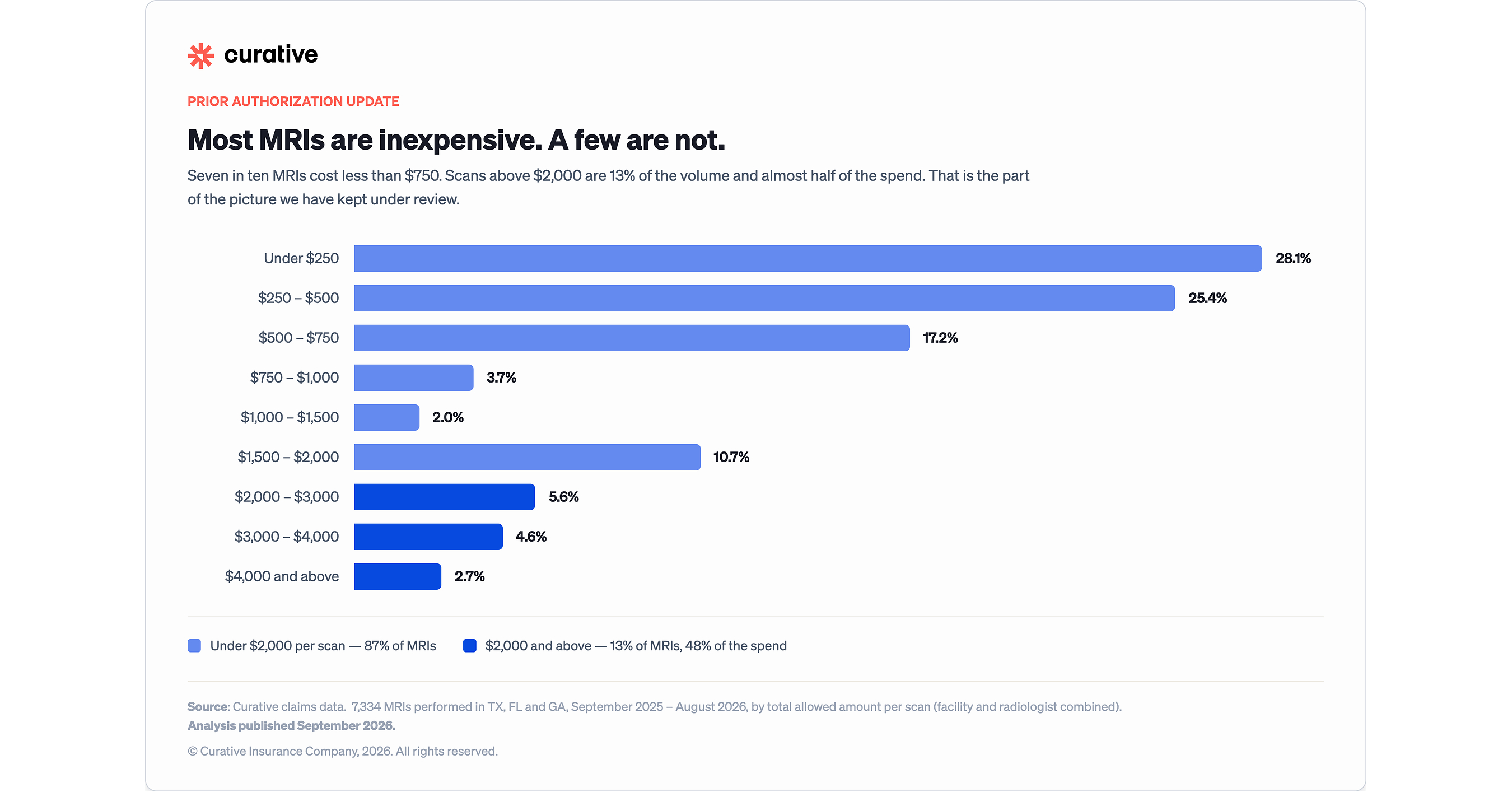
Curative eliminated prior authorization for 86% of MRIs at directly contracted providers and facilities, effective immediately, while retaining controls for sites with documented excessive pricing. Its review of 7,334 MRIs found a $445 median cost and $902 average cost; scans priced at $2,000 or more were 13% of volume but accounted for 48% of spending, driven by 42 facilities. The policy aims to reduce administrative friction for members while concentrating cost-management efforts on high-priced providers.
Analysis
The investable read-through is modestly negative for scaled managed-care incumbents, including UNH, because prior authorization is both an administrative cost-control lever and a source of provider abrasion. Curative's model suggests that price-outlier steering can substitute for broad utilization management in high-variance imaging categories; if replicated, it weakens the industry argument that friction is necessary to contain trend. The direct earnings effect on UNH is immaterial, but the strategic risk is that employers increasingly value demonstrably lower administrative burden alongside medical-cost control.
The more important second-order effect is on imaging-site economics. Hospital outpatient departments and independent facilities with opaque, high contracted MRI rates face greater exclusion, referral diversion, or more burdensome authorization requirements, while efficient independent imaging operators could gain volume as payers steer members toward lower-cost networks. This may compress high-margin ancillary imaging revenue at hospital systems over the next 6-18 months, although there is no evidence that Curative's limited geographic footprint alone can move public hospital earnings.
Near term, this is not a standalone UNH trade catalyst. The 1-3 month signal is whether larger carriers disclose targeted prior-authorization removals paired with site-of-care or reference-pricing programs; that would indicate a competitive shift rather than a marketing initiative. The thesis is falsified if reduced authorization produces materially higher MRI utilization or downstream specialist/procedure spend, demonstrating that administrative review was suppressing unnecessary care rather than merely redirecting expensive sites.
AllMind Terminal
AI-powered research, real-time alerts, and portfolio analytics for institutional investors.
Request TrialMarket Sentiment
Overall Sentiment
mildly positive
Sentiment Score
0.38
Ticker Sentiment
Key Decisions for Investors
- No standalone position in UNH on this announcement; maintain an alert for 2027 benefit-design disclosures and employer win/loss commentary showing simplified prior authorization as a competitive differentiator.
- For hospital exposure, scrutinize outpatient imaging revenue and commercial-price realization at HCA and large nonprofit-system bond issuers over the next 2-4 quarters; avoid treating MRI price dispersion as isolated if payers expand targeted network steering to CT, PET, and infusion services.
- Monitor UNH's medical-care ratio and Optum provider-contract commentary for evidence that authorization reductions are offset by narrower price controls. A sustained deterioration in utilization without a corresponding unit-cost reduction would invalidate the operationally favorable interpretation.
- Potential relative-value watch: long efficient independent imaging/service providers versus hospital outpatient-exposed operators only after confirmation of payer steering contracts or volume data. Required missing data are payer market share, contracted facility rates, and referral-volume migration; absent these, risk/reward is not yet actionable.
More News
- South Korean solar stocks jump as curbs on Chinese sector expected to remain in place
- Trump Says US Team Met With Iranians at UNGA
- Meta is breaking out after introducing Muse AI agent. Where the stock is going, according to the charts
- Heidi CEO on AI in Healthcare, $900M valuation
- Australia’s IDP shares drop after rejecting $494 mln Blackstone offer
- Meta’s Muse AI is exploding in popularity—and already drawing heated backlash from another tech giant
From AllMind Research
- Anthropic IPO Preview: Valuation, Timing, and What to Watch
- Shein After the IPO: Venue, Valuation, and What Must Be Proved
- What AI Research Tools Should a Small Hedge Fund Buy First?
- Index and ETF Holdings Data for AI Research
- Capital Intensity as Gravity: The AI Trade Enters Its Industrial Era (Looking at Q3 2025 Earnings in Tech)