
AlphaESS umacnia swoją pozycję na rynku magazynowania energii w regionie Adriatyku podczas Targów Zielonej Energii 2026
Source: PR Newswire
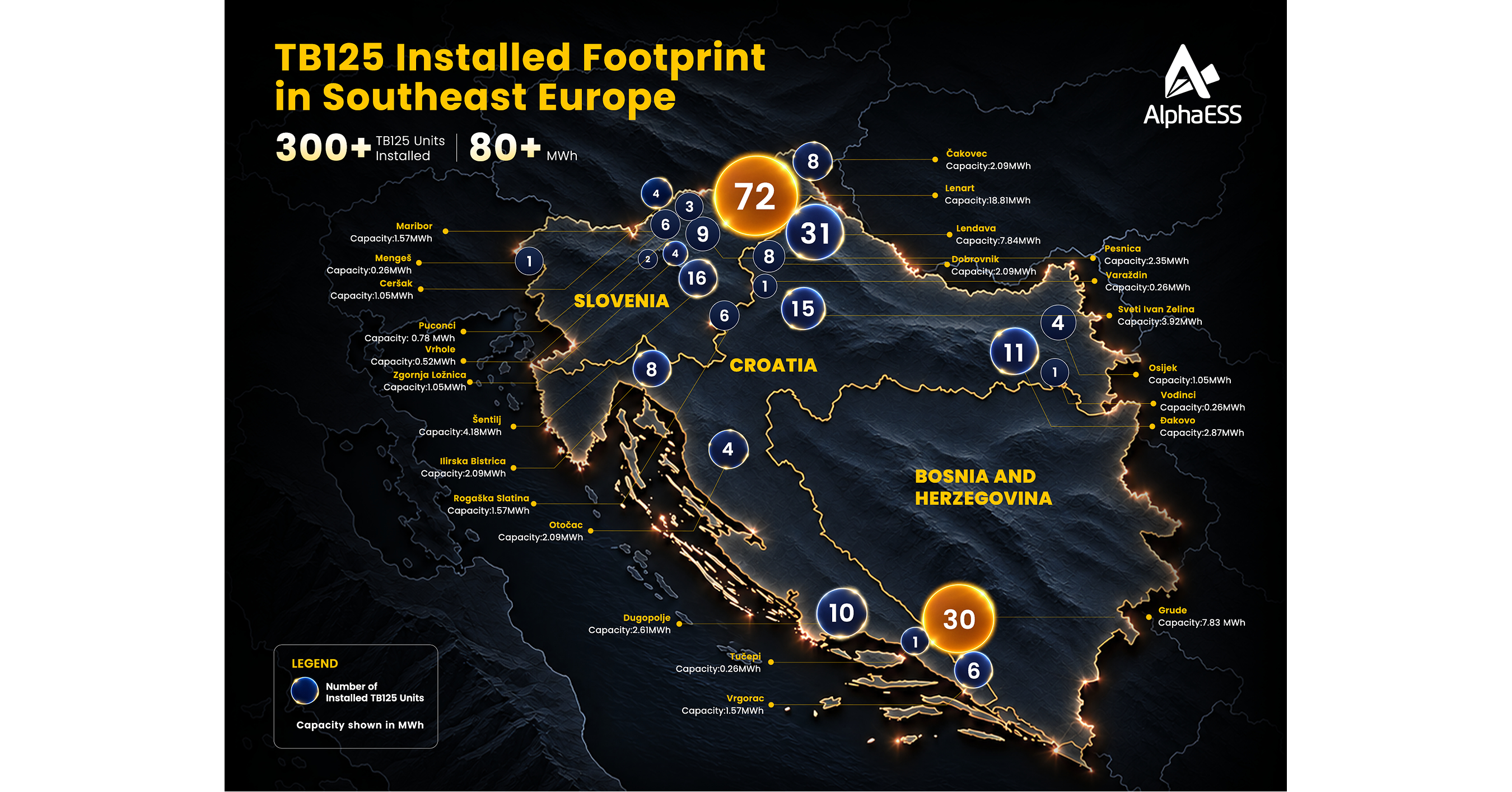
AlphaESS said it has installed more than 300 TB125 systems, each rated at 125 kW/261 kWh, in Croatia, Slovenia and Bosnia and Herzegovina, with combined storage capacity exceeding 80 MWh. The company said more than 100 TB125 units were delivered in Croatia in 2026, primarily for grid-frequency regulation projects. At the Zagreb trade fair, AlphaESS also unveiled its TB150 in Croatia and introduced the Aster 6260; it cited 91.7% round-trip efficiency for the TB150.
Analysis
The investable signal is not the product launch; it is whether Adriatic grid-balancing markets can turn installed batteries into repeatable, financeable cash flows. If frequency-response procurement expands, the second-order winners may be project developers, integrators, and EMS providers able to guarantee availability and optimize dispatch—not simply the lowest-cost cell supplier. Conversely, more storage can compress ancillary-service prices as competing capacity enters, weakening returns on later projects even while deployment accelerates.
AlphaESS’s regional traction is a useful validation point for the market, but a trade signal is weak: the source is a company announcement, provides no contract values, utilization, realized revenue, margins, or independently verified pipeline, and no issuer ticker is supplied. Product efficiency and lifetime-energy claims do not establish project-level economics; warranty terms, degradation, cycle assumptions, and system boundary need verification. Competition from established integrators such as Fluence, Wärtsilä, and Tesla could intensify procurement pressure, while local installers and grid-service aggregators may capture value through execution and market access.
Near term (days), limited fundamental repricing is warranted. Over 1–3 months, watch Croatian and neighboring-market tenders, ancillary-service rules, connection queues, and disclosed project awards. Over 6–18 months, the key structural test is whether storage revenues remain attractive after new capacity lowers balancing prices. Contrarian risk: optimism about deployment may overlook revenue cannibalization and financing dependence on volatile service markets. No mapped public security offers direct AlphaESS exposure.
AllMind Terminal
AI-powered research, real-time alerts, and portfolio analytics for institutional investors.
Request TrialMarket Sentiment
Overall Sentiment
mildly positive
Sentiment Score
0.35
Key Decisions for Investors
- Do not trade the announcement alone. Treat it as a regional demand datapoint, not evidence of AlphaESS revenue or profitability; no direct ticker is available in the supplied identities.
- Set an alert for verifiable Adriatic storage awards and changes to frequency-response procurement, clearing prices, and eligibility rules. Reassess listed storage integrators, including Fluence and Wärtsilä, only if contract flow and economics become observable.
- For any prospective long in storage suppliers, require evidence on backlog conversion, project gross economics, warranty/degradation assumptions, and recurring EMS or service revenue. Falsify the growth thesis if balancing prices fall materially or procurement volumes fail to expand.
- Monitor battery-system pricing and commissioning timelines: lower equipment costs support project returns, but aggressive bidding, connection delays, or falling ancillary-service revenues can offset that benefit. No options or pair trade is justified on this release alone.
More News
- What Wall Street billionaires are saying about Democrats' midterm sweep
- NextDC shares surge 43% after Goodman, Digital Realty stake purchases
- Oil and data centre stocks sink after US midterms
- Qualcomm issues disappointing earnings forecast as memory shortage weighs on smartphone sales
- China Blocks SoftBank Acquisition of ABB Robot Unit, FT Says
- After the midterms, a bigger clash over data centers could be coming