
Mako Mining Announces Q3 2026 Production Results with Gold Recovered of 12,743 oz Au (Sales of 11,581 oz Au), and Positive Permitting Updates at Mt. Hamilton and San Albino
Source: Newswire
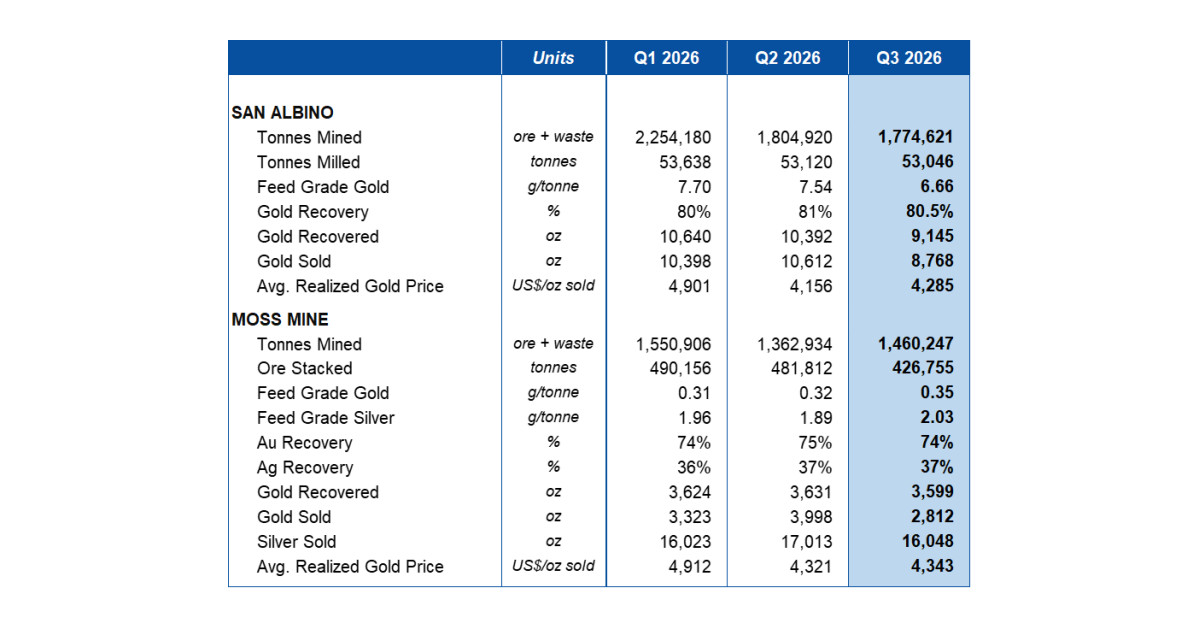
Mako recovered 12,743 oz of gold and sold 11,581 oz in Q3 2026, generating approximately $50 million in revenue; cash, securities and trade receivables totaled $119.3 million at quarter-end. San Albino recovered 9,145 oz, while Moss recovered 3,599 oz amid plant constraints and lower solution availability; a crushing upgrade is expected to lift Moss throughput above 12,000 short tons per day by Q3 2027. Mt. Hamilton received permits for condemnation drilling, with first gold pour anticipated in December 2027, and Mako expects to submit Eagle Mountain’s final ESIA in Q4 2026.
Analysis
The key underwriting issue is conversion of operating promises into cash, not the reported quarter. At San Albino, a lower-grade feed mix and a large, lower-grade stockpile create a near-term production-quality risk: sustained output depends on returning to higher-grade vein material, while drawing stockpiles can support throughput but dilute ounces per tonne. At Moss, the proposed step-change in crushing capacity is a material upside option, but the gap between current throughput and the target makes execution—not the target itself—the catalyst. Verify commissioning, recoveries, and unit costs before capitalizing the forecast into valuation.
Over days, the gold price and headline cash balance may dominate sentiment. Over 1–3 months, Q4 sales should test whether Moss’s deferred ounces convert to cash and whether San Albino maintains grade. Over 6–18 months, Moss ramp-up and Mt. Hamilton construction are the consequential drivers; any delay, cost overrun, or permitting slippage would weaken management’s claim that cash plus operating flow covers development. Eagle Mountain’s ESIA comments and approval timing remain a separate permitting risk.
Contrarian angle: strong gold pricing can mask weak operating leverage if ounces recovered do not translate promptly into sales and free cash flow. The stated realized prices are before Sailfish adjustments, so do not model them as net revenue per ounce. Sailfish Royalty (FISH) may benefit from stream deliveries, but the contract economics are not provided; quantify its sensitivity only after reviewing the agreement. No defensible valuation-based entry is available from this release alone.
AllMind Terminal
AI-powered research, real-time alerts, and portfolio analytics for institutional investors.
Request TrialMarket Sentiment
Overall Sentiment
mildly positive
Sentiment Score
0.18
Ticker Sentiment
Key Decisions for Investors
- MKO: avoid chasing the forward Moss production target; consider a staged long only after the next operating update confirms throughput improvement and Q4 sales demonstrate conversion of deferred ounces. Falsify the thesis if throughput remains near recent levels or the ramp schedule slips.
- Track San Albino mined grade, feed mix, recovery, and stockpile tonnes together. A falling stockpile without a recovery in vein contribution would signal production support is being borrowed from future periods.
- Before underwriting development funding, verify project-level capex, remaining commitments, and cash-flow forecasts; the headline cash figure alone does not establish that both builds can be funded without dilution or schedule trade-offs.
- FISH: watch, rather than trade on this release alone. Obtain the stream’s pricing, delivery, and volume terms to assess how the reported deliveries affect royalty revenue and sensitivity to gold prices.
More News
- BlackRock, GIC among investors chasing Indian telecom major Jio's IPO as anchor bids top $26 billion
- Nscale, Anthropic Eye $45 Billion Cloud Deal as AI Trade Rebounds
- Copper Holds Drop as Traders Gauge Risks From US Tariff Policy
- Gartner analyst behind tech rout: AI returns are not yet large enough to justify neocloud build-out
- Saudi Arabia cancels 2026 ‘Davos in the Desert’ amid Houthi attacks
- Walmart’s Flipkart is quietly building a food delivery challenger in India