
YIKEDA™ accélère son expansion internationale lors du salon ASIA FRUIT LOGISTICA 2026 : Renforcement des partenariats, lancement de tomates cerises exclusives dotées d'un label de traçabilité
Source: PR Newswire
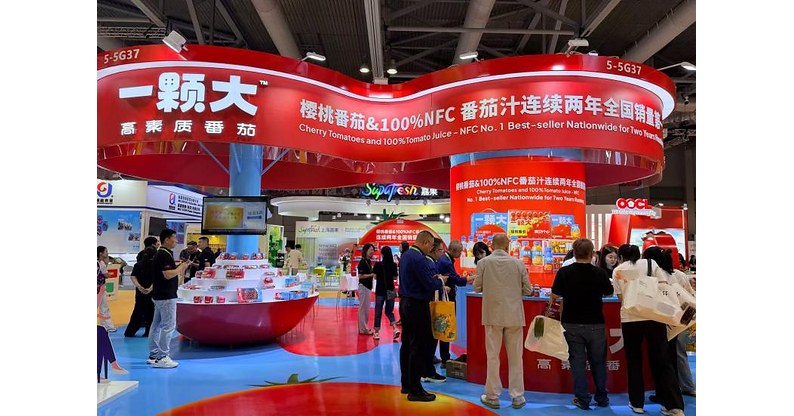
YIKEDA showcased its full tomato product range at Asia Fruit Logistica 2026 and debuted cherry tomatoes with an exclusive traceability label, positioning the offering around food-safety transparency. The brand, founded in 2022, supplies products from 267 hectares of smart glass greenhouses and has expanded sales to Hong Kong, Macau, the U.S., Canada, Russia and several Southeast Asian markets. YIKEDA said its cherry tomatoes and 100% NFC tomato juice were China sales leaders for two consecutive years, according to Frost & Sullivan, and it plans further international distribution expansion.
Analysis
This is not yet an investable public-equity catalyst: the issuer is privately held, the release provides no export revenue, contracted volumes, pricing, capex, or distributor commitments, and the claimed market-position data is not sufficient to establish incremental earnings power. The near-term read-through is limited to a modest validation of premium, traceable produce demand in Asian urban retail rather than a material shift in listed consumer staples or agriculture valuations.
The more relevant second-order signal is that controlled-environment agriculture is pursuing branding and food-safety premiums to offset structurally high energy, depreciation, and logistics costs. If premium tomatoes can sustain sell-through outside China, greenhouse operators may gain utilization and price stability; if not, export expansion adds working-capital, spoilage, FX, and cold-chain risk without resolving fixed-cost leverage. For listed proxies, this is directionally supportive of premium produce distribution and cold-chain logistics, but too immaterial to alter estimates.
Over 6-18 months, the key question is whether traceability becomes a procurement requirement among Hong Kong, Southeast Asian, and North American retailers. That could favor scaled branded suppliers over fragmented open-field producers, but it also lowers differentiation as large competitors replicate QR-based provenance systems. The contrarian view is that traceability is marketing rather than a durable moat; retailer private labels can appropriate the concept and pressure supplier margins.
Monitor import registrations, retailer shelf placements, repeat orders, and realized export pricing versus domestic pricing before assigning value to the international narrative. Falsification of any bullish controlled-environment read-through would be persistent wholesale tomato-price weakness, elevated Chinese power costs, or evidence that export channels require discounting and extended receivables.
AllMind Terminal
AI-powered research, real-time alerts, and portfolio analytics for institutional investors.
Request TrialMarket Sentiment
Overall Sentiment
moderately positive
Sentiment Score
0.42
Key Decisions for Investors
- No immediate trade recommendation; treat this as a watch item rather than a catalyst for listed equities given the absence of a public issuer, disclosed financials, or identifiable contract economics.
- For existing AgTech/controlled-environment exposure, require evidence of export volumes and realized premium pricing over the next 2-3 quarters before increasing risk; do not underwrite a valuation re-rating solely on trade-show demand.
- Set an alert for listed cold-chain and produce-distribution companies with meaningful Greater China/Southeast Asia exposure if retailers begin mandating traceability standards; the investable signal would be disclosed capex, multi-year procurement agreements, or measurable margin expansion rather than product-launch publicity.
More News
- Here’s the ‘core economic flaw’ in the AI bull case as stock and bond trades unravel, according to a top economist
- How Pepsi fell behind in the cola wars—and then lost KFC
- 5 big analyst AI moves: ’Uniquely catalyst-rich’ months ahead for SpaceX
- First Russian diesel tanker heads to New York after Trump's deal with Putin to lower fuel prices
- Qatar official calls for peace and security to boost trade, investment
- The experience economy keeps defying expectations. Maybe we’ve been looking at it all wrong