
Responding more frequently to MiniMed Smart MDI alerts linked to better glucose outcomes for people with diabetes
Source: PR Newswire
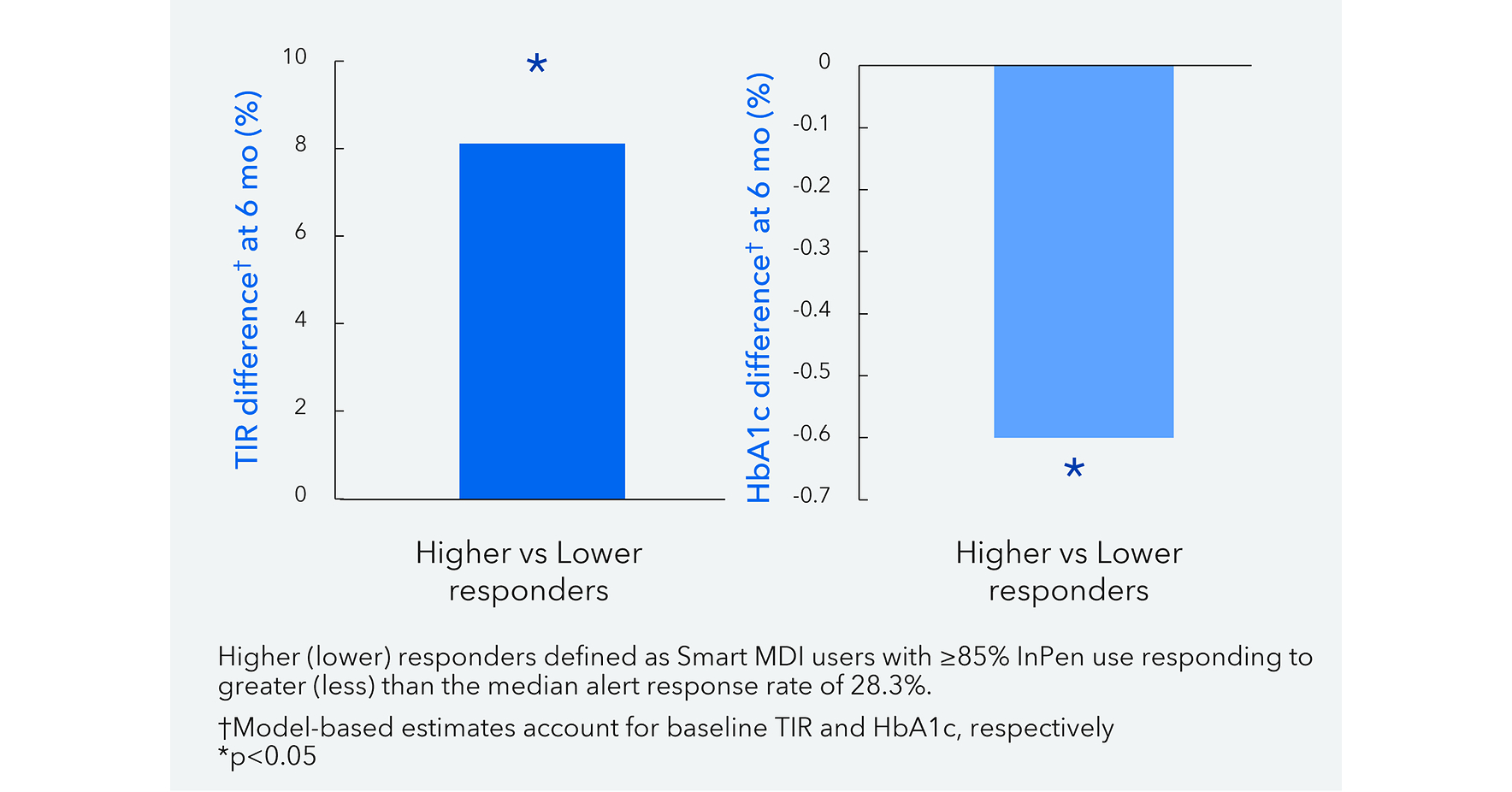
In a six-month randomized trial of 143 people with type 1 diabetes and HbA1c above 8%, higher responders to MiniMed Smart MDI alerts averaged 8.1 percentage points more Time in Range and 0.6 percentage points lower HbA1c than lower responders. A separate real-world analysis of more than 5,500 users found a 9.4-point Time in Range difference; HbA1c was not analyzed in that dataset. The system met its primary endpoint and was non-inferior to injections plus continuous glucose monitoring in glycemic outcomes, with no severe hypoglycemia or diabetic ketoacidosis events reported in the Smart MDI arm.
Analysis
The investable signal is product engagement, not the clinical delta by itself. Comparing higher with lower alert responders is not a randomized test of responding: motivation, device comfort, and baseline behavior may explain part of the gap. The trial’s overall non-inferiority result also limits the claim that the system improves outcomes for the average user versus MDI plus CGM. Treat the responder analysis as evidence for a retention/adherence mechanism, not proof of broad incremental efficacy.
For MiniMed Group (MMED), the upside path is better conversion and persistence if the unified app reduces friction and clinicians use its reports to reinforce engagement. The counterpoint is that alert response is the product’s active ingredient: weak uptake or rapid alert fatigue could prevent clinical separation and constrain pricing or reimbursement leverage. The MDI format could also retain patients who would otherwise consider pumps, but it may cannibalize MiniMed’s own delivery ecosystem; the net effect depends on customer migration, not this study alone. Abbott (ABT) is a potential sensor-side beneficiary through the named sensor integration, but the release gives no attach-rate or revenue evidence. Do not attribute this product evidence to Medtronic (MDT).
Near term, the announcement may support MMED sentiment, but it does not establish material revenue or valuation impact. Over 1–3 months, look for launch/access data and clinician adoption; over 6–18 months, persistence and repeat use determine whether the adherence mechanism scales. The contrarian risk is that markets capitalize responder outcomes as if they were average-user outcomes. Falsify the adoption thesis if usage/persistence remains weak or later evidence fails to show benefit in the broader user base.
AllMind Terminal
AI-powered research, real-time alerts, and portfolio analytics for institutional investors.
Request TrialMarket Sentiment
Overall Sentiment
mildly positive
Sentiment Score
0.30
Ticker Sentiment
Key Decisions for Investors
- No standalone MMED trade on this release: wait for verified prescriptions, active-user growth, persistence, and access/reimbursement evidence before underwriting revenue impact. Treat the clinical subgroup result as supportive, not a forecast.
- Set an alert for the next 1–3 months of launch or earnings disclosures. If adoption and persistence are demonstrably improving, consider a small, defined-risk MMED call spread rather than an unhedged chase; exit the thesis if reported utilization stalls or broader-user outcomes fail to replicate.
- Keep ABT as a watch item, not a trade: verify whether the named sensor integration produces incremental CGM placements or attach rates. No direct implication for MDT is established by this announcement.
More News
- Bernstein cuts Boston Scientific stock price target on device competition
- Samsung, SK Hynix shares drop as Q3 earnings loom
- DeepSeek set to raise at least $12 bln in Tencent, CATL-led round- Bloomberg
- CH Robinson to Buy RXO for $5.8B in Bet on AI Model
- Security researcher claims to they found KVM guest-host escape flaw
- BPCE acquires 7% stake in Spain’s Banco Sabadell
From AllMind Research
- Anthropic IPO Preview: Valuation, Timing, and What to Watch
- Shein After the IPO: Venue, Valuation, and What Must Be Proved
- What AI Research Tools Should a Small Hedge Fund Buy First?
- Choosing an AI Copilot for Equity Research
- Weekly Update: Advanced Search Filters, Redesigned Ticker Dashboard, and Improved Search Experience