
DxCheck Taps Zocdoc to Streamline and Accelerate Patients' Access to Specialist Care
Source: PR Newswire
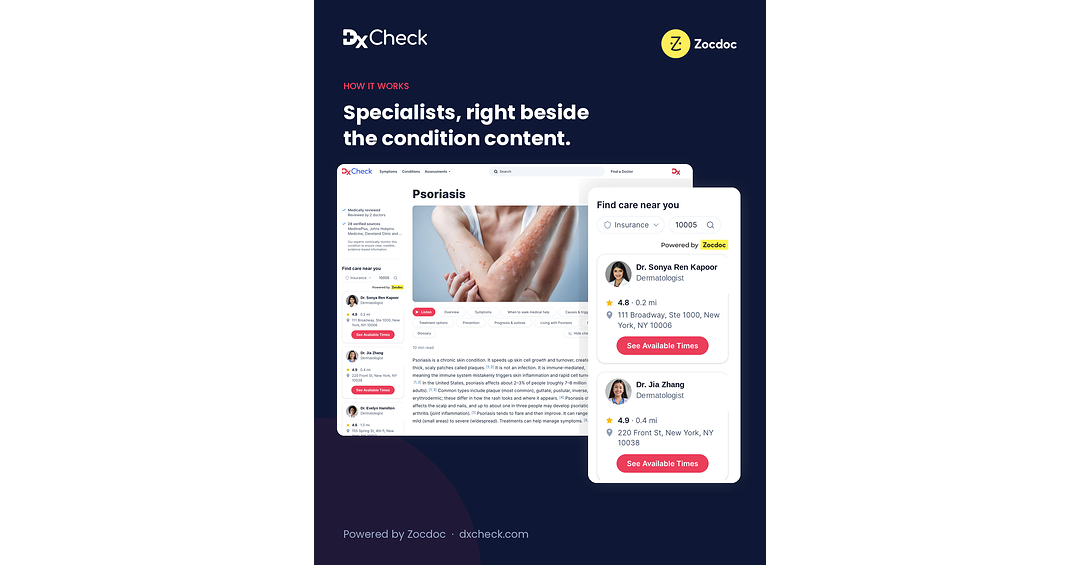
DxCheck partnered with Zocdoc to embed real-time specialist discovery and appointment booking into its health-information platform. Patients can filter providers by insurance and proximity and book, often for same- or next-day visits; Zocdoc says its typical booked appointment occurs within 24 to 72 hours. The partnership expands DxCheck's digital-health workflow from condition research to care access, though no financial terms or revenue impact were disclosed.
Analysis
This is a distribution partnership rather than evidence of durable monetization or clinical engagement. The economic value depends on whether high-intent condition-page traffic converts into incremental completed visits, not bookings, and whether Zocdoc pays a meaningful referral fee after accounting for cancellations and provider-acquisition costs. Without disclosed traffic, conversion, exclusivity, or revenue-share terms, the announcement is not independently actionable for public-equity valuation.
The broader read-through is modestly supportive for consumer healthcare-navigation models: embedding scheduling at the point of health research can raise conversion and reduce patient leakage versus standalone directory products. Over 6-18 months, scaled content platforms that own search or symptom-intent traffic could face greater pressure to add transactional care pathways; this is incrementally relevant to DOCS, TDOC, AMWL and HIMS, though each has materially different monetization and clinical-accountability models. The more important risk is that AI search interfaces and insurer/provider-owned directories increasingly retain this demand upstream, compressing referral economics for independent navigation platforms.
Consensus should resist treating another integration endpoint as proof that appointment-marketplace economics are improving. Provider supply, insurance-data accuracy, no-show rates, and patient acquisition cost determine unit economics; a higher booking funnel can simply shift spending from one channel to another. A meaningful sector signal would require subsequent disclosure of incremental provider yield, completed-visit conversion, or lower customer-acquisition costs rather than partnership volume.
AllMind Terminal
AI-powered research, real-time alerts, and portfolio analytics for institutional investors.
Request TrialMarket Sentiment
Overall Sentiment
mildly positive
Sentiment Score
0.32
Key Decisions for Investors
- No standalone trade: Zocdoc and DxCheck are private, and the release lacks transaction economics, traffic scale, or exclusivity required to underwrite a public-market valuation impact.
- Maintain a 1-3 month watch on DOCS versus TDOC/AMWL: consider long DOCS / short AMWL only if DOCS reports sustained practitioner growth and improving marketing efficiency while AMWL continues declining visit revenue; falsify if DOCS customer-acquisition cost rises or provider retention weakens.
- For HIMS, treat third-party care-navigation expansion as a competitive-intensity monitor rather than an immediate negative. Reassess any long if management signals rising paid-search costs, lower new-subscriber conversion, or slower specialty expansion in the next two earnings reports.
- Create an alert for disclosed referral economics from Zocdoc or major content-distribution partners: completed-appointment conversion above marketplace norms or evidence of lower provider acquisition cost would be a constructive private-market read-through for DOCS; absent that data, avoid extrapolating from partnership announcements.
More News
- Here’s the ‘core economic flaw’ in the AI bull case as stock and bond trades unravel, according to a top economist
- 5 big analyst AI moves: ’Uniquely catalyst-rich’ months ahead for SpaceX
- The experience economy keeps defying expectations. Maybe we’ve been looking at it all wrong
- Xencor reports phase 1 data for cancer drug XmAb819
- The U.S. military and NASA have power problems. Nuclear microreactors might solve both
- Biotech stocks are surging. How investors can play the new drug innovation boom
From AllMind Research
- Anthropic IPO Preview: Valuation, Timing, and What to Watch
- Shein After the IPO: Venue, Valuation, and What Must Be Proved
- What AI Research Tools Should a Small Hedge Fund Buy First?
- Capital IQ Alternatives for Research and Deal Work
- Research Workflows, Report Format Selection, and Interactive Synthesis