
Global Autoimmune Treatment Market to Reach USD 321.95 Billion by 2034, Driven by Rising Prevalence of Autoimmune Diseases, Growing Adoption of Biologics, and Advances in Precision Medicine Says Maximize Market Research
Source: PR Newswire
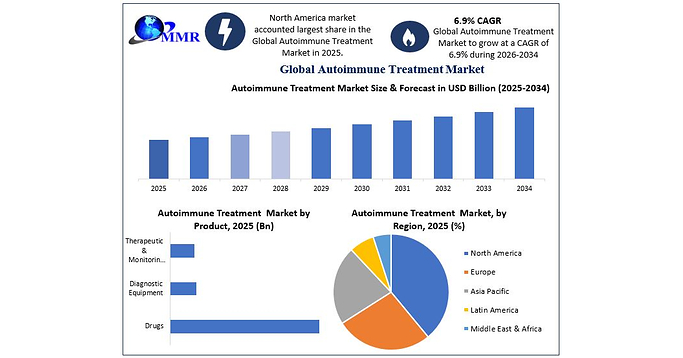
Maximize Market Research projects the global autoimmune-treatment market will grow from $176.6 billion in 2025 to $321.95 billion by 2034, a 6.9% CAGR. Growth is expected to be driven by rising autoimmune-disease prevalence and adoption of biologics, biosimilars, JAK inhibitors, targeted immunotherapies, and precision medicine, while high treatment costs, reimbursement constraints, and limited specialist access remain headwinds. North America led the market in 2025, while Asia-Pacific is expected to be the fastest-growing region.
Analysis
This is not a near-term earnings catalyst: the forecast is a vendor-sponsored, highly aggregated market estimate that double-counts mature generic categories alongside premium biologics and provides no company-level share, pricing, or volume assumptions. The investable implication is instead that immunology remains a durable allocation pool, but incremental value will accrue to differentiated mechanisms and label expansion rather than to broad category exposure. ABBV and UCB have the clearest operating leverage to sustained immunology demand; JNJ and LLY benefit but their diversified revenue bases dilute the signal.
The key second-order effect is payer-driven substitution. As biosimilars penetrate established TNF/IL franchises, originators face net-price pressure even if treated-patient growth remains healthy; SDZ and VTRS can gain volume, while ABBV's post-Humira portfolio must demonstrate that Skyrizi/Rinvoq growth offsets both erosion and JAK safety-label/reimbursement friction. This also favors companies with evidence generation, diagnostics, and specialist-channel infrastructure over undifferentiated biologic manufacturers. ROP is a watch beneficiary only if autoimmune biomarker testing meaningfully expands laboratory workflow spend; this release alone does not establish that.
Over the next 1-3 months, focus on quarterly prescription trends, formulary wins, and pipeline readouts rather than the market forecast. Over 6-18 months, the decisive variables are biosimilar pricing, oral-versus-injectable switching, and whether cell therapies can deliver durable remission with acceptable safety and manufacturing economics. A contrarian risk is that investors extrapolate patient prevalence into revenue growth while reimbursement caps, step edits, and biosimilar deflation shift the economics from drug innovators to payers and lower-cost suppliers.
AllMind Terminal
AI-powered research, real-time alerts, and portfolio analytics for institutional investors.
Request TrialMarket Sentiment
Overall Sentiment
mildly positive
Sentiment Score
0.38
Ticker Sentiment
Key Decisions for Investors
- No directional trade solely on this release; treat it as thematic confirmation, not a valuation-changing catalyst. Require company-specific prescription, gross-to-net, and guidance evidence before adding exposure.
- Maintain or initiate a 6-12 month long ABBV / short VTRS pair, sized modestly: ABBV offers differentiated immunology growth and label-expansion optionality, while VTRS remains more exposed to structurally deflationary off-patent markets. Falsify if ABBV immunology growth decelerates below management's long-term framework or VTRS demonstrates sustained biosimilar margin expansion rather than volume-only growth.
- Prefer UCB over broad large-pharma immunology exposure for 6-18 months where liquidity permits; its concentrated neurology/immunology mix provides higher sensitivity to specialty-drug execution. Use upcoming launch uptake and reimbursement access as entry gates; reduce on material formulary exclusions or safety-driven label constraints.
- Monitor SDZ and VTRS for a biosimilar-volume trade only after evidence of tender wins and stable gross margins. Avoid assuming that biologic adoption translates into earnings upside: a 5-10% adverse price/mix move can offset substantial unit growth in this segment.
More News
- Why we like Starbucks’ latest turnaround move — plus, two more wins for Eli Lilly
- Cyber startup Island hits $6.4 billion valuation in new round as AI attacks fuel spending wave
- FDA approves Eli Lilly's once-weekly insulin injection for type 2 diabetes
- Jefferies reiterates Sarepta Therapeutics stock rating on pipeline potential
- U.S. Food and Drug Administration (FDA) approves Lilly's Onswik™ (insulin efsitora alfa-gobe), a once-weekly basal insulin injection treatment for adults living with type 2 diabetes
- Here's who is attending the Trump-Xi state dinner