
GM Stock Falls 7% Despite Q3 Earnings Beat: Buy the Dip?
Source: zacks.com
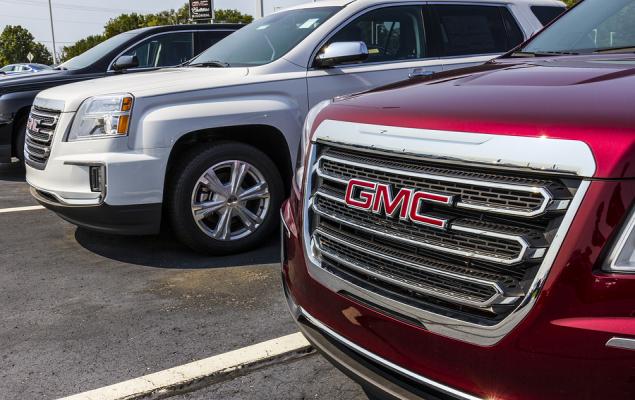
GM’s Q3 2026 EPS rose 32.2% year over year to $3.70, beating the $3.55 consensus, while revenue increased 3% to $50.02 billion versus $48.21 billion expected; adjusted automotive free-cash-flow guidance was raised to $11.5–$12.5 billion and the company authorized a multi-year $20 billion buyback. Shares nevertheless fell 6.84% after results as investors weighed a projected $2 billion 2026 commodity, logistics and DRAM headwind, gross tariff costs expected near the low end of $2.5–$3.5 billion, and truck-launch disruptions expected to cut Q4 output by about 35,000 units. The article sees long-term support from truck launches and digital revenues, but considers near-term margin and execution risks significant and the risk-reward balanced.
Analysis
The key issue is earnings quality and cash allocation, not the quarterly beat: a buyback can support per-share results, but it does not offset operating-cost inflation, launch disruption or EV restructuring cash outflows. The risk is that input costs and tariffs arrive before GM can reprice vehicles, while truck downtime limits the volume and mix benefit expected from the next product cycle. Conversely, constrained truck supply could protect pricing; watch transaction prices and incentives, not just unit production.
Near term (days to 1–3 months), the stock’s decline looks like a reset of margin expectations rather than proof that the long-term thesis broke. Ford’s Oct. 28 report is a useful read-through on industry cost and tariff exposure, but GM-specific launch timing and EV cash costs should not be generalized across peers. Tesla’s report may move EV sentiment, but it is not a clean read-through to GM’s legacy truck economics.
Over 6–18 months, the upside case depends on truck launches translating into richer mix and recurring software revenue becoming recognized, profitable cash flow—not simply deferred revenue growth. The buyback authorization is supportive but multi-year; pace and execution matter. Contrarian point: the selloff may already discount a difficult transition, yet a single strong quarter and higher cash-flow guidance do not establish that 2027 headwinds have peaked. Falsify the cautious view if GM demonstrates improving adjusted automotive margins despite costs and executes launches without further disruption; worsening guidance, delayed production or higher EV cash payments would reinforce it.
AllMind Terminal
AI-powered research, real-time alerts, and portfolio analytics for institutional investors.
Request TrialMarket Sentiment
Overall Sentiment
mixed
Sentiment Score
-0.15
Ticker Sentiment
Key Decisions for Investors
- Do not chase the post-earnings dip yet; keep GM exposure sized for margin and execution risk rather than treating the buyback authorization as a near-term floor.
- Set an add-on trigger for the next 1–3 months: evidence in guidance or reported results that commodity/logistics costs are stabilizing and truck launch execution is on plan. Reassess if adjusted automotive margin outlook deteriorates or production disruption extends.
- Track buyback pace against automotive free-cash-flow delivery and EV restructuring cash payments. A slower repurchase pace alongside higher cash outflows would weaken the capital-return support.
- Use Ford’s Oct. 28 results as an industry-cost read-through, not as a direct GM valuation signal; compare disclosed tariff/input-cost effects and margin outlook before considering any GM/F relative-value position.
More News
- The U.S. market has never been more focused on one single bet—but AI’s payoff will likely take decades
- Why is Tesla stock falling after-hours today?
- Zuckerberg told Meta directors he might leave California, where he could lose billions to a wealth tax. Meta answered with a new class of stock
- Futures orbit around SpaceX as Tesla merger talk cheers investors
- Elon Musk Thinks $3.5 Trillion Tesla-SpaceX Mashup Is a Good Idea
- SpaceX gives the AI trade a shot in the arm. What it means for our stocks