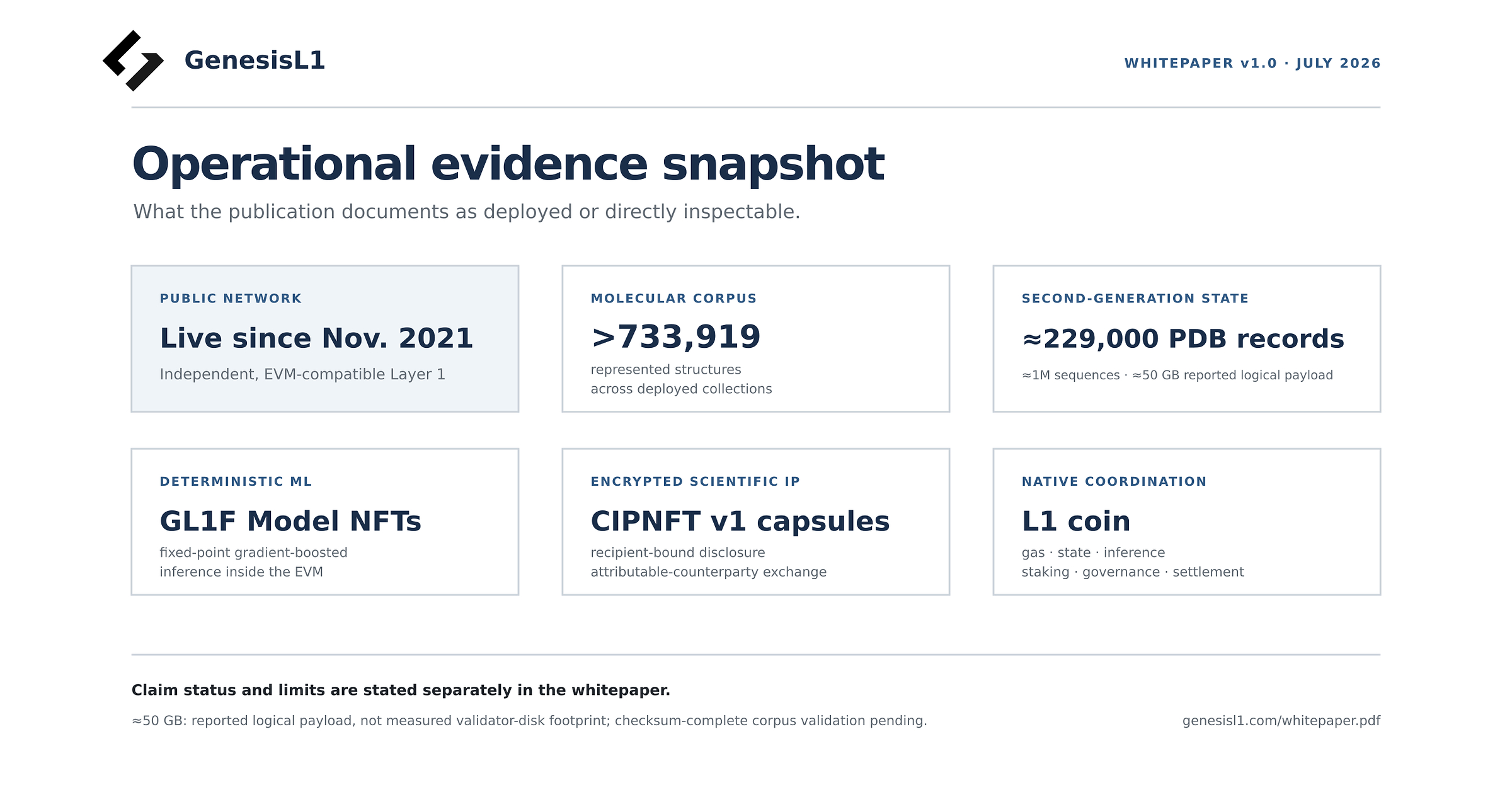
GenesisL1 published its Version 1.0 technical whitepaper for a live, public, permissionless EVM-compatible Layer 1 focused on scientific data, deterministic ML inference, and encrypted scientific IP. The paper cites 733,919+ tokenized molecular structures in first-generation collections and a second-generation deployment of ~229,000 PDB structures plus ~1M sequences (~50GB logical payload). L1 coin is positioned as the network’s native infrastructure asset for metered consensus/scientific state writes and proof-of-stake governance, but the release is explicitly not a token offering or fundraising.
This is closer to a standards-and-workflow story than a monetizable crypto catalyst. If the thesis ever becomes investable, the economic value should accrue to identity, provenance, secure compute, and data governance layers around biotech R&D, not to the chain’s own unit economics; the token only matters if it becomes the settlement medium for repeated institutional workflows. That puts incumbents in cloud, cybersecurity, and data infrastructure at the edge of the upside, while the most obvious losers are speculative L1s that rely on narrative rather than usage.
Near term, the key risk is adoption theater: impressive on-chain payload counts do not translate into durable fee revenue, governance demand, or sticky users. The next 1-3 months catalyst is external validation — third-party audits, integrations with real research stacks, and observable transaction velocity — because without that, this is still a small-community protocol with limited market transmission. Over 6-18 months, the real test is whether pharma/biotech workflows accept on-chain reproducibility and licensing, or whether the off-chain compute constraint keeps most of the economic value outside the network.
The contrarian view is that the market may be misclassifying this as a pure AI+crypto upside story when the bottleneck is actually institutional workflow adoption and compliance. If that is right, the move in adjacent tokens is likely overdone relative to the probable financial impact, and the better trade is to stay skeptical until usage data proves monetization. What would falsify the bearish read is a sustained increase in third-party integrations, fee-bearing activity, and repeat institutional counterparties rather than one-off announcements.
AI-powered research, real-time alerts, and portfolio analytics for institutional investors.
Request TrialOverall Sentiment
neutral
Sentiment Score
0.05
Ticker Sentiment
