
Building an app has plummeted in cost. Building for everyone everywhere has ballooned. k-ID launches Kai: age-adaptive design as fast as developers can build.
Source: PR Newswire
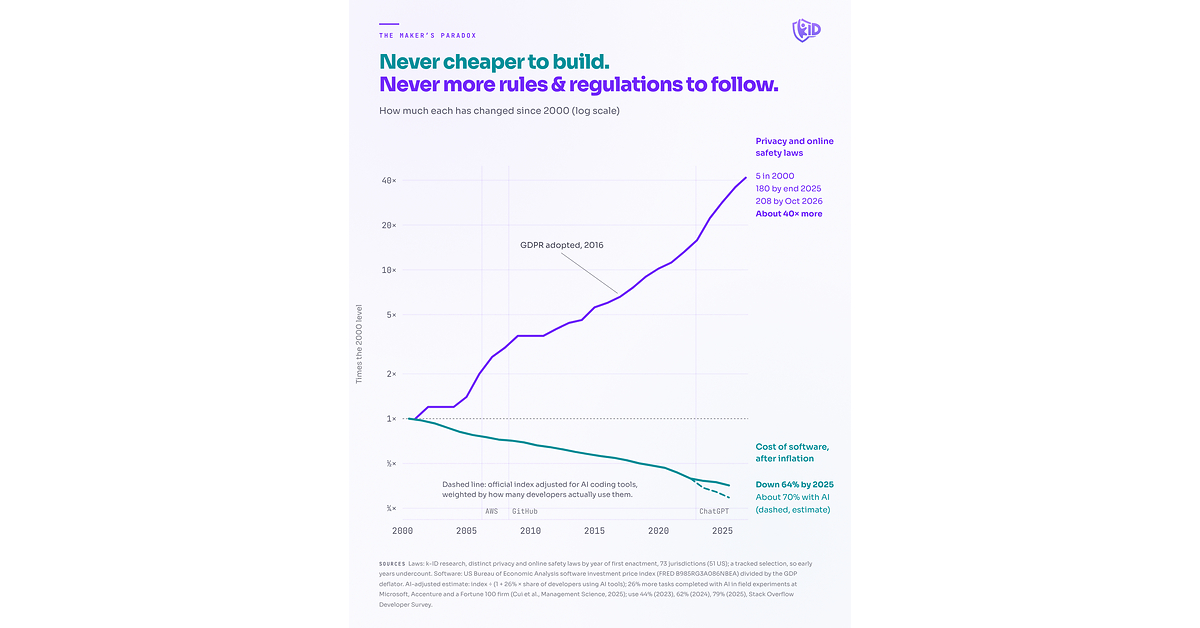
k-ID launched Kai, a self-serve JavaScript and React SDK that applies age-based permissions and consent decisions to apps, with rules updated automatically without new code. It is available immediately and free for each product’s first 10,000 monthly users; builders can test results without an approval queue. The release describes a product launch, but provides no revenue, adoption or market-reaction figures.
Analysis
Kai is a potentially useful compliance layer, but the investable signal for Amazon is weak: AWS is named as a launch partner, with no disclosed distribution commitment, workload volume, commercial terms, or customer conversion. Treat the partnership as ecosystem positioning—not evidence of incremental AWS revenue or a competitive win. If adopted, age-aware SDKs could reduce the friction of building consumer apps and modestly support cloud usage, while shifting some compliance work from individual developers to specialist infrastructure providers. The second-order opportunity is for identity, moderation, and safety vendors to bundle into a common integration path; the counter-risk is that platforms such as Apple, Google, and Microsoft incorporate comparable controls into their own developer stacks, limiting third-party pricing power.
Near term, the launch and hackathon demonstrate developer interest, not production adoption. Over 1–3 months, the relevant checks are paid conversion after the 10,000-user free tier, retained integrations, and evidence of AWS-led distribution. Over 6–18 months, regulatory fragmentation could make outsourced age assurance more valuable, but implementation remains market- and product-specific, and Kai does not remove builders’ certification or legal responsibilities. A breach, inaccurate age classification, or a regulatory finding that the approach is inadequate could raise liability and reputational costs across the ecosystem. Contrarian view: the product’s broad applicability sounds compelling, but free entry and a partner roster can overstate commercial traction; compliance complexity may also slow adoption rather than create urgent spend. No AMZN trade is warranted on this announcement alone.
AllMind Terminal
AI-powered research, real-time alerts, and portfolio analytics for institutional investors.
Request TrialMarket Sentiment
Overall Sentiment
mildly positive
Sentiment Score
0.25
Key Decisions for Investors
- Do not change AMZN exposure based on the launch: the article provides no evidence of AWS revenue contribution, exclusivity, or committed customer distribution.
- Put k-ID on a watchlist rather than treating it as a public-equity catalyst; verify production deployments, paid conversion, and renewal/retention after the free tier before underwriting meaningful demand.
- Monitor AWS developer-platform announcements and comparable age-assurance offerings from Apple, Google, and Microsoft; broad native distribution would weaken the third-party SDK opportunity.
- Falsify the positive infrastructure thesis if adoption remains limited to demos or pilots, or if regulators reject the underlying assurance approach; upgrade the signal only with disclosed commercial traction or measurable AWS workload adoption.
More News
- VCs will make billions on Anthropic’s IPO, but Amazon is set to make much (much) more
- Indian investors rush to Nvidia, SpaceX, Apple as local trading apps roll out access to U.S. stocks
- Oracle integrates ChatGPT, Codex into apps and expands cloud chip lineup
- What's behind the AI trade comeback — plus, our take on Intel's latest deal
- Fmr. MSFT Exec.: Buyouts Is a Harbinger of AI Future
- As Anthropic’s IPO approaches, CFO Krishna Rao faces a defining test