
ROST Sees Strong Closeout Supply: Is Off-Price Set to Benefit?
Source: zacks.com
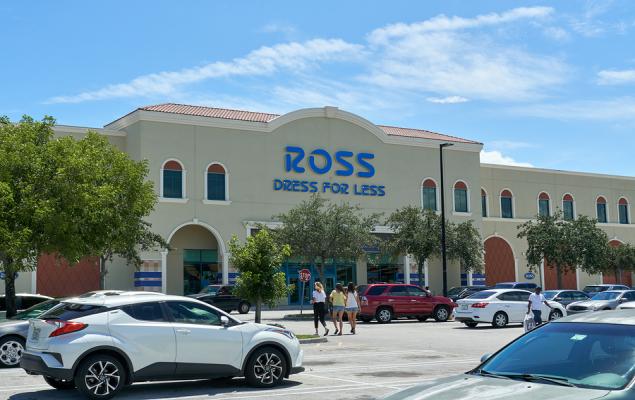
Ross Stores is benefiting from abundant closeout merchandise as weakness at mainstream retailers creates more canceled-goods supply, supporting branded assortment quality and value pricing. Q2 consolidated inventory rose 18%, but store turns remained strong, clearance levels stayed low and merchandise margins improved. Management expects only modest average unit-retail price increases in the second half of 2026, positioning ROST to attract inflation-pressured consumers; shares are down 1.4% over three months versus an 8.2% decline for the industry.
Analysis
The key earnings mechanism is not merely value demand; it is the widening gross-margin spread between retailers able to buy opportunistically and branded/full-price channels forced to clear inventory through promotions. ROST, TJX and BURL can convert vendor distress into better ticket quality without absorbing the original markdown risk, while department-store and mall-apparel operators such as KSS, M and GPS face a more difficult choice between margin protection and inventory liquidation. If closeout availability persists through holiday buying, off-price comp resilience should be accompanied by favorable merchandise margin rather than the usual trade-off between traffic and profitability.
The near-term stock catalyst is evidence that inventory is translating into units per transaction and branded-assortment improvement rather than a later markdown reserve. Over the next 1-3 months, monitor promotional intensity at ANF, AEO, GPS, KSS and M: escalating promotions would validate vendor excess and extend off-price sourcing leverage into spring. The 6-18 month risk is that a broad consumer slowdown eventually reaches off-price shoppers; high inventory then becomes a working-capital drag and turns the current margin tailwind into clearance pressure.
Consensus likely overstates the direct inflation hedge. Off-price retail benefits most from dislocation in full-price inventory, not simply from a weak consumer, and a rapid normalization in apparel demand would reduce the flow of attractive branded closeouts. ROST's valuation leaves limited room for a routine operational beat, making relative-value exposure preferable to an outright momentum long until the next sales and margin update confirms that sourcing advantages are durable.
AllMind Terminal
AI-powered research, real-time alerts, and portfolio analytics for institutional investors.
Request TrialMarket Sentiment
Overall Sentiment
mildly positive
Sentiment Score
0.38
Ticker Sentiment
Key Decisions for Investors
- Initiate a 3-6 month pair: long ROST / short KSS, sized beta-neutral. The thesis is relative gross-margin and traffic divergence as promotional inventory migrates downstream; target a 10-15% relative return. Exit if ROST reports rising clearance activity or KSS demonstrates sustained margin recovery without incremental promotions.
- Use TJX and BURL as confirmation reads rather than incremental longs: broad-based off-price comparable-sales strength and stable merchandise margins at their next reports would support expanding the ROST long. If only ROST performs, treat the signal as company-specific and avoid extrapolating the industry thesis.
- Maintain a watch short in GPS or AEO only if holiday promotions broaden and inventory days rise at the next update. These are more direct expressions of the upstream excess-inventory mechanism, but require verified inventory and gross-margin deterioration before entry; absent that data, no position.
- For existing ROST exposure, take partial profits into any multiple expansion materially above its off-price peer group rather than assuming unlimited upside from sourcing. Falsification is two consecutive periods of slowing traffic or unit growth combined with increasing markdowns/clearance, which would indicate inventory has shifted from asset to liability.
More News
- Coherent's Datacenter Business Powers its Revenue Growth
- Kevin Warsh just revealed a huge change for the Fed. The press missed it
- Warren Buffett stepping down as chairman of Berkshire Hathaway: 'Father Time always wins'
- Three words from Kevin Warsh have Wall Street wondering how far the Fed will go with rate hikes
- American, United and Southwest are all cutting ‘marginal routes’ as jet fuel prices spike
- Time for Cyclical Sector ETFs?