
MATELASER Unveils MATEROBOT®, a Next-Generation Six-Axis Laser Therapy Robot With a Detachable Portable Laser System
Source: PR Newswire
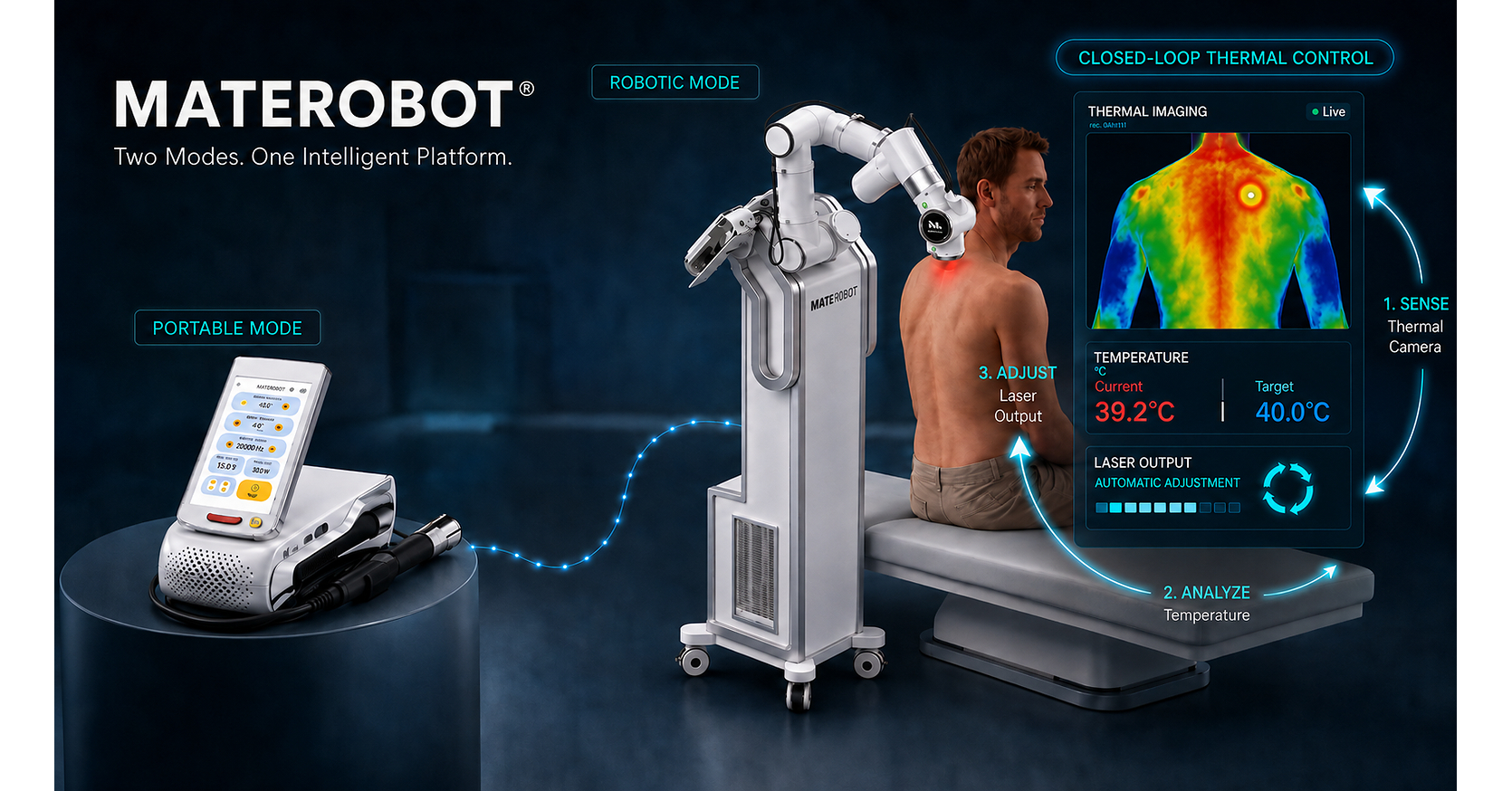
MATELASER launched the MATEROBOT® intelligent six-axis laser rehabilitation robot with a detachable FDA-cleared X1 PERFORMANCE ULTRA laser system. The modular platform supports two use cases—robotic hands-free clinic treatment and portable off-site manual operation—with up to 15W CW output across 650/810/980 nm and real-time thermal closed-loop imaging to automatically help maintain intended temperature ranges. The company says the system is now commercially available for rehabilitation, pain-management, sports medicine, and multi-location providers.
Analysis
This is less a near-term revenue event than a signal that the rehab/pain-tech category is trying to migrate from discretionary hardware toward workflow software and service-led systems. The real economic upside, if any, comes from higher utilization per clinic, easier multi-site deployment, and a stronger leasing/distribution model; that matters more than the underlying therapeutic modality. Public-market beneficiaries would be the broader medtech automation complex and distributors, while the most vulnerable are niche standalone device vendors whose differentiation is mostly specs rather than workflow integration.
The base case is slow adoption: outpatient rehab buyers are capex-sensitive, reimbursement is opaque, and clinical evidence usually lags product launches by 2-4 quarters. Over the next 1-3 months, the main catalyst is channel validation — purchase orders, distributor signings, or reference accounts — not the press release itself. If those don’t show up by the next earnings cycle, this is likely a marketing story with minimal downstream impact.
Contrarian view: the market may be underestimating how much of this category’s margin pool shifts to software, documentation, and fleet management rather than the device. But it is also overestimating the moat from robotics; unless the company can prove repeatable utilization and reimbursement support, competitors can match the hardware while undercutting on price. Falsifiers are simple: no evidence of multi-site adoption, no meaningful service/recurrent revenue mix, or any sign that clinicians treat this as a novelty rather than a budgeted workflow upgrade.
AllMind Terminal
AI-powered research, real-time alerts, and portfolio analytics for institutional investors.
Request TrialMarket Sentiment
Overall Sentiment
mildly positive
Sentiment Score
0.25
Key Decisions for Investors
- No immediate public-equity trade; treat this as a watch item until the company shows installed-base growth, reimbursement support, or repeat purchase evidence over the next 1-2 quarters.
- Set a 1-3 month alert on medtech workflow names like IHI: only consider a tactical long if multiple rehab/pain automation launches start showing up across peers, indicating a real category upgrade rather than a single-company promo.
- Monitor direct pain-device and clinic-equipment exposure such as ZYXI and ENOV for signs of procurement pressure; if management commentary points to longer sales cycles or price competition, that would support a short-on-strength setup.
- If the next earnings cycle lacks distributor expansion or clinic utilization data, fade the story rather than chase it; the likely outcome is multiple compression for any name trading on 'robotics' narrative without recurring revenue.
More News
From AllMind Research
- Anthropic IPO Preview: Valuation, Timing, and What to Watch
- Shein After the IPO: Venue, Valuation, and What Must Be Proved
- What AI Research Tools Should a Small Hedge Fund Buy First?
- AlphaSense Pricing: What Public Contract Data Shows in 2026
- Eli Lilly Q4 2025 Earnings: Revenue Surges 43% as Mounjaro and Zepbound Dominate the GLP-1 Market