
Jeonbuk National University Study Reveals Why Diabetics Are More Vulnerable to Air Pollution's Cellular Toll
Source: PR Newswire
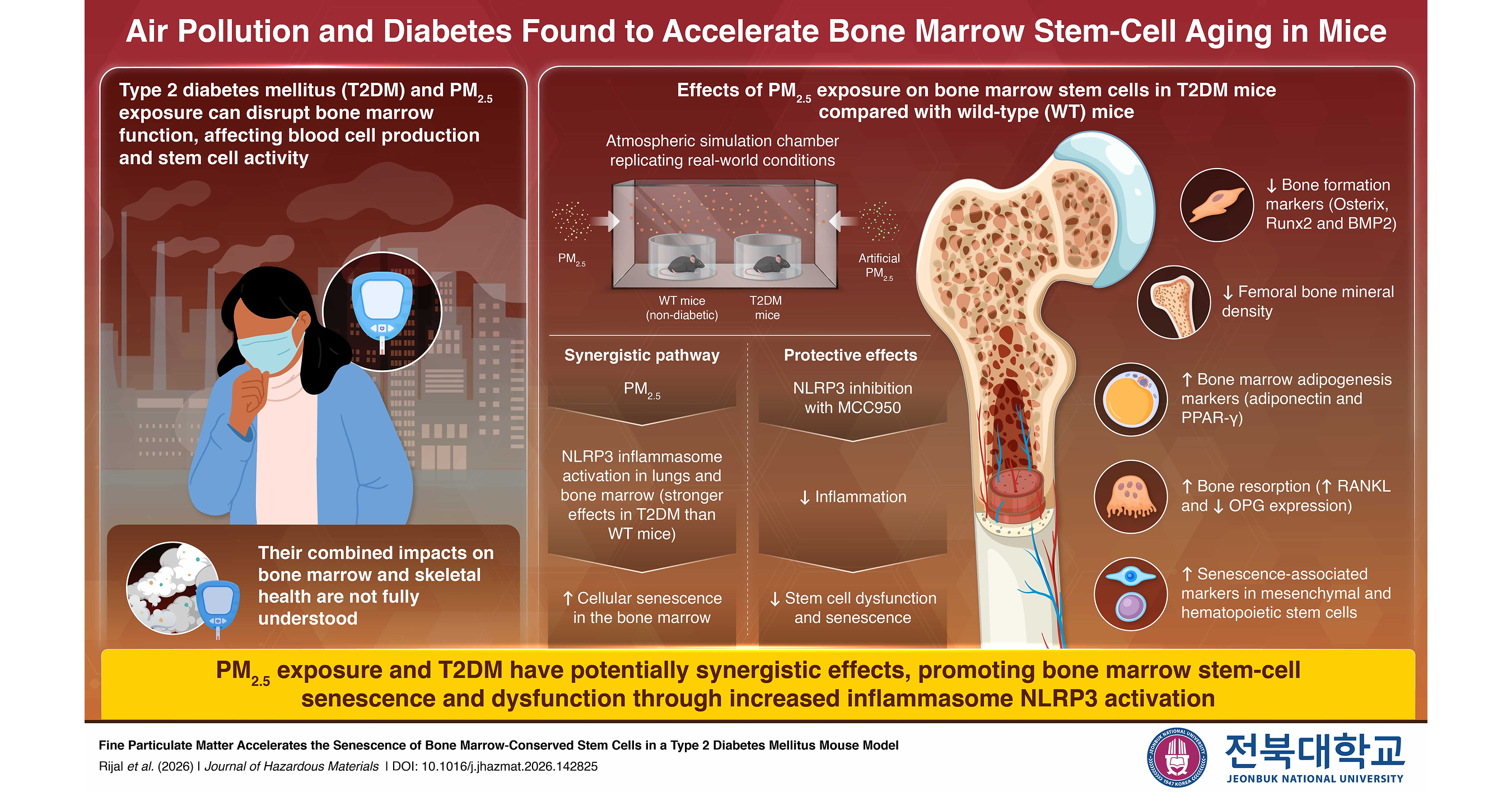
A Jeonbuk National University mouse study found that exposure to PM2.5 at 50 micrograms per cubic meter for two hours daily over five days accelerated bone marrow stem-cell aging and impaired function, with stronger effects in diabetic mice. MCC950 inhibition of the NLRP3 inflammasome mitigated inflammation and cellular damage; the findings identify a potential research target but do not establish a treatment for people.
Analysis
Investable signal is low: this is a mouse study, not evidence of a quantified increase in human disease, healthcare utilization, or drug demand. The five-day exposure protocol also leaves real-world dose and duration translation unresolved. The more relevant second-order implication is a potential interaction between chronic disease and environmental exposure: if human data confirm it, risk models and prevention priorities could shift toward higher-risk diabetic populations, but that is a multi-year research and policy path rather than a near-term earnings catalyst.
The NLRP3 result supports a biological hypothesis, not a commercial asset thesis. MCC950’s benefit in mice does not establish human efficacy, safety, or a viable product; without a named clinical-stage program or trial catalyst, assigning value to NLRP3-focused biotech exposure is premature. Air-quality monitoring and pollution-control providers could see incremental policy interest only if the finding is replicated and translated into guidelines; no immediate demand change is indicated.
Near term, expect little fundamental impact on listed companies. Over 1–3 months, the key checks are independent replication, human cohort evidence, and any follow-on clinical work. Over 6–18 months, credible epidemiology could strengthen pressure for targeted pollution mitigation and improve the case for research funding. The thesis weakens if human studies do not find a diabetes-specific effect or if exposure-response estimates are small.
AllMind Terminal
AI-powered research, real-time alerts, and portfolio analytics for institutional investors.
Request TrialMarket Sentiment
Overall Sentiment
neutral
Sentiment Score
0.00
Key Decisions for Investors
- No trade on this release alone. Treat the study as hypothesis-generating; do not infer revenue upside for air-quality companies or biotech from a mouse result.
- Watch for human epidemiology linking PM2.5 exposure to bone-marrow, hematologic, or bone outcomes specifically in people with diabetes, and for independent replication. These are the evidence gates before revisiting sector exposure.
- Monitor whether any NLRP3 inhibitor enters or reports a relevant human trial. Verify compound ownership, indication, safety, and clinical data before considering a biotech position; MCC950’s preclinical effect is not a commercial catalyst by itself.
- Falsification trigger: well-powered human studies show no material diabetes-by-pollution interaction, or exposure-response findings fail to replicate. In that case, the likely policy, healthcare-cost, and drug-development spillovers remain immaterial.
More News
- Daiichi Sankyo’s first-half profit rises on cancer drug growth; shares up
- Spanish PM, facing reelection, says it’s ‘unacceptable’ to suffer two high-speed rail accidents in one year as at least 68 die in collision
- We're raising our price target on Eli Lilly as the obesity-drug boom rolls on
- ATEC Q3 2026 slides show profitability surge despite execution gaps
- West Pharma earnings show it's more than a GLP-1 play. Why we see more upside
- Linde delivers a good quarter and puts in a fix for an overhang on the stock