
Five Below: The Growth May Not Be Sustainable In The Long Term
Source: seekingalpha.com
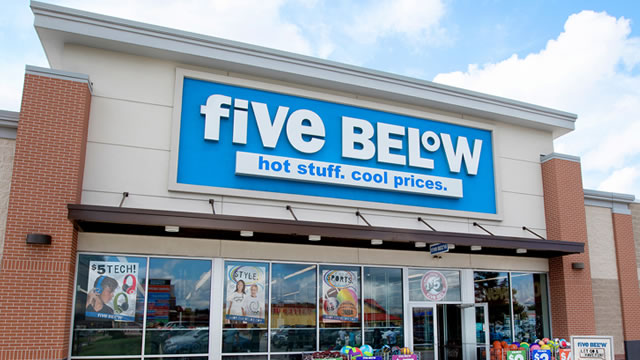
Five Below reported 22.9% net sales growth, including 14.1% comparable-sales growth, reflecting resilient demand for its value-focused offering amid weak consumer confidence and elevated inflation. Near-term macroeconomic pressure is expected to support demand, but double-digit growth is viewed as unlikely to persist over the medium to long term as inflation normalizes and consumer sentiment improves.
Analysis
The key debate is not demand resilience but the durability of incremental store economics. FIVE’s earnings power is highly sensitive to whether newer locations maintain mature-store productivity without rising cannibalization, shrink, or labor deleverage. A deceleration in comparable sales can be absorbed if unit growth and merchandise margin remain intact; a simultaneous slowdown in both would expose the stock’s growth multiple to disproportionate compression over the next 1-3 quarters.
Competitive read-through is mixed. FIVE is better positioned than DLTR for discretionary “small-ticket” trade-down, but its assortment is also less necessity-driven than WMT, COST, or dollar-store consumables. If lower-income consumers deteriorate further, spending may migrate from novelty and seasonal categories toward staples, making apparent value-retail strength a less reliable indicator of FIVE-specific share gains. Conversely, a consumer recovery is not automatically bearish: improved discretionary budgets could support higher-ticket Five Beyond mix and gross margin, provided inventory turns do not weaken.
The contrarian risk is that a widely expected normalization in growth is already embedded in expectations, while the market may be underestimating the upside from mix, new-store productivity, and vendor buying power. The relevant catalyst path is next earnings: merchandise margin, inventory growth relative to sales, shrink commentary, and new-store productivity matter more than the headline comp. A deterioration in inventory turns or any reduction in store-opening cadence would falsify the constructive operating thesis and likely trigger a sharper rerating than a modest sales miss alone.
AllMind Terminal
AI-powered research, real-time alerts, and portfolio analytics for institutional investors.
Request TrialMarket Sentiment
Overall Sentiment
mildly positive
Sentiment Score
0.22
Ticker Sentiment
Key Decisions for Investors
- Maintain a watch-list long bias on FIVE rather than chase near-term strength; initiate only if the next report confirms positive merchandise-margin trajectory, inventory growth below sales growth, and unchanged unit-opening plans. Target a 6-12 month holding period, with thesis invalidation on a guidance cut tied to store productivity or margin erosion.
- Use a relative-value expression only after valuation work: long FIVE / short DLTR can capture superior discretionary merchandising and execution, but avoid entry if FIVE’s forward EV/EBITDA premium materially exceeds its historical premium without evidence of sustained margin expansion. Review after both companies report their next quarterly results.
- For downside protection around earnings, monitor implied volatility and consider a 2-3 month FIVE put spread if inventory growth accelerates while traffic or transaction trends soften. The catalyst is a margin-led miss; do not execute without confirming option pricing and open interest.
- Monitor WMT, COST, and DLTR category commentary as a demand-quality signal. Broad value-retail traffic strength alongside weakening discretionary-ticket mix would argue for reducing FIVE exposure, since that outcome implies necessity trade-down rather than durable share capture.
More News
- Companies promised AI gains— here's how the payoff showed up in earnings
- FBI blames North Korea for record $6.3bn crypto heist
- Binance to resume crypto withdrawals in phases after record $6 billion hack
- Bangladesh to form wage board after garment protests shut factories
- AWS grows 39% and Amazon will spend even more on AI in 2027
- SpaceX loses bid to toss NAACP lawsuit over Memphis data center air pollution