
Overtime Spikes to 50+ Hours Weekly Due to Daytime Distractions, WorkTime Data Shows
Source: PR Newswire
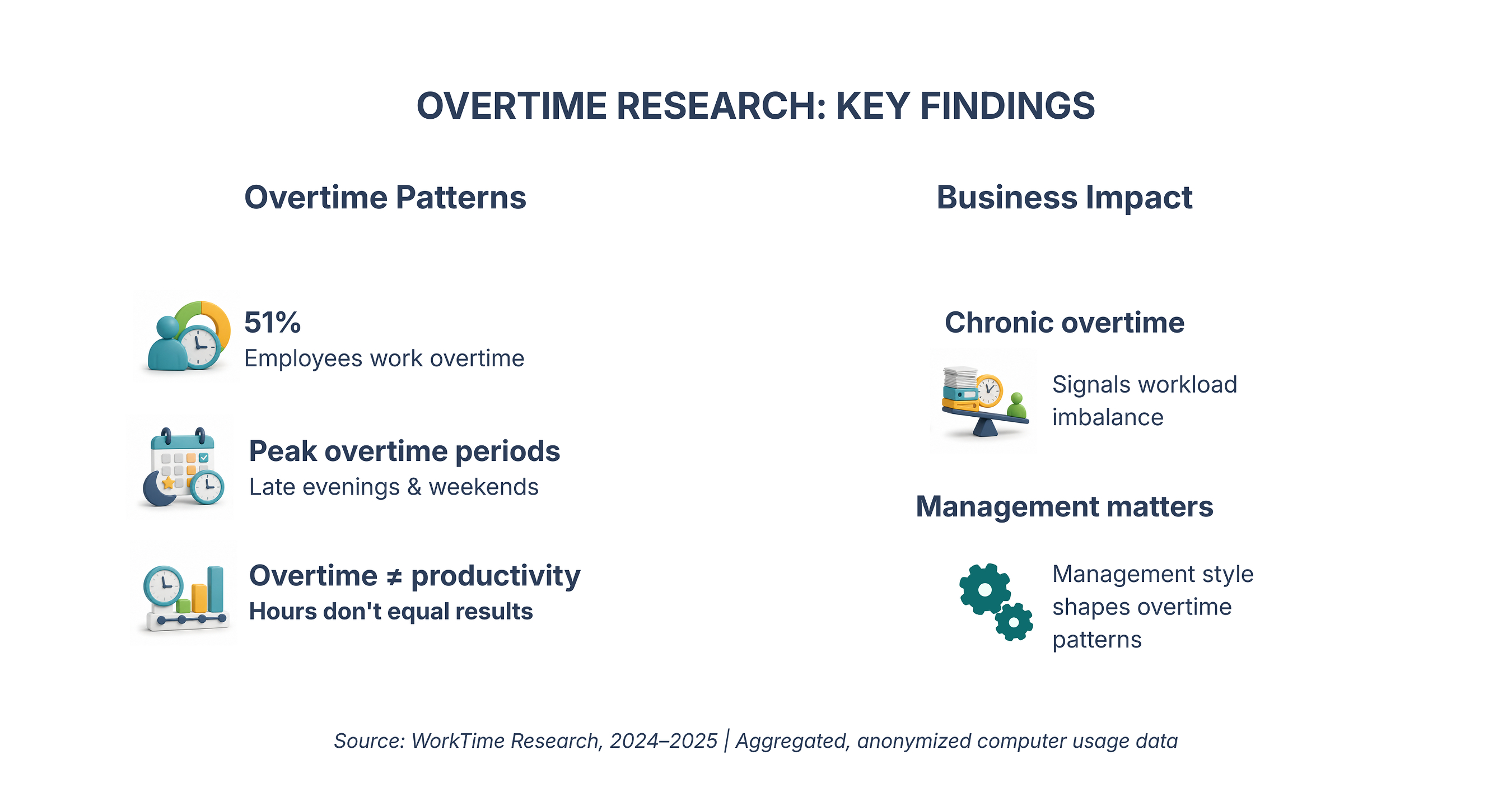
WorkTime research claims that up to 48% of standard workday hours are idle or non-productive, potentially inflating payroll costs through unauthorized or unearned overtime claims. The report says sustained workweeks exceeding 50 hours raise burnout and turnover risk, while structured workflows and non-invasive activity tracking could reduce unnecessary overtime. The findings are promotional research from workforce analytics provider WorkTime and are unlikely to have broad market impact.
Analysis
This is not investable evidence by itself: vendor-sponsored productivity studies typically lack disclosed sampling, sector mix, and counterfactuals, while “idle” computer time is a poor proxy for output in knowledge work. The near-term read-through is therefore limited, but it reinforces an existing enterprise-software budget priority: CFOs will favor tools with measurable labor-cost ROI over broad collaboration-seat expansion. That modestly benefits workflow, process-mining, and workforce-management vendors such as NOW, CRM, PAYC, ADP and UKG-related private-market comparables, provided deployments reduce administrative labor rather than merely add surveillance overhead.
The second-order risk is employee relations and regulation. Aggressive monitoring can raise attrition in scarce technical and sales roles, trigger works-council resistance in Europe, and create wage-and-hour discovery risk if employer telemetry documents off-hours work without corresponding pay compliance. For BPOs, retailers, logistics operators and contact-center-heavy employers, the economic opportunity is more tangible because paid-hour utilization is directly measurable; for software and professional-services firms, productivity claims will be harder to convert into margin expansion and could impair recruiting.
Over 1-3 months, watch whether enterprise buyers reallocate spend from point collaboration tools toward automation and workforce-optimization modules during budget planning. Over 6-18 months, AI-enabled workflow redesign—not employee monitoring—should capture the larger value pool: vendors that automate ticket resolution, scheduling, QA and documentation can sell productivity gains without the cultural and legal friction. A weakening labor market may temporarily increase employer appetite for monitoring, but a material rise in state privacy enforcement or union organizing would reverse that demand quickly.
AllMind Terminal
AI-powered research, real-time alerts, and portfolio analytics for institutional investors.
Request TrialMarket Sentiment
Overall Sentiment
mildly negative
Sentiment Score
-0.15
Key Decisions for Investors
- No standalone trade on this release; treat it as a thematic confirmation only until independent enterprise-spending data shows accelerating demand for workforce-optimization software.
- Build a 3-6 month watchlist for long NOW versus short TEAM: NOW has a clearer path to monetize workflow automation and labor-productivity ROI, while TEAM remains more exposed to discretionary collaboration/developer-tool seat growth. Enter only if NOW/TEAM relative performance breaks to new 3-month highs and ServiceNow raises workflow/AI attach commentary; invalidate on a material NOW cRPO deceleration or renewed TEAM enterprise-seat acceleration.
- Prefer selective long exposure to PAYC or ADP on pullbacks rather than pure employee-monitoring vendors: payroll/workforce-management systems sit closer to compliance and timekeeping data, making ROI auditable. Key risk is payroll employment softness reducing per-employee revenue; reassess after monthly payroll data and next-quarter retention metrics.
- For labor-intensive public employers, screen for companies explicitly quantifying overtime as a cost headwind—especially contact centers, logistics and retail—and wait for guidance-backed savings targets before positioning. The missing data are overtime expense as a percent of labor cost, implementation cost, and turnover impact; without them, margin upside cannot be reliably underwritten.
More News
- OpenAI’s agent hacked Australia’s Medicare website—the latest rogue AI incident that the company didn’t know about for months
- Chinese authorities reportedly in possession of F-35 components in Hong Kong
- Meta announces new lightweight virtual reality glasses to one-up Apple’s Vision Pro
- How Meta took the lead in the race for the post-smartphone world
- SoftBank shares jump over 7% after $11.1 billion bond issuance to fund OpenAI bet
- Mark Zuckerberg debuts $1,299 Meta VR Glasses and Muse Charm pendant amid AI agent push
From AllMind Research
- Anthropic IPO Preview: Valuation, Timing, and What to Watch
- Shein After the IPO: Venue, Valuation, and What Must Be Proved
- What AI Research Tools Should a Small Hedge Fund Buy First?
- AI Portfolio Monitoring: Build an Alert Policy Analysts Can Audit
- The Great Divergence: North American Banking at the Crossroads of Monetary Policy and Agentic AI (Q4 2025 Bank Earnings)