
The Engine Plans October 15 Launch of an AI Team That Creates Content and Handles Sales Conversations
Source: PR Newswire
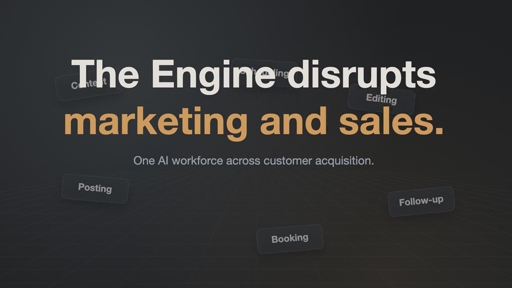
The Engine plans to publicly launch its AI content-production and sales-conversation platform on October 15, 2026. The company says one beta client added more than $112,000 in monthly recurring revenue, surpassed 600,000 followers, and eliminated roughly $65,000 in annual content-production costs; a separate internal comparison found its AI appointment setter booked over 3x as many qualified appointments as human setters. The claims are company-reported prelaunch beta results and are not independently verified.
Analysis
This is not independently actionable public-equity news: the addressable customer base appears to be high-ticket SMBs, and the operating claims are self-reported beta results without cohort size, retention, customer-acquisition cost, pricing, or gross-margin disclosure. A successful launch would primarily validate demand for bundled AI content generation plus lead qualification, rather than establish a durable moat; workflow integrations, distribution, and compliant customer-data handling are likely to matter more than model capability.
The nearer public-market read-through is modestly negative for point-solution marketing agencies and entry-level outsourced sales-development vendors, but too diffuse to trade. At scale, incumbent platforms such as HUBS, CRM, ADBE and SHOP could benefit from incremental AI-feature adoption, yet a standalone tool can also expose their vulnerability in the lower-end market where customers favor a single, low-friction workflow over enterprise-grade systems. Meta's (META) and Alphabet's (GOOGL) ad platforms may receive a second-order benefit if lower creative-production costs increase the volume of paid-content testing.
Over the next 1-3 months, the relevant catalyst is evidence of paid conversion and retention after launch, not demo engagement or follower metrics. The key falsifiers are elevated error rates in customer-facing sales conversations, platform-policy restrictions on automated messaging, weak attribution from content to booked revenue, or customer churn once human oversight requirements are recognized. Over 6-18 months, commoditization is the base case unless the company develops proprietary distribution or data advantages; foundation-model vendors and established CRM suites can replicate much of the feature set.
Contrarian view: automation of content and first-response sales may expand the total marketing funnel but not necessarily improve customer economics, because broader adoption raises content supply and can increase paid-media auction prices. The likely value capture is therefore upstream in advertising platforms and infrastructure, while SMB application vendors face pricing pressure and high support/compliance costs.
AllMind Terminal
AI-powered research, real-time alerts, and portfolio analytics for institutional investors.
Request TrialMarket Sentiment
Overall Sentiment
mildly positive
Sentiment Score
0.38
Key Decisions for Investors
- No direct position: The Engine is private and the disclosed information does not establish a measurable revenue or valuation impact for public comparables.
- Maintain a watchlist on HUBS and CRM into the next two earnings cycles; initiate no trade unless management discloses rising AI-assisted lead conversion, AI attach rates, or material SMB share pressure. A negative read-through would require churn or pricing concessions, not merely competing product launches.
- Monitor META and GOOGL for evidence that AI-generated creative is lifting ad impressions, campaign count, or SMB advertiser demand over the next 1-2 quarters. Treat this as a marginal upside catalyst rather than a standalone thesis; weaker ad pricing or deteriorating conversion would invalidate it.
- For private-market diligence, require verified customer cohorts showing 90-day retention, human-review burden, cost per qualified appointment, and attributable incremental gross profit before assigning a premium to claimed sales automation.
More News
- US job growth expected to slow in September; unemployment rate likely steady
- SoftBank completes final phase of $30 billion investment in OpenAI
- Trump launches midterms campaign blitz amid record low approval ratings
- Amazon seeks to offload $8 billion of Nvidia chips to investors, FT reports
- Amazon seeks to offload $8 bln of Nvidia chips to investors- FT
- Fed’s Cook sees AI buildup as top inflation risk for 2027