
Global 300mm Fab Equipment Spending to Reach $227 Billion in 2029 as Buildout Accelerates, SEMI Projects
Source: PR Newswire
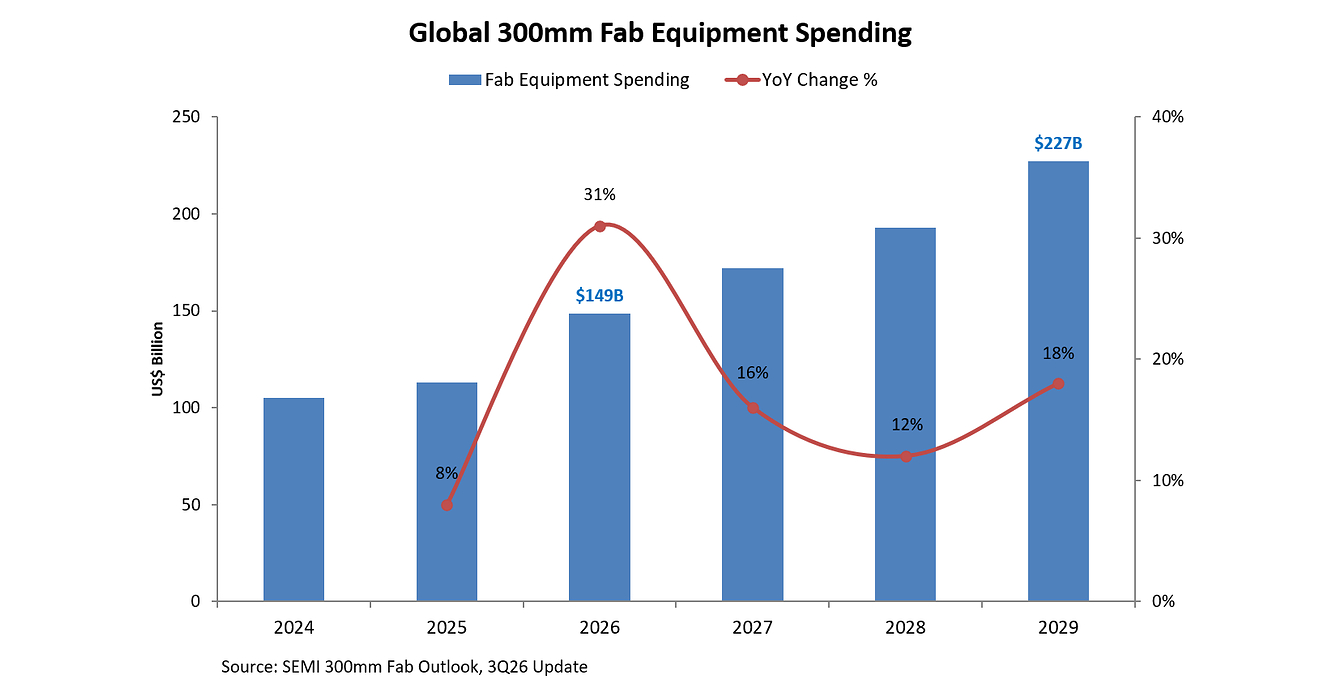
SEMI projects global 300mm front-end fab equipment spending will rise 31% year over year to $149 billion in 2026 and reach $227 billion by 2029, with double-digit annual growth expected through 2029. Global fab construction spending is forecast to grow 23% to $47.5 billion in 2026 and 33% to $63.3 billion in 2027; Americas equipment investment is projected to more than double from $18.1 billion in 2026 to $40.6 billion in 2029. The outlook also forecasts 20 new fabs or lines beginning construction worldwide in 2026 and 18 in 2027, reflecting expanding capacity for AI, high-performance computing and other semiconductor applications.
Analysis
The investable signal is a potential extension of the equipment-order cycle, not proof that fab owners will earn attractive returns on the added capacity. Tool vendors can benefit before new fabs reach meaningful output, while construction-to-production delays, tool delivery timing, and customer mix may make realized orders less smooth than the headline trajectory implies. The beneficiaries are equipment suppliers such as ASML, Applied Materials, Lam Research, KLA, and Tokyo Electron; suppliers of process materials and infrastructure may also gain if projects proceed. Treat that spillover as conditional, not automatic.
The second-order risk is that capacity arrives after the AI/HPC demand window or grows faster than demand outside leading-edge logic. In that case, depreciation and utilization pressure could weigh on fab-owner returns and eventually wafer pricing, even as equipment suppliers initially book business. U.S. buildout also faces execution constraints—power, skilled labor, permitting, and construction costs—that could defer tool installation or first production. SEMI’s numerous forecast changes reinforce that the pipeline is not equivalent to committed, on-schedule spending.
Near term (days), this is supportive sector context but not, by itself, a reason to chase equipment shares. Over 1–3 months, customer capex guidance, equipment orders/backlog, and project delays are the key confirmation points. Over 6–18 months, watch utilization and pricing as new lines ramp. The contrarian risk is that investors capitalize the multi-year spend forecast while underweighting returns on capital and supply additions. A deterioration in tool orders or repeated fab delays would invalidate the near-term bullish read.
AllMind Terminal
AI-powered research, real-time alerts, and portfolio analytics for institutional investors.
Request TrialMarket Sentiment
Overall Sentiment
moderately positive
Sentiment Score
0.55
Key Decisions for Investors
- Prefer a staged, pullback-based long bias in semiconductor equipment suppliers (ASML, Applied Materials, Lam Research, KLA, and Tokyo Electron) over a blanket long in fab owners; size positions only as customer capex guidance and orders confirm the forecast.
- Do not initiate a short in foundries or memory solely on this outlook. Put utilization, wafer pricing, and customer return-on-investment on a 6–18 month watchlist for evidence that supply is outrunning demand.
- Use the next 1–3 months of earnings and guidance to test the thesis: upgrade conviction if tool orders/backlogs and customer spending plans strengthen; cut exposure if capex is deferred, orders weaken, or construction schedules slip.
- Monitor U.S. project execution—especially power availability, labor, permitting, and installation timing—as a potential source of delays for equipment demand; the construction pipeline is not a guarantee of timely production.
More News
- Why is Domino’s Pizza Enterprises stock sliding today?
- Taiwan agrees to buy 30% of gas from Alaska LNG project, Trump says
- South Korean carmaker Hyundai plans 'strategic' investment of $15.5 billion in India by 2032
- Houthis Hit Saudi Aramco Headquarters in Missile Attack
- Applied Materials’ $5 billion AI lab aims to cut chip development time in half—and restore Silicon Valley’s edge
- China's exports likely grew by double-digits in September