
Seoul National University of Science and Technology Researchers Develop New AI-Assisted Pipeline to Identify Errors in Construction Design Documents
Source: PR Newswire
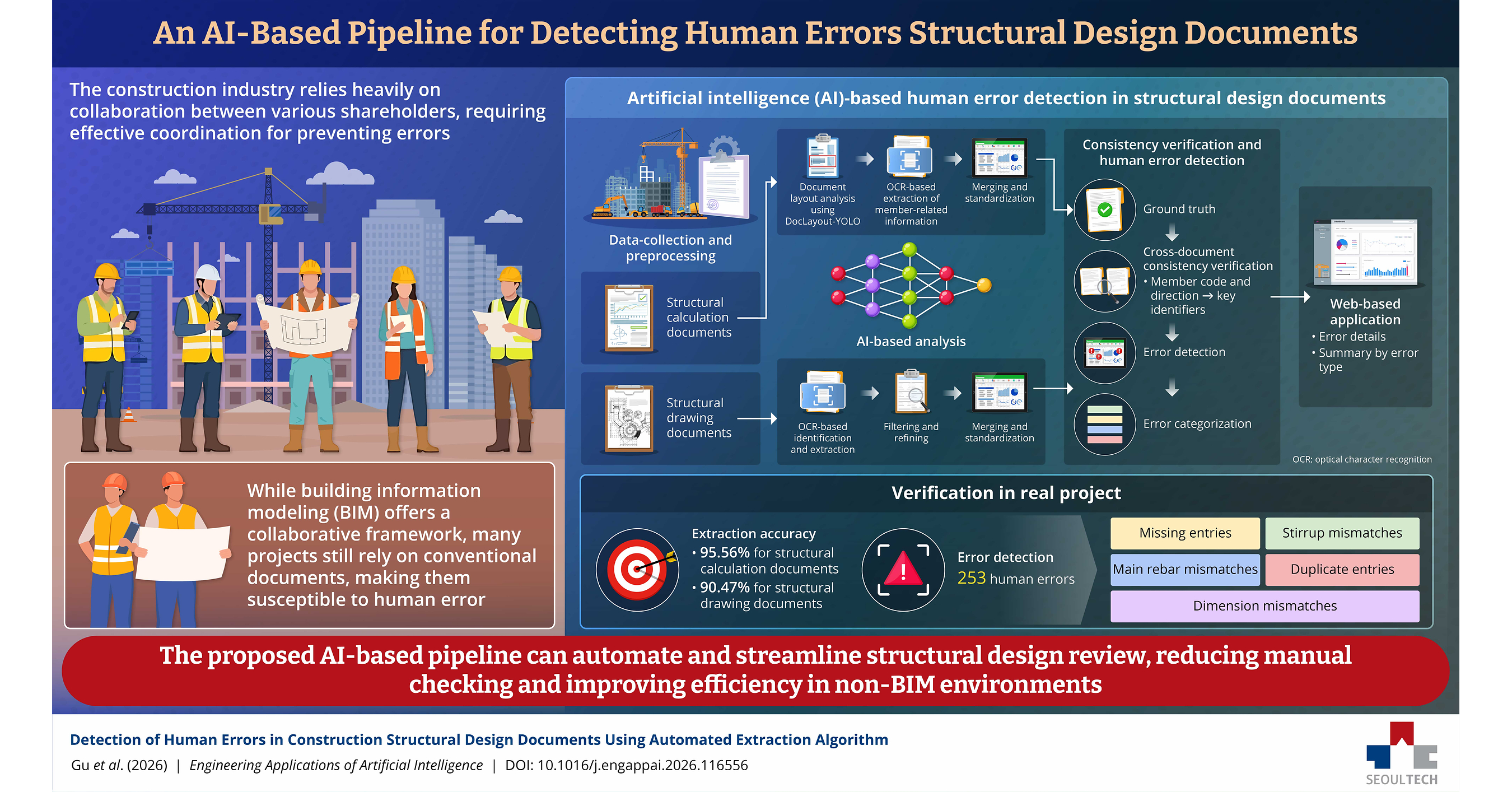
Researchers at Seoul National University of Science and Technology developed an AI-assisted pipeline to compare structural calculations and drawings without requiring building information modeling (BIM). In a South Korean residential-project case study, extraction accuracy reached 95.56% for calculation documents and 90.47% for drawings; verification flagged 253 discrepancies, including 224 missing entries. The system could reduce manual checking and make design-error detection more accessible to smaller projects, though the article reports no commercial deployment or financial impact.
Analysis
This is evidence of a potentially useful workflow layer, not yet evidence of a scalable software business. The economic wedge is smaller firms that cannot justify full BIM adoption: a document-checking tool could lower their QA burden and, if embedded in existing workflows, expand the addressable market for construction software without requiring a BIM rip-and-replace. Incumbents such as Autodesk, Bentley Systems, Trimble, and Procore could respond by adding similar checks or partnering; the risk to them is more likely feature-level price pressure than near-term displacement.
The case study is a single South Korean residential project. Reported extraction accuracy does not establish field performance across document formats, languages, project types, or the costly tail of missed safety-critical errors. False positives could also create review work and erode trust. Liability allocation, validation standards, integration effort, and willingness to pay are the gating variables—not model novelty.
Days: limited fundamental read-through; avoid trading the announcement as a standalone catalyst. Over 1–3 months, look for independent replication, pilots, product commercialization, and named software-vendor integrations. Over 6–18 months, adoption could improve QA economics for smaller projects, but structural impact depends on recurring revenue and workflow lock-in. A contrarian risk is that the “BIM-free” framing overstates an advantage: established platforms may absorb the feature, while contractors remain reluctant to rely on automated checks without human sign-off. No company-specific trade is supported by the available evidence.
AllMind Terminal
AI-powered research, real-time alerts, and portfolio analytics for institutional investors.
Request TrialMarket Sentiment
Overall Sentiment
mildly positive
Sentiment Score
0.30
Key Decisions for Investors
- No immediate position: the study has no identified commercial owner, revenue model, or deployment evidence. Treat it as a watch item for construction-software vendors rather than a sector earnings catalyst.
- Monitor Autodesk, Bentley Systems, Trimble, and Procore for document QA launches, partnerships, or commentary on SMB adoption. A credible integration and paid customer evidence would be a stronger catalyst than additional academic accuracy claims.
- Before underwriting a long in construction-software names on this theme, verify performance across multiple live projects, especially false-negative rates on safety-critical discrepancies, implementation costs, and whether checks are recurring paid features.
- Falsification: no repeatable pilots or commercial integration over the next 6–18 months, or evidence that review burden and liability concerns prevent customers from relying on automated flags, would leave the investment thesis at feature-demo stage.
More News
- AMD stock jumps 7% on earnings as data center revenue nearly doubles
- Marvell-Lumentum Deal Puts Optical Networking at the Center of the AI Boom
- Marvell Technology could plunge on latest multibillion-dollar acquisition
- AI Inference Startup Fal Raises Capital at $16 Billion Valuation
- Stock futures plunge as blue tsunami hits red states and data center hot spots. Wall Street usually likes political gridlock—but maybe not this time
- AMD rides data center riches to ‘largest and most profitable’ quarter in history