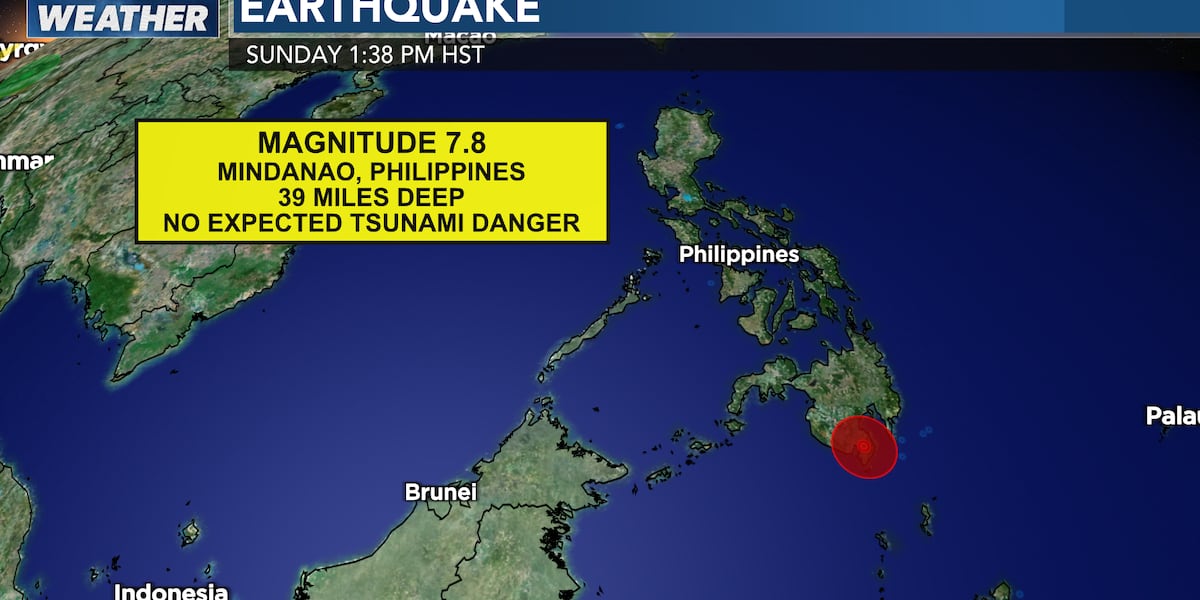
A magnitude 7.8 earthquake struck near Mindanao in the southern Philippines, after initially being reported at 8.2, prompting Pacific tsunami monitoring. The Pacific Tsunami Warning Center said there is no tsunami threat to Hawaii, while advisories were issued for Guam and the Mariana Islands. The event is primarily a regional natural disaster update with limited broader market impact.
The market impact is likely to be more about operational noise than direct asset damage, but that still creates tradable dispersion. In the next 24-72 hours, expect a modest bid for regional logistics, telecom resilience, and emergency-response vendors in affected corridors, while any meaningful pressure should show up first in port throughput, airport ops, and intraday shipping/insurance headlines rather than broad Asia risk assets.
The bigger second-order effect is on supply chains that are already fragile: semis, electronics assembly, and agribusiness flows through the southern Philippines and nearby transshipment routes can see short-lived delays even without physical destruction. That matters because lead times in these sectors are thin; a 1-2 day disruption can force expedited freight and inventory rebooking, which hits margins before it shows up in revenue. If aftershocks persist, the risk shifts from a one-off headline to a rolling reliability discount on local suppliers.
This is also a classic case where the first move can be overdone in adjacent markets. Tsunami monitoring headlines often trigger a temporary risk-off move in tourism, airlines, and local property names, but if there is no cascading infrastructure event, those trades usually mean-revert within 1-2 sessions. The contrarian read is that the absence of Hawaii risk removes the only mechanism for a Pacific-wide de-risking event, so any broad selloff in Hawaii-exposed names would likely be a fade rather than a trend.
Tail risk is not the quake itself but the follow-on: port closures, power outages, or a larger aftershock sequence that turns a localized event into a 1-2 week logistics issue. For portfolio construction, this is best treated as a short-duration volatility spike with optionality around infrastructure names, not a macro shock. If later data confirm minimal damage, the trade is to monetize elevated implied vol and exit any defensive hedges quickly.
AI-powered research, real-time alerts, and portfolio analytics for institutional investors.
Request TrialOverall Sentiment
neutral
Sentiment Score
-0.05
