
Truist advances AI to create more meaningful client interactions
Source: PR Newswire
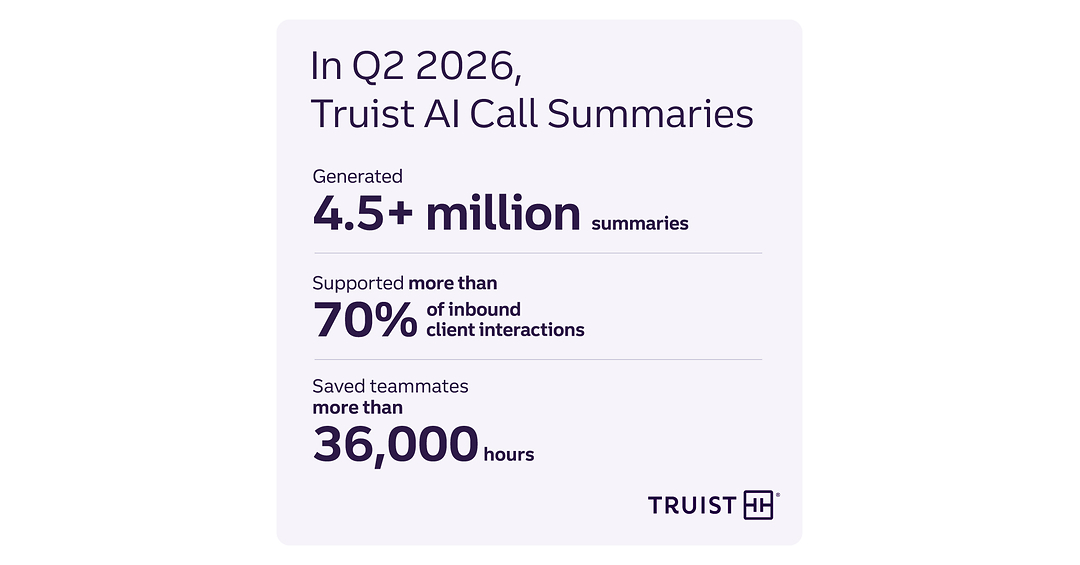
Truist fully deployed generative-AI Call Summaries across its care centers, covering more than 70% of inbound client interactions and producing over 4.5 million summaries in Q2 2026. The tool saved more than 36,000 employee hours during the quarter, based on approximately 30 seconds saved per call. Truist plans to expand the application to additional bank operations as part of its broader AI workflow strategy.
Analysis
The disclosed productivity gain is economically modest relative to TFC's cost base, but it matters as proof that the bank can move a governed generative-AI workflow from pilot to broad production. The investable issue is not the initial labor saving; it is whether this becomes a repeatable deployment model across servicing, operations, compliance documentation and commercial onboarding. If management can redeploy rather than backfill attrition, the opportunity is incremental positive operating leverage in a business where efficiency-ratio improvement is more valuable to the multiple than isolated digital-engagement claims.
Near term, this is unlikely to alter consensus EPS and should not command a standalone rerating. The relevant 1-3 month catalyst is evidence in earnings materials of lower service expense, improved call resolution, reduced customer attrition, or a quantified enterprise AI pipeline; absent those disclosures, this remains a marketing datapoint. Over 6-18 months, banks with fragmented legacy systems and higher servicing labor intensity face a greater implementation burden, potentially widening efficiency dispersion between scaled regional banks and smaller peers.
The contrarian concern is that automated summaries create privacy, record-retention and model-error exposure precisely in disputes, complaints and vulnerable-client interactions. A single regulatory or litigation issue could force human review layers that absorb much of the stated savings. TFC's thesis is falsified if its efficiency ratio fails to improve despite continued technology spending, if management raises AI-control costs, or if customer-service metrics deteriorate as usage expands.
AllMind Terminal
AI-powered research, real-time alerts, and portfolio analytics for institutional investors.
Request TrialMarket Sentiment
Overall Sentiment
moderately positive
Sentiment Score
0.42
Ticker Sentiment
Key Decisions for Investors
- No standalone directional trade on this release; retain TFC only within a broader regional-bank view until management quantifies annualized expense savings, implementation cost and redeployment/headcount effects at the next earnings call.
- For a 6-12 month efficiency-dispersion expression, consider long TFC versus short KRE in equal dollar amounts only if TFC guides to sustained efficiency-ratio improvement while credit costs remain contained. Target 8-12% relative upside; exit if TFC's efficiency ratio worsens year over year or commercial real-estate provisioning accelerates.
- Monitor PNC and USB as the more relevant large-regional comparables: accelerated AI-servicing disclosures from either would reduce any TFC execution premium, while TFC demonstrating measurable service-cost improvement first would support a modest relative-long position.
- Set an earnings alert for explicit evidence of call-resolution improvement, complaint trends, service FTE attrition, and incremental noninterest-expense guidance. Without at least two of these indicators improving, treat the announced deployment as operationally interesting but immaterial to valuation.
More News
- Truist Financial: A Combination Of High-Yielding Preferreds And Common Stock Makes The Most Sense
- Here’s the ‘core economic flaw’ in the AI bull case as stock and bond trades unravel, according to a top economist
- How Pepsi fell behind in the cola wars—and then lost KFC
- 5 big analyst AI moves: ’Uniquely catalyst-rich’ months ahead for SpaceX
- Braskem creditors, shareholders near deal on $11bn debt restructuring
- Brookfield to open Qatar office as it expands Middle East operations