
Waste Energy Completes Expansion of Midland Waste Conversion Facility to Approximately 12.5 Acres
Source: Newswire
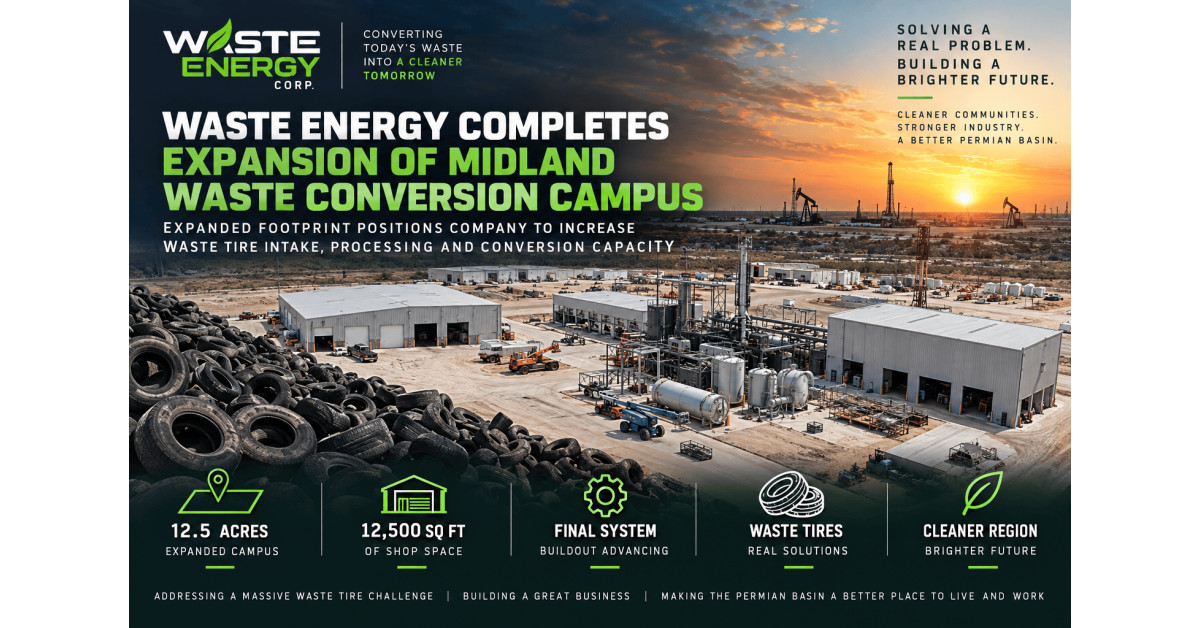
Waste Energy completed the expansion of its Midland, Texas waste-conversion campus to approximately 12.5 acres, adding 7,500 square feet of shop capacity for a total of 12,500 square feet. The company said its first commercial-scale tire conversion system is nearing the end of mechanical construction, with final major equipment placement expected next week before piping, integration and testing. The larger site is intended to increase waste-tire intake, processing and future conversion capacity in Texas, where roughly 40 million used and scrap tires were managed in 2024; however, commercial operations and revenue generation remain unproven and subject to execution risk.
Analysis
This is a pre-revenue execution update in an OTC issuer, not a fundamental inflection point. The relevant valuation question is not site acreage or installed equipment, but whether the first line can demonstrate sustained throughput, acceptable uptime, environmental compliance, and positive unit economics after tire collection, preprocessing, energy, labor, disposal, and offtake costs. Until independently disclosed commissioning dates, nameplate capacity, contracted feedstock, product yields, and customer pricing are available, the announcement should carry limited institutional signal.
The nearer-term risk is a familiar waste-to-energy sequence: mechanical completion is followed by commissioning delays, yield variability, and working-capital needs before commercial volumes arrive. A larger intake footprint can become a liability if inventory accumulates ahead of conversion capacity, creating permitting, fire, insurance, and carrying-cost exposure. Any future financing before demonstrated cash generation would likely be dilutive, particularly given the limited liquidity and disclosure standards typical of OTC securities.
The non-obvious read-through is modestly constructive for established tire-recycling and carbon-black incumbents only if regional waste-tire collection pricing tightens; one small facility is unlikely to alter Texas disposal economics. For public-market exposure, the more investable beneficiaries of a durable circular-materials trend remain diversified waste operators and recycled-carbon suppliers rather than a single-asset development-stage operator. Consensus promotional language is likely to overvalue the addressable waste stream while underweighting conversion yield, product qualification, and offtake execution—the variables that determine whether waste availability translates into EBITDA.
AllMind Terminal
AI-powered research, real-time alerts, and portfolio analytics for institutional investors.
Request TrialMarket Sentiment
Overall Sentiment
mildly positive
Sentiment Score
0.38
Key Decisions for Investors
- No position in WAST at this stage. Treat as a watch item until the company reports independently verifiable commercial operation, monthly throughput, uptime, realized product yields, and signed feedstock/offtake contracts; absence of these disclosures within 3-6 months of claimed mechanical completion is thesis-negative.
- If seeking liquid thematic exposure over 6-18 months, prefer a basket led by WM and RSG rather than development-stage conversion names; both have established collection economics and can benefit if landfill/permitting constraints tighten, without binary commissioning risk.
- Set an alert for any WAST capital raise, convertible issuance, or material increase in shares outstanding. Dilutive financing before recurring revenue would be a stronger downside signal than additional construction milestones.
- For a potential future event-driven trade, require evidence that realized conversion economics exceed feedstock handling and operating costs at sustained utilization for at least one quarter. Mechanical completion alone is not a catalyst sufficient to underwrite a long.
More News
- Iran says it awaits US response on seven-day roadmap to end war
- Houthi attack on Mecca, Medina would cross ‘red line’, Pakistan PM tells UN
- Shares of Akamai surge after deal with Anthropic. What Wall Street is saying
- The Tiny Magnet Maker That Attracted $1.6 Billion From Lutnick
- Bonds Stabilize as Oil Retreats
- Warsh's regime change at the Fed pushes ahead – and meets resistance