
MINISFORUM Launches MS-S1 MAX-P495 with 192GB Unified Memory, Expanding Its Local AI Computing Strategy
Source: PR Newswire
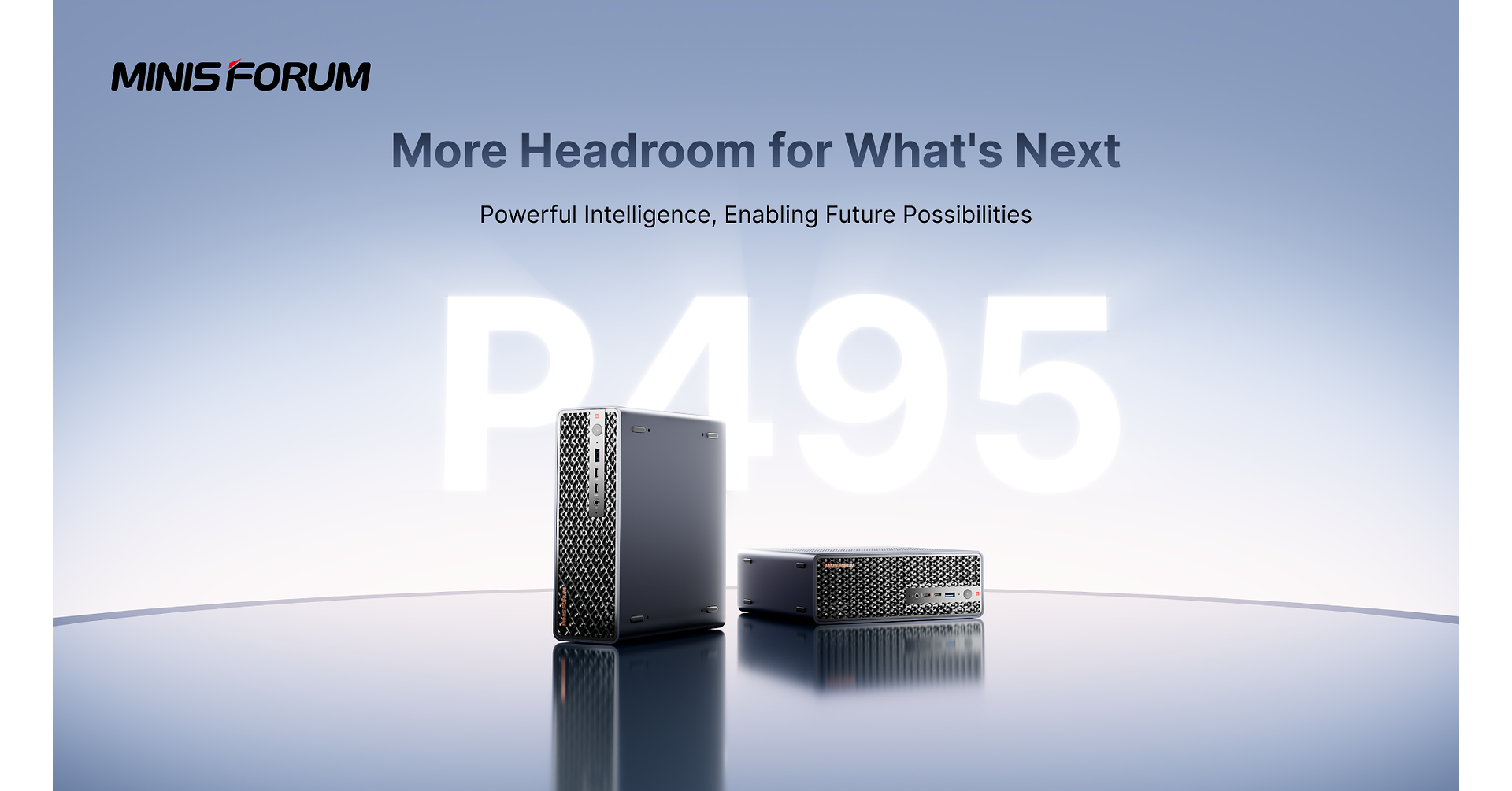
MINISFORUM launched the MS-S1 MAX-P495, a local AI workstation with up to 192GB unified memory, 160GB allocatable VRAM and 131 TOPS of total AI compute, supporting 300B-class models on one system. The company reports DeepSeek V4 Flash 284B inference at about 12 tok/s on one system and Qwen3.5-397B at about 16 tok/s on a two-system cluster. The 192GB RAM/2TB SSD configuration is available for preorder at $7,399 after a 20% discount from its $9,249 regular price; shipping is expected to begin in mid-October.
Analysis
AMD | Edge-AI validation, not yet an earnings catalyst
The launch is a small positive proof point for AMD’s high-memory, integrated-compute positioning: a larger shared memory pool may let developers run some inference workloads without buying a separate accelerator. The second-order opportunity is platform adoption by workstation makers and enterprise integrators—not this single system’s sales. If workloads scale, AMD could gain design wins where compactness and memory capacity matter more than peak accelerator throughput, while dedicated-GPU vendors face limited substitution pressure in those specific use cases.
Near term, the financial read-through is immaterial absent evidence of meaningful unit volumes or incremental processor revenue. The stated model sizes and throughput are vendor testing claims; independently reproduced performance, sustained workload behavior, and total system economics remain unverified. A premium price also narrows the buyer pool, and cloud inference may remain cheaper for intermittent or large-scale workloads. Local deployment is more compelling where privacy, latency, or predictable utilization carries measurable value.
Over 1–3 months, watch third-party benchmarks, actual shipping and sell-through, and whether additional system builders adopt the platform. Over 6–18 months, the signal strengthens only if AMD discloses broader demand or its financial reporting shows durable growth in relevant client/embedded products; this launch alone does not establish either. The thesis weakens if independent tests show poor performance-per-dollar versus cloud or discrete-GPU systems, or if the product remains a low-volume niche.
AllMind Terminal
AI-powered research, real-time alerts, and portfolio analytics for institutional investors.
Request TrialMarket Sentiment
Overall Sentiment
mildly positive
Sentiment Score
0.30
Ticker Sentiment
Key Decisions for Investors
- No standalone trade on the announcement: the likely AMD revenue contribution is unquantified and too small to establish a near-term earnings catalyst.
- Treat AMD as a watch item for edge-AI design-win evidence; seek confirmation from additional OEM systems, repeat orders, and relevant segment commentary before adding exposure on this theme.
- Monitor independent benchmarks against cloud inference and discrete-GPU alternatives, including throughput under sustained loads and total deployment cost. Weak relative economics would falsify the substitution thesis.
- For a 1–3 month catalyst check, track availability, verified customer deployments, and third-party reviews; distinguish shipment of a niche premium workstation from scalable enterprise demand.
More News
- OpenAI's revenue scare, Delta earnings, what investors think of a Starbucks-Chipotle deal and more in Morning Squawk
- The AI race may be decided by financing—not just better chips
- From H-1B to CEO: How Satya Nadella traveled the path the U.S. just cut off for Microsoft workers
- Sequoia-backed Nuvacore seeks $2.5bn valuation in funding round
- Why AMD's Supply Crunch Could Be Good News for Its Stock
- Cathie Wood’s ARK sells DraftKings stock and buys CRISPR Therapeutics