
CNBC's Becky Quick to Moderate CEO Leadership Dialogue on the Next Decade of Rare Disease at the NORD Breakthrough Summit
Source: PR Newswire
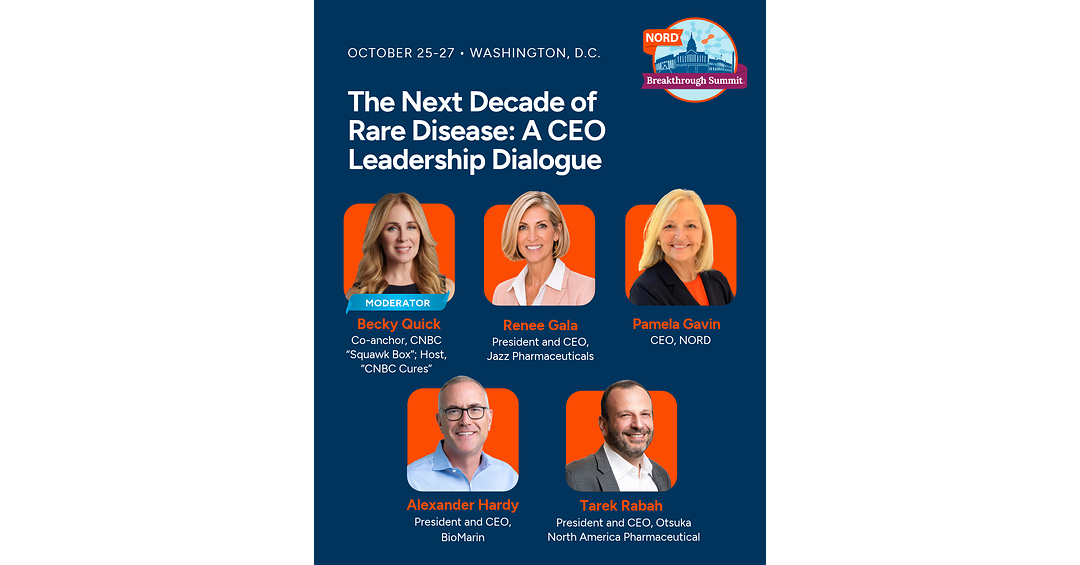
NORD announced a rare-disease CEO leadership panel for Oct. 26 at its Oct. 25–27 Breakthrough Summit in Washington, D.C., with BioMarin, Jazz Pharmaceuticals and Otsuka executives and NORD CEO Pam Gavin. The discussion will address how scientific and technological advances can translate into treatments and patient progress, including the roles of policy, regulation, investment, infrastructure and treatment delivery. The 16th annual summit expects more than 900 leaders and will also feature senior FDA and NIH officials.
Analysis
This is a visibility event, not evidence of a change in product economics: there are no announced policy commitments, trial results, reimbursement changes, or company guidance updates. Treat any near-term BMRN or JAZZ move attributed to the summit as event-driven noise unless the discussion produces specific, independently verifiable policy or commercial implications.
The more consequential read-through is a potential shift from discovery bottlenecks toward delivery: diagnosis, specialist capacity, payer coverage, and treatment infrastructure can determine whether scientific advances translate into addressable patients. That could favor companies able to support diagnosis and treatment pathways, while limiting returns for developers whose launches encounter access or administration barriers. The article provides no company-specific evidence to rank BMRN against JAZZ on this dimension, and Otsuka is not mapped to a supplied ticker.
Days: low-probability catalyst; no fundamental repricing signal. Over 1–3 months, monitor any concrete FDA, NIH, or policy proposals raised at the summit and subsequent implementation details. Over 6–18 months, the structural issue is whether access and care capacity scale alongside rare-disease innovation. The contrarian risk is reading a high-profile CEO panel as a sector catalyst: public discussion may reinforce the access narrative without changing approvals, uptake, or revenue. Thesis changes only with measurable policy action or company-level evidence of improved patient identification, access, uptake, or guidance.
AllMind Terminal
AI-powered research, real-time alerts, and portfolio analytics for institutional investors.
Request TrialMarket Sentiment
Overall Sentiment
neutral
Sentiment Score
0.10
Ticker Sentiment
Key Decisions for Investors
- No event-driven trade in BMRN or JAZZ on this announcement; it contains no new financial or clinical information.
- Use the Oct. 26 discussion as a monitoring point, not a catalyst assumption. Look for specific proposals affecting FDA review, NIH priorities, reimbursement, diagnosis, or treatment delivery, and verify them against official sources afterward.
- For any future rare-disease access thesis, compare company-level launch and patient-access indicators rather than applying the panel’s broad sector narrative uniformly to BMRN and JAZZ.
- Falsify a constructive access thesis if follow-through produces no implementable policy changes and company disclosures show no improvement in patient identification, access, uptake, or guidance; reassess if concrete policy changes or measurable adoption data emerge.
More News
- Singapore's Temasek warns of the ‘biggest risk’ facing markets right now
- Australia top court rules against coal mine expansion, citing climate harm
- A 32% beat, a +6% jump: the IT solutions name our models picked in July
- Paramount's hard-fought takeover of Warner Bros. Discovery closes Tuesday. Here's how we got here
- What Marvell's rosy long-term guidance means for our AI chip stocks
- Paramount and Warner Bros. Discovery complete $110 billion media megamerger
From AllMind Research
- Anthropic IPO Preview: Valuation, Timing, and What to Watch
- Shein After the IPO: Venue, Valuation, and What Must Be Proved
- What AI Research Tools Should a Small Hedge Fund Buy First?
- Eli Lilly Q4 2025 Earnings: Revenue Surges 43% as Mounjaro and Zepbound Dominate the GLP-1 Market
- Investment Research Software Costs: A 2026 Budget Framework